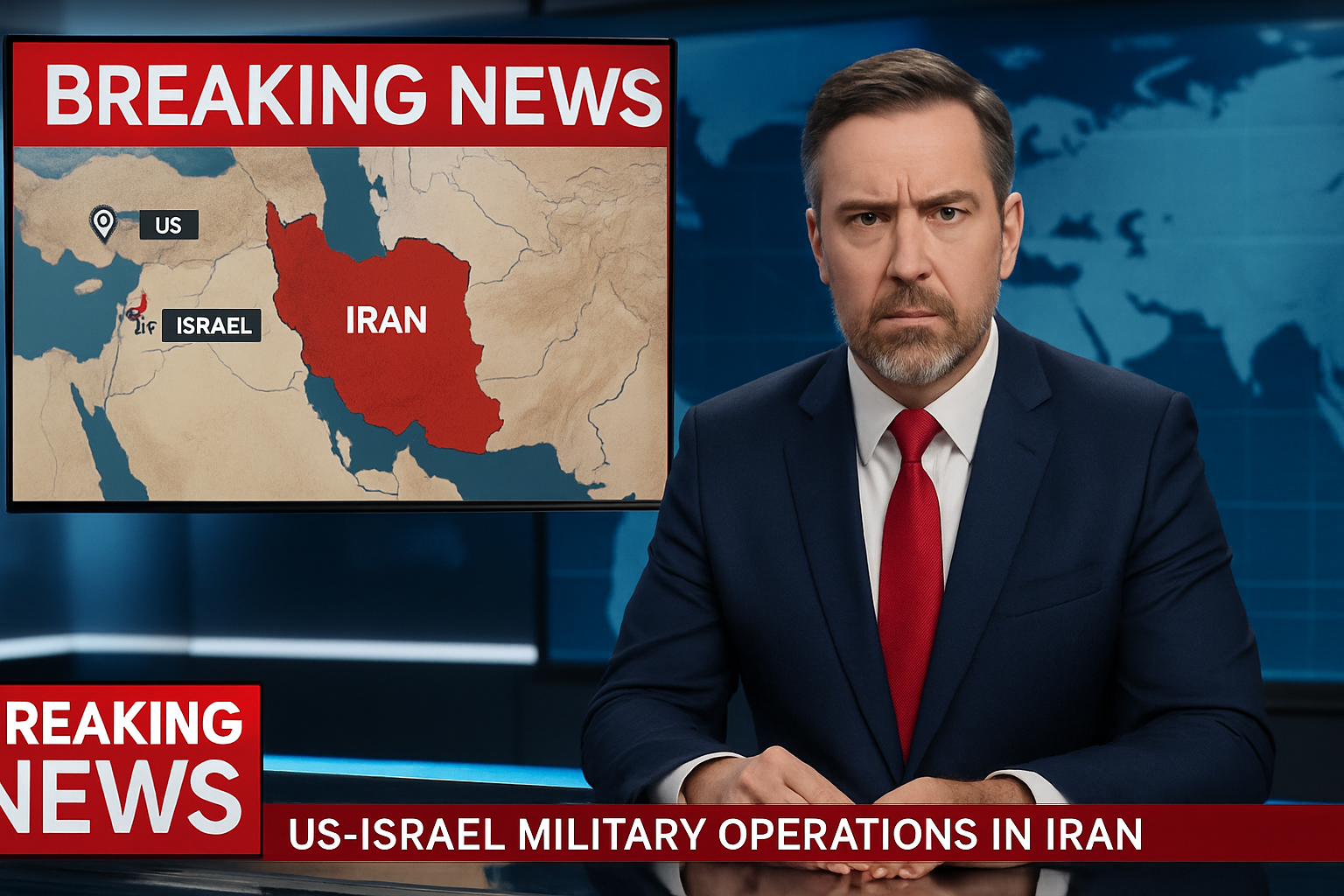
The United States and Israel launched a coordinated military assault against Iran on Saturday, February 28, 2026, targeting government facilities and military installations across the Islamic Republic in what President Donald Trump called "Epic Fury" operations aimed at eliminating what he described as an "existential threat" and achieving regime change.
Israeli Defense Minister Israel Katz announced the "preemptive attack" against Iran, stating that "The State of Israel launched a preemptive strike against Iran to eliminate threats against the State of Israel." Multiple explosions were reported across Tehran, with Iranian state media IRNA confirming "heavy smoke rising over the city."
In an unprecedented address, President Trump declared the commencement of "major combat operations" against Iran, telling the Iranian people: "The hour of your freedom is at hand. You are not our enemies... Cast off the yoke of this murderous regime." The operation represents the most significant escalation in US-Iran tensions since the 1979 revolution.
Collapse of Nuclear Diplomacy
The military action follows the dramatic breakdown of months-long nuclear negotiations that had shown promise with Iranian Foreign Minister Abbas Araghchi announcing "broad agreement on guiding principles" just days before. The Geneva talks, mediated by Switzerland and Oman, represented the most significant diplomatic progress since the JCPOA collapse in 2018.
However, fundamental disagreements persisted throughout the negotiations. Iran maintained ballistic missiles and regional proxy activities as "red lines" excluded from nuclear-only discussions, while US Secretary Marco Rubio insisted on comprehensive agreements addressing missiles, armed groups, and human rights.
"We will never abandon uranium enrichment even if war is imposed,"
— Abbas Araghchi, Iranian Foreign Minister
Iran had been enriching uranium at 60% purity, approaching the 90% threshold needed for weapons-grade material. Former IAEA inspector Dr. Yusri Abu Shadi confirmed Iran possessed over 400kg of enriched uranium, making nuclear weapons "easily achievable."
Operation "Epic Fury" Details
The coordinated strikes began early Saturday morning, with explosions reported in Tehran and other Iranian cities. Israeli air raid sirens sounded nationwide as the country prepared for potential Iranian retaliation. Schools were closed and the population ordered indoors.
The operation follows an unprecedented military buildup over recent weeks, including the deployment of USS Gerald R. Ford and USS Abraham Lincoln carrier strike groups—representing the largest US naval presence in the Middle East since the 2003 Iraq invasion. Approximately one-third of the active US Navy fleet was positioned 800km from Iran's coast.
Trump's announcement of the military action was accompanied by his most explicit regime change rhetoric to date, calling the overthrow of Iran's government "the best thing that could happen." This represented a policy evolution from nuclear-focused negotiations to comprehensive political transformation objectives.
Regional and Global Response
The strikes have triggered immediate regional consequences. Iran closed its airspace completely and cut mobile phone services in parts of Tehran. Iraq announced it would begin closing its airspace following the attacks.
A senior Iranian official told Al Jazeera that all American and Israeli resources and assets in the region are now considered "legitimate targets," declaring that "no red lines remain." This marks a dramatic escalation from previous restrained responses.
Australian Prime Minister Anthony Albanese declared Iran's regime "without legitimacy" and supported US actions "to prevent Iran from obtaining a nuclear weapon and to prevent Iran continuing to threaten international peace."
Unprecedented Coalition Support
The military action comes despite an extraordinary regional coalition that had backed diplomatic efforts. Saudi Arabia, UAE, Qatar, and Egypt had all supported the nuclear negotiations—representing unprecedented Middle Eastern consensus for preventing military confrontation.
The strikes have disrupted this diplomatic unity, with multiple countries issuing travel warnings and embassy evacuations. The UK, France, Germany, and Poland had all warned against travel to the region in the days leading up to the operation.
Nuclear Crisis Context
The military action occurs amid a broader nuclear governance crisis. The New START treaty between the US and Russia expired on February 5, marking the first time in over 50 years without nuclear constraints between the superpowers. China's nuclear expansion has further complicated multilateral frameworks.
Iran's nuclear program had advanced significantly since withdrawing from the JCPOA in 2018, with sophisticated centrifuge technology and expanded infrastructure requiring unprecedented verification mechanisms far exceeding the original agreement's complexity.
Immediate Consequences and Market Impact
Oil prices rose immediately following reports of the strikes, with Iran controlling significant portions of global energy supply through the Strait of Hormuz, which handles 40% of global oil transit. The attacks have raised concerns about potential disruption to worldwide supply chains.
Israel declared a state of emergency expecting Iranian retaliation "in coming time," with air defense preparations activated across the country as the population sought shelter.

Trump's Revolutionary Appeal
In his most extraordinary diplomatic move, President Trump directly addressed the Iranian people, urging them to "take control of their country" once military operations conclude. This unprecedented appeal for popular uprising represents a dramatic departure from traditional diplomatic protocols.
"Your moment of freedom has arrived," Trump declared, warning civilians to remain indoors due to "extremely dangerous" conditions while promising that once operations complete, Iranians should seize control from what he called their "murderous regime."
Intelligence and Military Assessment
Intelligence sources suggest Iran's Supreme Leader Ayatollah Ali Khamenei was not in Tehran at the time of the strikes and had been transferred to a secure location. The operation appeared to target government compounds and military installations rather than nuclear facilities exclusively.
Pentagon sources indicated the military had prepared scenarios for "potentially weeks-long operations" ranging from nuclear facilities to Revolutionary Guard infrastructure, expecting Iranian retaliation cycles creating "back-and-forth attacks."
Historical Significance
The joint US-Israeli operation represents the most significant military action against Iran since the 1979 Islamic Revolution. It marks a dramatic escalation from diplomatic engagement to direct military confrontation, potentially reshaping Middle Eastern geopolitics for decades.
The timing coincides with broader international tensions, including the ongoing Ukraine conflict and rising US-China strategic competition, creating a multipolar crisis management challenge.
What Comes Next
Iran has begun launching missiles toward Israel in response to the joint strikes, according to Israeli Defense Forces reports. The IDF confirmed active interception of Iranian missiles, marking the beginning of what military planners had anticipated as retaliatory cycles.
The collapse of diplomatic negotiations after months of intensive efforts raises fundamental questions about the viability of diplomatic solutions to modern nuclear crises. The precedent may influence future approaches to territorial and nuclear disputes globally.
"We will destroy Iran's missiles and eliminate their naval fleet, ensuring they will never have a nuclear weapon,"
— Donald Trump, US President
The international community now faces the challenge of managing a regional conflict that could destabilize global energy markets, encourage nuclear proliferation elsewhere, and undermine diplomatic credibility for international crisis resolution in the 21st century.
As explosions continue to echo across Iranian cities and missiles streak across Middle Eastern skies, the world witnesses a historic breakdown of diplomacy giving way to military confrontation with implications extending far beyond the immediate region to international law enforcement, territorial sovereignty principles, and the future of nuclear governance in an increasingly multipolar world.