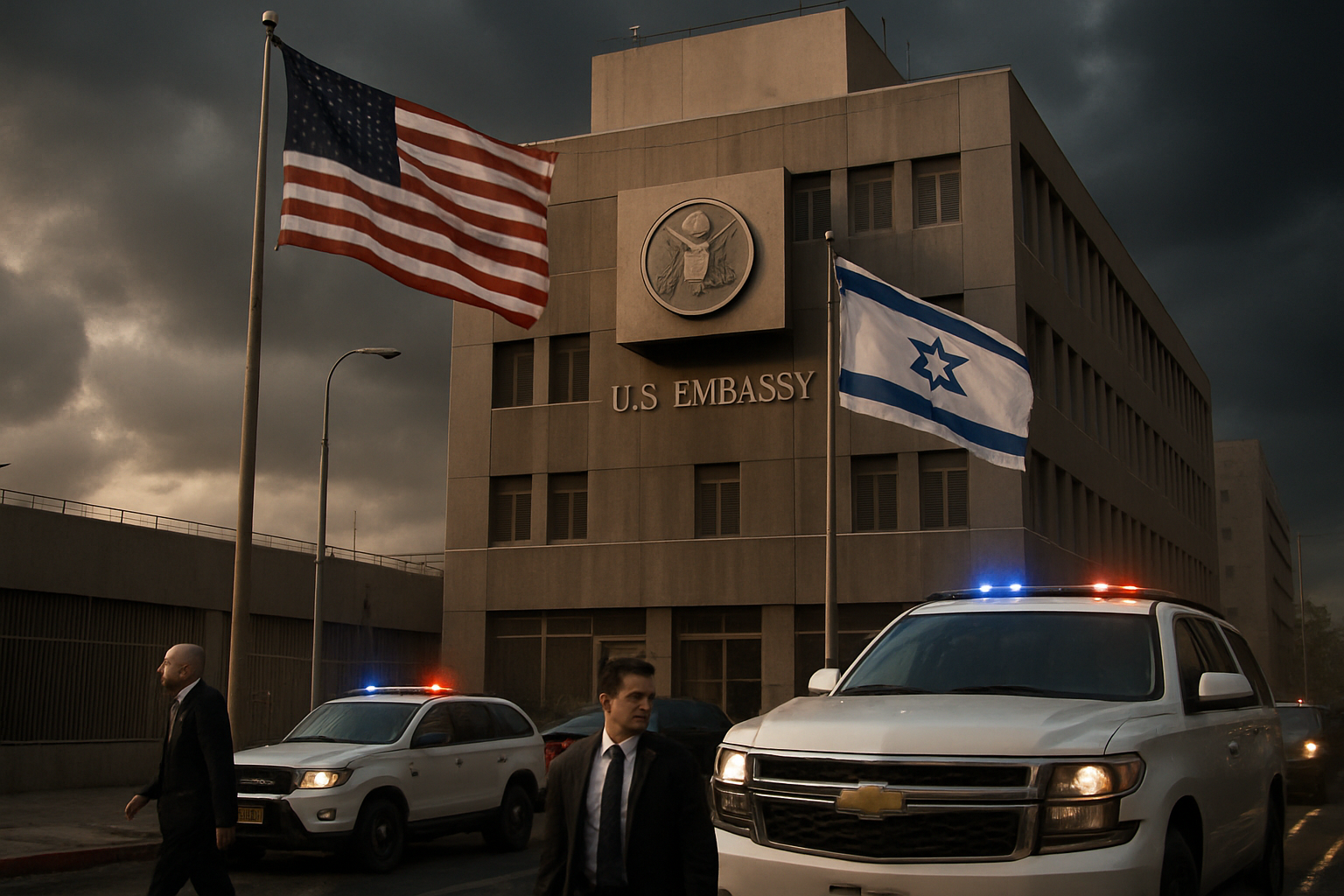
The United States has authorized the immediate departure of non-essential embassy staff and their families from Israel, marking the most dramatic escalation in the Iran nuclear crisis as President Trump's 10-day ultimatum expires and unprecedented military forces converge in the Middle East.
US Ambassador to Israel Mike Huckabee delivered stark internal warnings to embassy personnel on Friday, telling staff who wished to leave to "do so TODAY" according to multiple diplomatic sources. The evacuation order represents the clearest signal yet that the Trump administration is preparing for potential military action against Iran after nuclear negotiations in Geneva failed to bridge fundamental disagreements.
Unprecedented Military Buildup
The embassy evacuation comes as the United States has deployed its largest military presence in the Middle East since the 2003 Iraq invasion. The dual-carrier strike force comprising USS Gerald R. Ford and USS Abraham Lincoln now represents approximately one-third of the active US Navy fleet, positioned just 800 kilometers from Iran's coast in the Arabian Sea.
Intelligence sources confirm that Pentagon officials have briefed the White House on scenarios for "potentially weeks-long operations against Iran," ranging from targeted strikes on nuclear facilities to broader campaigns against Revolutionary Guard infrastructure. Military planners expect Iranian retaliation that could trigger extended "back-and-forth attacks" across the region.
"The military capability exists for immediate strikes, but the political decision remains fluid,"
— Senior Defense Official, speaking on condition of anonymity
Recent military incidents have heightened tensions dramatically. An F-35C fighter from USS Abraham Lincoln shot down an Iranian Shahed-139 drone that aggressively approached the carrier, while Islamic Revolutionary Guard Corps vessels have systematically harassed US tankers in the Strait of Hormuz, which handles 40% of global oil transit.
Diplomatic Breakthrough Overshadowed by Deadlock
The evacuation order follows the conclusion of third-round nuclear talks in Geneva, where Iranian Foreign Minister Abbas Araghchi had declared a nuclear deal "within reach" - the most optimistic assessment in years. Previous rounds achieved what negotiators called "broad agreement on guiding principles," marking the most significant diplomatic progress since the 2018 collapse of the Joint Comprehensive Plan of Action (JCPOA).
However, fundamental obstacles persist that have prevented breakthrough for over a decade. Iran maintains ballistic missiles and support for regional proxy forces as absolute "red lines" excluded from nuclear-only talks. The United States, under Secretary of State Marco Rubio's direction, insists any comprehensive agreement must address Iran's missile program, armed groups, and human rights violations alongside nuclear restrictions.
Iran continues enriching uranium to 60% purity - far beyond the 3.67% limit under the original nuclear deal and approaching the 90% threshold needed for weapons-grade material. Former International Atomic Energy Agency inspector Dr. Yusri Abu Shadi confirms Iran now possesses over 400 kilograms of highly enriched uranium, making nuclear weapons capability "easily achievable."
Regional Powers Rally for Diplomacy
Despite military tensions, an unprecedented coalition of Middle Eastern powers continues backing diplomatic resolution. Saudi Arabia, the United Arab Emirates, Qatar, and Egypt have maintained extraordinary consensus supporting negotiations - a remarkable achievement given the region's typically fractured alliances.
Oman's mediation role, leveraging its historical neutrality and experience facilitating the original 2015 nuclear deal, has proven essential for maintaining structured dialogue. Switzerland's support for the Geneva venue represents an evolution from Gulf-focused talks to broader international engagement.
Israeli Prime Minister Benjamin Netanyahu has coordinated extensively with Trump, establishing Israeli red lines that require any agreement to include "limiting ballistic missiles and ending Iranian axis support." Nuclear-only frameworks are viewed as insufficient for Israel's existential security concerns given the integrated threat from Iran's missile and proxy network including Hezbollah, Hamas, and the Houthis.
Domestic Pressures Mount
Iran faces severe internal pressures with over 42,000 arrests since 2022 uprisings and continued crackdowns during nuclear negotiations. Nobel Peace Prize laureate Narges Mohammadi was sentenced to additional prison time even as talks proceeded, demonstrating the regime's prioritization of domestic control over international progress.
The Trump administration confronts its own political balancing act, managing Republican congressional pressure viewing engagement as appeasement while seeking foreign policy achievements. The President has made increasingly explicit regime change comments, calling Iranian government overthrow "the best thing that could happen" - representing a policy evolution from nuclear-focused negotiations to comprehensive political transformation objectives.
Global Nuclear Governance Crisis
The crisis unfolds against a broader breakdown in international nuclear governance. The New START treaty between the United States and Russia expired February 5, marking the first time in over 50 years without bilateral nuclear constraints between the superpowers. China's nuclear expansion and the UN Secretary-General's warnings that nuclear risks are at their "highest in decades" create urgent pressure for successful crisis resolution.
"This represents a template-setting moment for 21st-century nuclear crisis resolution. Success could provide a diplomatic precedent, while failure may accelerate military solutions with global implications,"
— Former State Department Official specializing in nuclear policy
Economic and Strategic Stakes
Oil prices have risen over $1 per barrel on escalating tensions, with energy markets closely watching potential disruption to Persian Gulf shipping lanes. Natural gas prices have increased 24% in Europe and 78% in the United States amid geopolitical pressures.
Iran has positioned potential cooperation as offering "trillion-dollar opportunities" in energy and mining sectors for American firms, framing commercial incentives beyond security arrangements. However, the Trump administration maintains its "maximum pressure" campaign, threatening 25% tariffs on countries that continue trading with Iran.
International Evacuations Expand
The US embassy evacuation parallels broader international concern. China has urged its citizens to leave Iran "as soon as possible" citing "significant increase in external security risks." The United Kingdom has withdrawn embassy personnel from Iran as a "preventive measure," while several European nations have issued travel advisories for both Israel and Iran.
Reports from Tehran indicate widespread anxiety among residents who experienced devastating conflict during the 12-day Iran-Israel war in June 2025. Many Iranians report severe psychological trauma and sleeplessness about potential renewed warfare.
Critical Decision Point Approaches
Verification challenges for any potential agreement remain unprecedented. Iran's advanced centrifuge technology, sophisticated nuclear infrastructure, and suspension of International Atomic Energy Agency inspections since November 2025 would require monitoring mechanisms far exceeding the complexity of previous frameworks.
Intelligence suggests potential Iranian concessions including a three-year enrichment halt and stockpile transfer to Russia, but hardline statements from Tehran cast doubt on meaningful compromises. Iranian officials maintain they will "never abandon enrichment even if war is imposed."
The coming days represent a decisive juncture for both diplomacy and military confrontation. Framework progress achieved in Geneva must translate into substantive agreements addressing decade-old challenges, or the region faces potential military escalation with implications extending far beyond the immediate crisis.
Global Implications
The stakes extend beyond regional security to fundamental questions about international law enforcement, territorial sovereignty, and conflict resolution in the multipolar era. Success could strengthen non-proliferation norms globally and provide a diplomatic template for future nuclear crises. Failure risks accelerating military solutions that could reshape Middle Eastern geopolitics for decades while encouraging nuclear proliferation elsewhere and undermining diplomatic credibility for international disputes worldwide.
As embassy staff prepare for potential evacuation and military forces position for possible action, the world watches whether innovative diplomatic solutions can bridge longstanding disagreements or whether the Middle East faces another devastating conflict with global ramifications. The window for diplomatic resolution appears to be narrowing as military capabilities advance and political rhetoric intensifies on all sides.