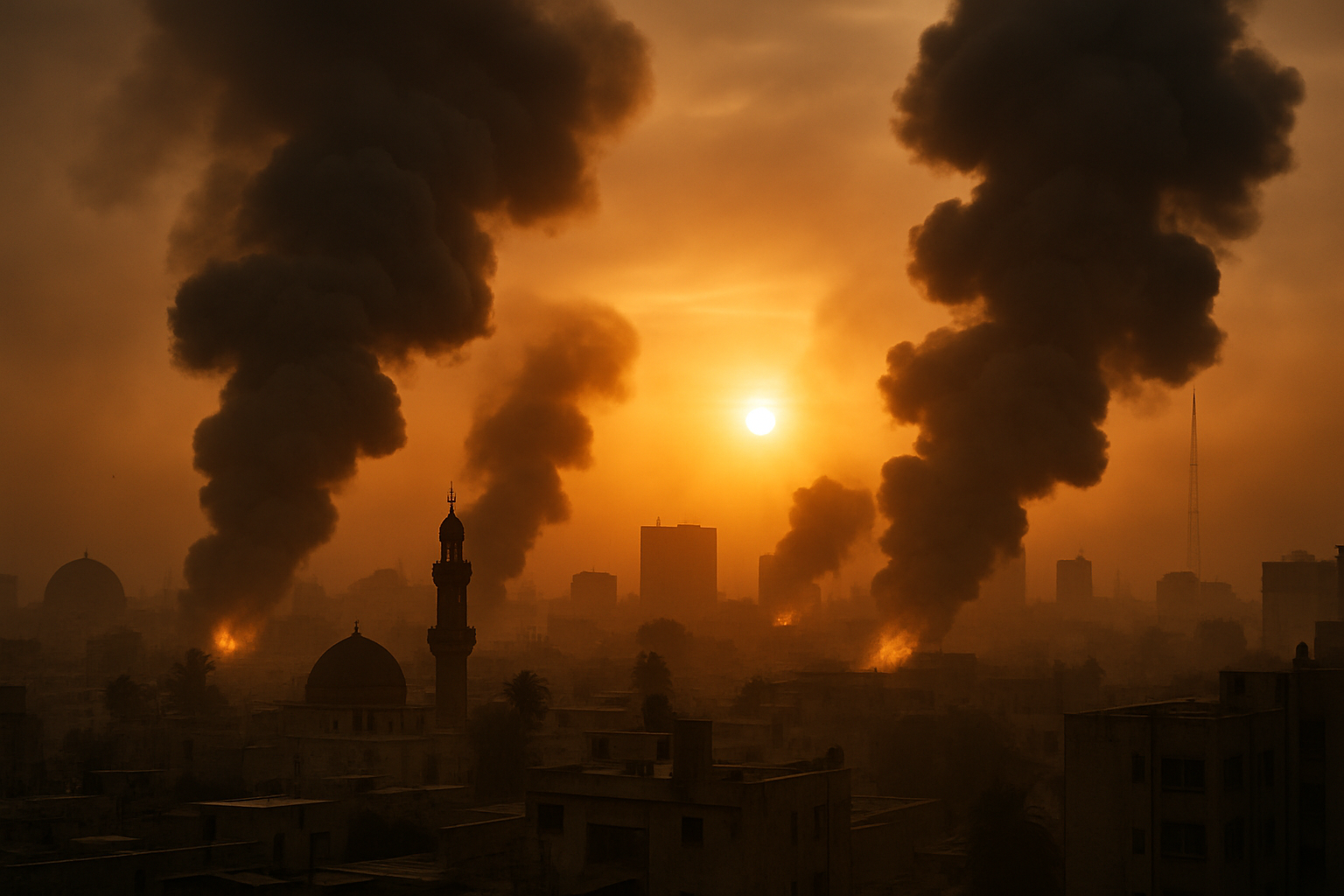
The most dangerous international crisis since the Cold War entered its second week as US-Israeli military operations against Iran continued while the Islamic Republic announced the appointment of a new Supreme Leader to replace Ali Khamenei, who was killed in the opening strikes of "Operation Epic Fury."
Iran's Assembly of Experts has reached consensus on Khamenei's successor, though the name remains classified according to intelligence sources. The CIA suggests a Revolutionary Guards member is likely to assume the position, marking a historic shift from clerical to military governance for the first time in the Islamic Republic's 47-year history.
Operation Epic Fury Intensifies
The coordinated US-Israeli campaign, launched on February 28, represents the largest Middle Eastern military operation since the 2003 Iraq invasion. Utilizing an unprecedented dual-carrier deployment of the USS Gerald R. Ford and Abraham Lincoln—representing approximately one-third of the active US Navy fleet—Operation Epic Fury has struck over 2,000 Iranian targets across the country.
The most recent phase has focused on Iran's energy infrastructure, with five strategic oil installations around Tehran targeted in devastating strikes that created massive fires and toxic black rain affecting nearly 10 million residents. Tehran's fuel distribution has been "temporarily interrupted" according to Governor Mohammad Sadegh Motamedian.
"This represents a strategic shift to the second phase of operations, targeting the infrastructure that sustains the Iranian regime."
— Pentagon Official, speaking on background
The operation has claimed significant Iranian leadership casualties, including Defense Minister Aziz Nasirzadeh, Revolutionary Guard Corps Chief Mohammad Pakpour, and numerous high-ranking officials. The strikes also resulted in family casualties, with Khamenei's daughter, son-in-law, and granddaughter killed in compound attacks.
Iranian Retaliation Spreads Conflict
Iran's systematic retaliation under "Operation True Promise 4" has expanded the conflict beyond the Middle East, with Iranian Revolutionary Guard Corps declaring "no red lines remain." The campaign has caused casualties across multiple countries:
- UAE: 1 civilian killed in Abu Dhabi, Dubai International Airport shut down
- Kuwait: 32 foreign nationals injured in airport drone strikes
- Qatar: 8 injured despite successful Patriot missile interceptions of 65 missiles and 12 drones
- Cyprus: RAF Akrotiri base struck—the first attack on European territory since World War II
The attack on Cyprus has prompted an unprecedented naval coalition response, with HMS Dragon, Spanish frigates, and vessels from Italy, France, Netherlands, and Greece deploying to protect European territory.
Global Economic and Aviation Crisis
The conflict has triggered the most extensive global aviation crisis since COVID-19, with over 18,000 flights cancelled worldwide as eight countries simultaneously closed their airspace. Dubai International Airport, the world's busiest, remains shut down from missile damage, while major carriers including Emirates, Air France-KLM, and Wizz Air have suspended operations indefinitely.
Energy markets have been severely disrupted, with oil prices surging 10% past $80 per barrel after Iran declared the Strait of Hormuz—through which 40% of global seaborne oil transits—"unsafe for shipping." Over 150 tankers worth billions in cargo remain stranded in the Persian Gulf as Maersk and MSC have suspended operations.
Natural gas prices have increased 24% in Europe and 78% in the United States, while Qatar has halted LNG production following strikes on Iranian infrastructure.
Nuclear Diplomacy Collapse
The military escalation followed the complete breakdown of nuclear negotiations despite achieving a "broad agreement on guiding principles"—the most significant diplomatic progress since the 2018 JCPOA collapse. The fundamental disagreement remained unchanged: Iran insisted on nuclear-only talks while excluding ballistic missiles and regional proxies as "red lines," while the US demanded a comprehensive agreement including missiles, armed groups, and human rights.
Iran continues enriching uranium to 60% purity—approaching the 90% threshold for weapons-grade material—with over 400kg of enriched uranium, sufficient for multiple weapons if weaponized.
Trump's Regime Change Demands
President Trump has escalated demands for Iran's "unconditional surrender" and claims the right to personally choose Iran's next Supreme Leader. Trump rejected Mojtaba Khamenei, the late Supreme Leader's son, as a "lightweight," representing the most direct assertion of American control over Iranian internal affairs since 1979.
In contrast, Iranian President Masoud Pezeshkian has offered a conditional ceasefire to neighboring countries while firmly rejecting surrender demands as "dreams they should take to their grave."
International Response and Humanitarian Crisis
The crisis has prompted the largest international evacuation since the Arab Spring, with Australia reporting 115,000 nationals trapped and Germany evacuating 30,000 stranded tourists. The EU has activated its ESTIA emergency evacuation protocol for Cyprus for the first time.
Congressional scrutiny has intensified, with bipartisan lawmakers demanding answers about strategy, costs, and potential ground troop deployment. Senator Richard Blumenthal expressed being "more concerned than ever" about the possibility of boots on the ground.
Operation Epic Fury has cost $3.7 billion in its first week, averaging $891.4 million daily, making it one of the most expensive military operations in recent history. The Pentagon is reportedly preparing operations through September, far beyond Trump's initial four-week timeline.
First US Casualties
The conflict has claimed its first American casualties, with three service members killed and five wounded—the first deaths in the largest Middle East operation since 2003. Additionally, the USS Charlotte submarine made history by sinking the Iranian frigate IRIS Dena off Sri Lanka, killing over 80 crew members—the first enemy vessel sunk by a US submarine since World War II.
Regional Coalition Under Strain
An unprecedented regional coalition of Saudi Arabia, UAE, Qatar, and Egypt that had backed diplomacy now faces severe strain as Iranian retaliation directly targets member territories. Egyptian President Sisi condemned attacks on "sisterly Arab countries," warning of "comprehensive chaos" spreading across the region.
Template-Setting Crisis
UN Secretary-General António Guterres has called the crisis the "greatest test of multilateral cooperation and crisis management in the modern era." The rapid transition from diplomatic breakthrough to military confrontation demonstrates the fragility of crisis management in the multipolar era.
The stakes are unprecedented: regional war prevention, global energy security, nuclear governance credibility, and international law enforcement are all being tested simultaneously. The crisis represents a template-setting moment for 21st-century conflict resolution approaches.
As the crisis enters its second week, the world watches whether diplomatic solutions can emerge from the most dangerous international confrontation since the Cold War, or whether the Middle East faces a prolonged conflict with global implications extending decades into the future.