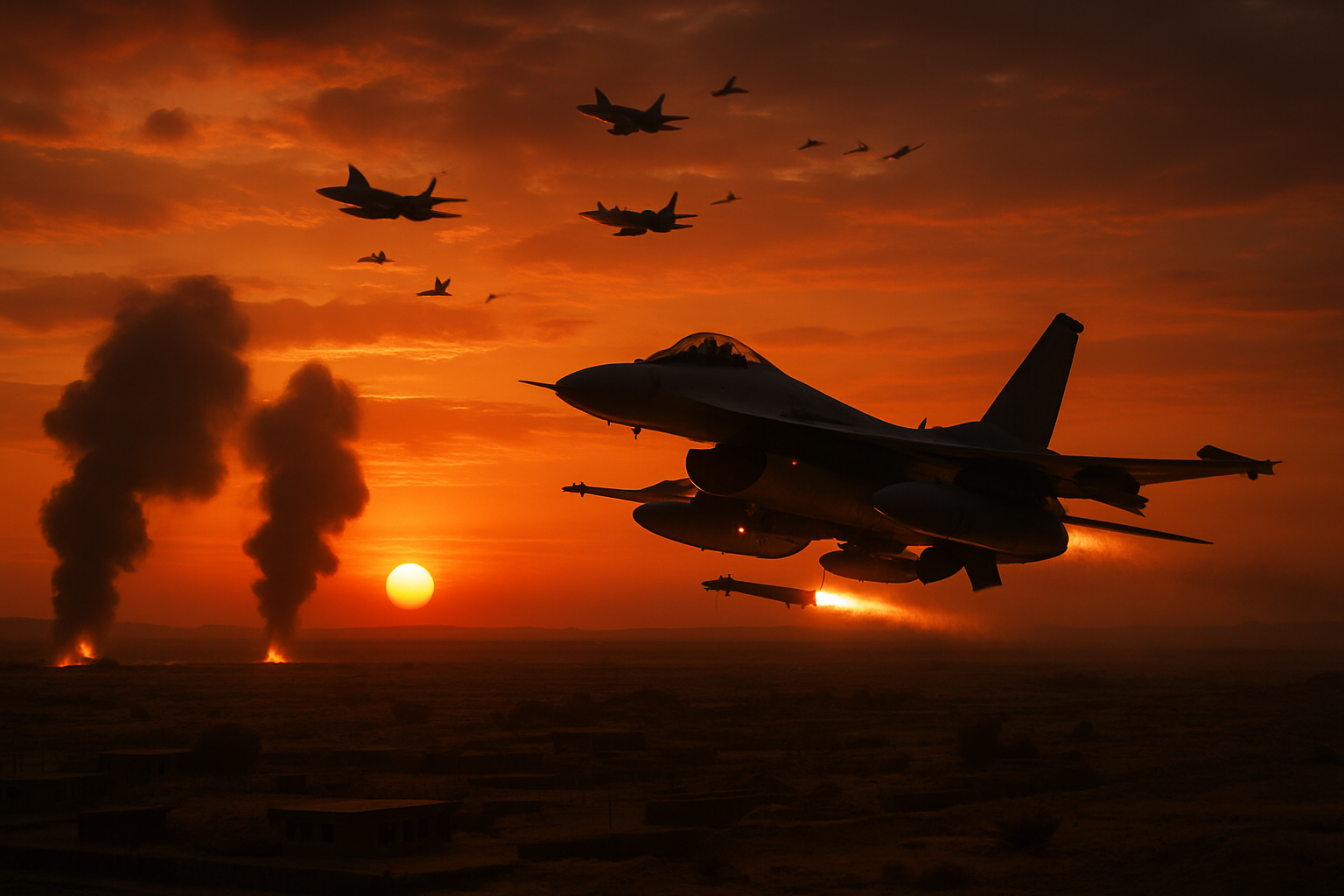
The most dangerous international crisis since the Cold War intensified Monday as the US-Israeli military campaign against Iran entered its third day, with Iranian forces retaliating across the Middle East while threatening to close the critical Strait of Hormuz oil chokepoint in response to confirmed reports of Supreme Leader Ali Khamenei's death.
Iran's Revolutionary Guard announced they had closed the Strait of Hormuz to all shipping and threatened to "burn any ship that attempts to pass," marking a dramatic escalation that could disrupt 40% of the world's seaborne oil trade. The announcement came as Iranian state media officially confirmed the death of 86-year-old Supreme Leader Ayatollah Ali Khamenei during Saturday's coordinated strikes in what Israeli officials called "Operation Epic Fury" - the largest Middle Eastern military operation since the 2003 Iraq invasion.
Global Aviation Crisis Spreads
The conflict's reach extended far beyond the Persian Gulf as aviation authorities simultaneously closed airspace across Iran, Iraq, Israel, UAE, Qatar, Syria, Kuwait, and Bahrain - the most extensive regional disruption since COVID-19. Over 18,000 flights have been cancelled worldwide, with Dubai International Airport, the world's busiest, completely shut down after sustaining missile damage.
Major international carriers including Emirates, Air France-KLM, Wizz Air, and Bulgaria Air have suspended all Middle East operations, stranding hundreds of thousands of passengers globally. The closures have severed critical Europe-Asia air corridors that typically handle millions of passengers monthly.
"The situation with Iran has created the most severe disruption to global aviation networks we've seen outside of the pandemic period,"
— International Air Transport Association spokesperson
Energy Markets in Crisis
Oil prices surged over 10% to $80 per barrel as Iran's Revolutionary Guard declared the Strait of Hormuz "unsafe for navigation" and warned all vessels to avoid the strategic waterway. Major shipping companies Maersk and MSC have suspended operations in the Persian Gulf, leaving over 150 oil and LNG tankers worth billions of dollars anchored and unable to move.
Natural gas prices have jumped 24% in Europe and 78% in the United States as markets react to potential supply disruptions. Qatar, one of the world's largest LNG exporters, announced it was halting production at facilities struck by Iranian missiles, further tightening global energy supplies.
The crisis highlights the vulnerability of global energy markets to Middle Eastern conflicts, with the Strait of Hormuz serving as a critical chokepoint that no alternative route can fully replace in the short term.
Iranian Leadership Succession Crisis
The confirmed death of Khamenei, Iran's Supreme Leader since 1989, has triggered a constitutional succession process. A three-member transitional council comprising President Masoud Pezeshkian, judiciary head Gholamhossein Mohseni Ejei, and Guardian Council jurist Ayatollah Alireza Arafi has been activated under Article 111 of Iran's constitution.
The Assembly of Experts, consisting of 88 senior clerics, must select a permanent successor within the 40-day mourning period. CIA intelligence assessments suggest a Revolutionary Guards member is likely to be chosen, indicating potential hardening of Iran's military posture.
Family casualties during the compound strikes included Khamenei's daughter, son-in-law, and granddaughter, according to Fars News Agency. His widow also died from injuries sustained in the attack, Iranian media reported Monday.
Regional Retaliation Spreads
Iran's "Operation True Promise 4" has systematically targeted US military installations and Gulf state territories. Casualties confirmed across multiple countries include:
- UAE: 1 civilian killed in Abu Dhabi from missile debris; Dubai International Airport shut down
- Kuwait: Airport struck by drones with employee injuries; 32 foreign nationals wounded
- Qatar: 8 injured from interceptor fragments despite Patriots shooting down 65 missiles and 12 drones
- Bahrain: US Fifth Fleet headquarters targeted
- Israel: 9 killed and 28 wounded in Beit Shemesh residential strike
Nuclear Diplomacy Collapses
The military escalation followed the complete breakdown of nuclear negotiations despite recent diplomatic progress. Geneva talks had achieved what Iranian Foreign Minister Abbas Araghchi called "broad agreement on guiding principles" - the most significant breakthrough since the 2018 JCPOA collapse.
However, fundamental scope disagreements proved insurmountable. Iran excluded ballistic missiles and regional proxies as "red lines" from nuclear-only discussions, while US Secretary Marco Rubio demanded comprehensive agreements addressing missiles, armed groups, and human rights.
Iran continues enriching uranium to 60% purity with over 400kg of material - approaching the 90% weapons-grade threshold and sufficient for multiple nuclear weapons if weaponized, according to former IAEA inspector Dr. Yusri Abu Shadi.
International Response Intensifies
UN Secretary-General António Guterres declared the military actions a "serious threat to international peace and security," warning they could "trigger a chain of events no one can control." An emergency Security Council session has been convened with France, China, Russia, Colombia, and Bahrain requesting immediate international intervention.
Russia condemned what Foreign Minister Sergey Lavrov called "reckless actions by Washington and West Jerusalem" as direct violations of international law. China issued its strongest condemnation in years, calling the assassination a "serious violation of Iran's sovereignty and security."
European governments have issued widespread travel warnings and begun evacuating citizens. Sweden and Serbia ordered immediate evacuations from Iran citing "extremely uncertain" security conditions, while the US authorized departure of non-essential embassy personnel from Israel.
Trump Administration Signals Expansion
President Donald Trump confirmed Khamenei's death hours before Iranian state media, calling him "one of the most evil people in history" and describing the situation as the "single greatest chance for the Iranian people to take back their country."
Defense Secretary Pete Hegseth told Congress the US was prepared for "weeks-long operations" and warned that "this is not Iraq, this is not endless," but acknowledged more American casualties are likely. US Central Command has confirmed three American service members killed and five wounded - the first US military deaths in the largest Middle Eastern operation since 2003.
Trump refused to rule out deploying ground troops and warned of an impending "big wave" of strikes, stating the US was "substantially ahead of our time projection" for the 4-5 week timeline initially planned.
Economic Shockwaves
Global financial markets opened sharply lower Monday with Asian indices leading the decline. Pakistan's KSE-100 crashed over 8%, forcing trading suspensions, while US futures dropped 400-570 points overnight. European markets face similar pressures as energy costs surge.
The crisis has disrupted supply chains far beyond energy, with major corporations from technology to automotive facing increased shipping costs and delivery delays. Alternative shipping routes around Africa add weeks to journey times and substantial costs.
Regional Coalition Under Strain
An unprecedented coalition of Saudi Arabia, UAE, Qatar, and Egypt that had supported diplomatic resolution now faces severe strain as Iranian retaliation targets their territories. Egyptian President Abdel Fattah el-Sisi condemned attacks on "sisterly Arab countries" and warned of "comprehensive chaos" if the conflict spreads.
The attacks have tested the Gulf states' advanced missile defense systems, with Qatar successfully intercepting the majority of projectiles but still suffering casualties from debris and fragments.
Nuclear Governance Crisis
The crisis unfolds amid broader concerns about nuclear governance following the February 5 expiration of the New START treaty - the first time in over 50 years without US-Russia nuclear constraints. Combined with China's nuclear expansion, experts warn this represents the "highest nuclear risks in decades."
The breakdown of the most promising US-Iran diplomatic opening in years raises questions about the viability of negotiated solutions to modern nuclear crises and could encourage other nations to pursue military rather than diplomatic options.
What's Next
The coming days will determine whether this remains a contained regional confrontation or escalates into a broader Middle Eastern war with global implications. Key factors include:
- Iran's succession process and whether hardliners consolidate power
- The international response to energy market disruption
- Whether regional coalition members can withstand continued attacks
- Trump administration decisions on ground deployment and escalation
- Effectiveness of UN and international mediation efforts
March 2026 may mark a watershed moment in international relations, with implications extending decades beyond the current crisis. The conflict tests not only regional stability but fundamental principles of the post-World War II international order, energy security architecture, and approaches to nuclear crisis resolution in an increasingly multipolar world.
As spontaneous celebrations erupted in Tehran with residents chanting "the tyrant is no more" while Revolutionary Guards urged citizens to evacuate, the Iranian people face an uncertain future amid the most dangerous moment in Middle Eastern geopolitics since the Cold War's end.