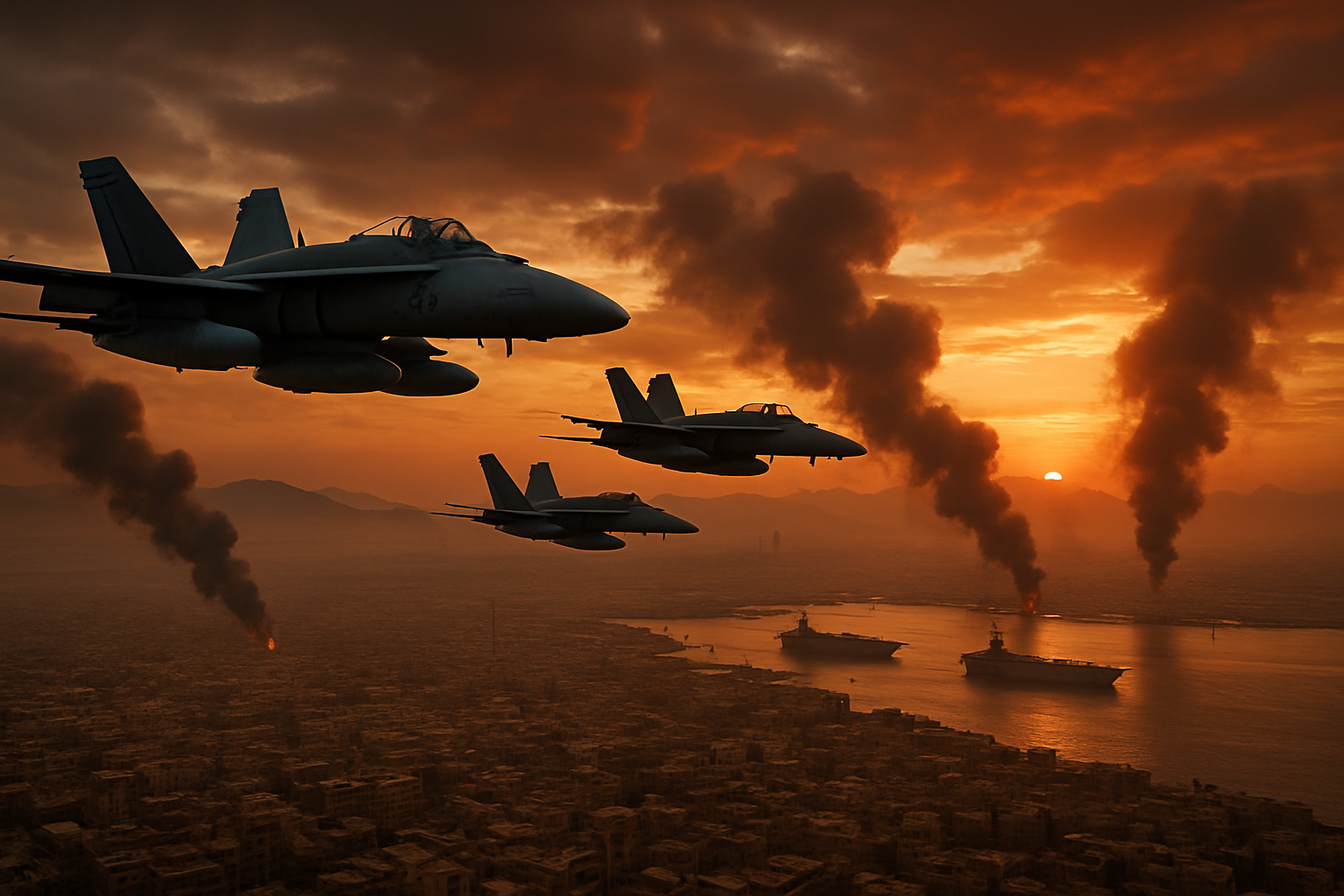
The United States and Israel launched coordinated military strikes against Iran early Saturday, killing Supreme Leader Ayatollah Ali Khamenei and dozens of senior officials in "Operation Epic Fury" — the largest Middle East military operation since the 2003 Iraq invasion. The unprecedented assault has triggered massive Iranian retaliation across the Gulf region and plunged the world into its gravest crisis since World War II.
Death of Iran's Supreme Leader Confirmed
Iranian state television confirmed the death of 86-year-old Khamenei Saturday evening after hours of conflicting reports. The Supreme Leader died "at his place of work" in Tehran while "performing official duties," according to Fars News Agency. President Donald Trump announced Khamenei's death hours earlier via Truth Social, calling him "one of the most evil people in History."
Also killed in the strikes were Khamenei's daughter, son-in-law, granddaughter, and daughter-in-law, according to Iranian media reports. Defense Minister Aziz Nasirzadeh, Revolutionary Guards Chief Mohammad Pakpour, and senior aide Ali Shamkhani were among more than 40 high-ranking officials eliminated in what Israeli Prime Minister Benjamin Netanyahu described as precision strikes targeting Iran's leadership compound.
"Many signs indicate he is no longer with us after we destroyed the tyrant's compound. This is the single greatest chance for the Iranian people to take back their country."
— Donald Trump, US President
Operation Epic Fury: Unprecedented Scale
The coordinated US-Israeli operation deployed an unprecedented dual-carrier strike force featuring the USS Gerald R. Ford and USS Abraham Lincoln — representing approximately one-third of the active US Navy fleet positioned 800 kilometers from Iran's coast. Pentagon sources confirm the attacks targeted nuclear facilities, Revolutionary Guard infrastructure, and government command centers across multiple Iranian cities.
Trump declared the operation would continue "without interruption throughout the week" until objectives are achieved. Israeli Defense Minister Israel Katz announced "preemptive strikes to eliminate threats" while confirming the operation would last "as long as necessary."
According to Red Crescent sources, the bombardment has caused at least 200 deaths and 700 injuries across Iran, making it the deadliest single day of conflict in the region since the devastating June 2025 Iran-Israel war.
Nuclear Diplomacy's Dramatic Collapse
The military escalation follows the complete breakdown of nuclear negotiations that had achieved unprecedented progress just days earlier. Iranian Foreign Minister Abbas Araghchi had announced a "broad agreement on guiding principles" in Geneva talks — the most significant diplomatic breakthrough since the 2018 JCPOA collapse.
However, fundamental disagreements proved insurmountable. Iran maintained ballistic missiles and regional proxy support as "red lines" excluded from nuclear-only talks, while US Secretary of State Marco Rubio demanded comprehensive agreements addressing missiles, armed groups, and human rights. Iran continued enriching uranium at 60% purity — approaching the 90% weapons-grade threshold — with sufficient material for multiple nuclear weapons if weaponized.
Trump's 10-day ultimatum warning "bad things will happen" preceded the military action, representing the starkest deadline issued to Iran in decades.
Iran's Massive Retaliation
Iran's Revolutionary Guard immediately launched "first wave" retaliatory strikes across the Gulf region, declaring "no red lines remain" and designating all US and Israeli assets as "legitimate targets." The Iranian response has caused significant casualties and infrastructure damage across multiple nations:
- United Arab Emirates: One civilian killed in Abu Dhabi from missile debris, Dubai International Airport evacuated and operations suspended
- Kuwait: International Airport struck by drones causing employee injuries and flight suspensions
- Qatar: 65 ballistic missiles and 12 drones intercepted by Patriot systems, 8 injured by fragments
- Bahrain: US Fifth Fleet headquarters in Manama targeted by missiles
The Iranian strikes represent the most significant regional escalation since the nuclear crisis began, with Tehran promising "unprecedented response" to what Foreign Minister Araghchi called an "unprovoked, illegal" attack.
Global Aviation Crisis Unfolds
The conflict has triggered the most extensive aviation disruption since the COVID-19 pandemic, with Iran, Iraq, Israel, UAE, and Qatar closing their airspace to civilian traffic. Flight tracking showed Iranian and Iraqi airspace completely empty as major carriers suspended operations:
- Emirates and Etihad Airways face operational crisis with UAE airspace closed
- Air France-KLM, Wizz Air, and Bulgaria Air suspended all Middle East operations
- Over 18,000 flights cancelled worldwide affecting hundreds of thousands of passengers
- Dubai International Airport — the world's busiest — completely shut down indefinitely
The disruption affects critical Europe-Asia connecting routes, with airlines exploring complex alternative routing strategies while navigating multiple conflict zones.
Energy Markets in Turmoil
Oil prices surged immediately on concerns about the Strait of Hormuz, through which 40% of global oil transit flows. Iran reportedly warned shipping operators the strait is "not allowed" for passage, raising fears of a complete closure that would devastate global energy supplies.
Natural gas prices jumped 24% in Europe and 78% in the United States as markets digested the potential for prolonged regional warfare. Energy analysts warn that supply chain disruptions could extend far beyond the immediate conflict zone, affecting worldwide economic stability.
Regional Coalition Under Strain
The unprecedented coalition of Saudi Arabia, UAE, Qatar, and Egypt that had supported diplomatic engagement now faces severe strain as Iranian retaliation targets member territories. Egyptian President Abdel Fattah al-Sisi condemned attacks on "sisterly Arab countries" while warning of "comprehensive chaos."
Multiple governments ordered immediate embassy evacuations, with Sweden and Serbia calling for citizens to leave Iran citing "extremely uncertain" security conditions. The United States authorized departure of non-essential embassy personnel from Israel, with Ambassador Mike Huckabee advising staff to leave "today."
International Response and UN Emergency Session
The UN Security Council convened an emergency session following requests from France, China, Russia, Colombia, and Bahrain. Russia condemned what Foreign Minister Sergey Lavrov called "reckless actions by Washington and West Jerusalem" violating international law.
European leaders called for maximum restraint while stopping short of condemning the initial strikes. France, Germany, and the UK issued a rare joint statement emphasizing they had not participated in the attacks while criticizing Iranian retaliations against regional partners.
Trump's Regime Change Appeal
In an unprecedented diplomatic departure, President Trump directly addressed the Iranian people, declaring Khamenei's death represents the "single greatest chance for Iranian people to take back their country." The explicit call for popular uprising represents the most direct US advocacy for regime change since the 1979 Islamic Revolution.
Tehran residents celebrated spontaneously across the capital — dancing at bus stops, participating in car parades, and chanting "the tyrant is no more" — while Revolutionary Guards ordered citizens to leave the city fearing mass demonstrations.
Succession Crisis Looms
Khamenei's death after 37 years as Supreme Leader creates an immediate succession crisis with no clear successor. Iran has formed a three-member transitional council comprising the president, judiciary head, and a Guardian Council jurist, while declaring 40 days of official mourning and seven days of public holidays.
The succession question threatens the Islamic Republic's stability at a moment of maximum external pressure, potentially fulfilling Trump's prediction that the strikes could precipitate comprehensive political transformation.
Nuclear Governance Crisis Deepens
The conflict occurs against the backdrop of a broader nuclear governance crisis, with the New START treaty having expired February 5 — marking the first time in over 50 years without US-Russia nuclear constraints. China's nuclear expansion and Iran's weapons-capable enrichment program have created what UN Secretary-General António Guterres called nuclear risks at their "highest level in decades."
The rapid collapse from diplomatic framework to military confrontation within days represents a template-setting moment for 21st-century conflict resolution, with implications extending far beyond the current crisis.
Historical Significance and Global Implications
The killing of Khamenei marks the end of an era that began with the 1979 Islamic Revolution and his subsequent rise to power in 1989. Under his leadership, Iran transformed into a regional anti-American force with an extensive proxy network spanning Lebanon, Syria, Iraq, Yemen, and Palestine.
The operation's success or failure will influence international approaches to nuclear crises for decades, potentially setting precedents for military versus diplomatic solutions to proliferation challenges. Energy security, regional stability, and nuclear governance credibility all hang in the balance as the world watches this unprecedented confrontation unfold.
What Comes Next
As both sides prepare for what appears to be sustained military confrontation, the immediate focus shifts to preventing regional war escalation that could reshape Middle Eastern geopolitics for generations. The stakes include not only regional stability but global energy security, nuclear non-proliferation norms, and the credibility of international law in the emerging multipolar world order.
With Iran's promise of continued retaliation and Trump's commitment to ongoing strikes "until necessary," the world faces its most dangerous moment since the end of the Cold War. The coming days will determine whether this represents a limited military confrontation or the beginning of a broader Middle Eastern war with global consequences.