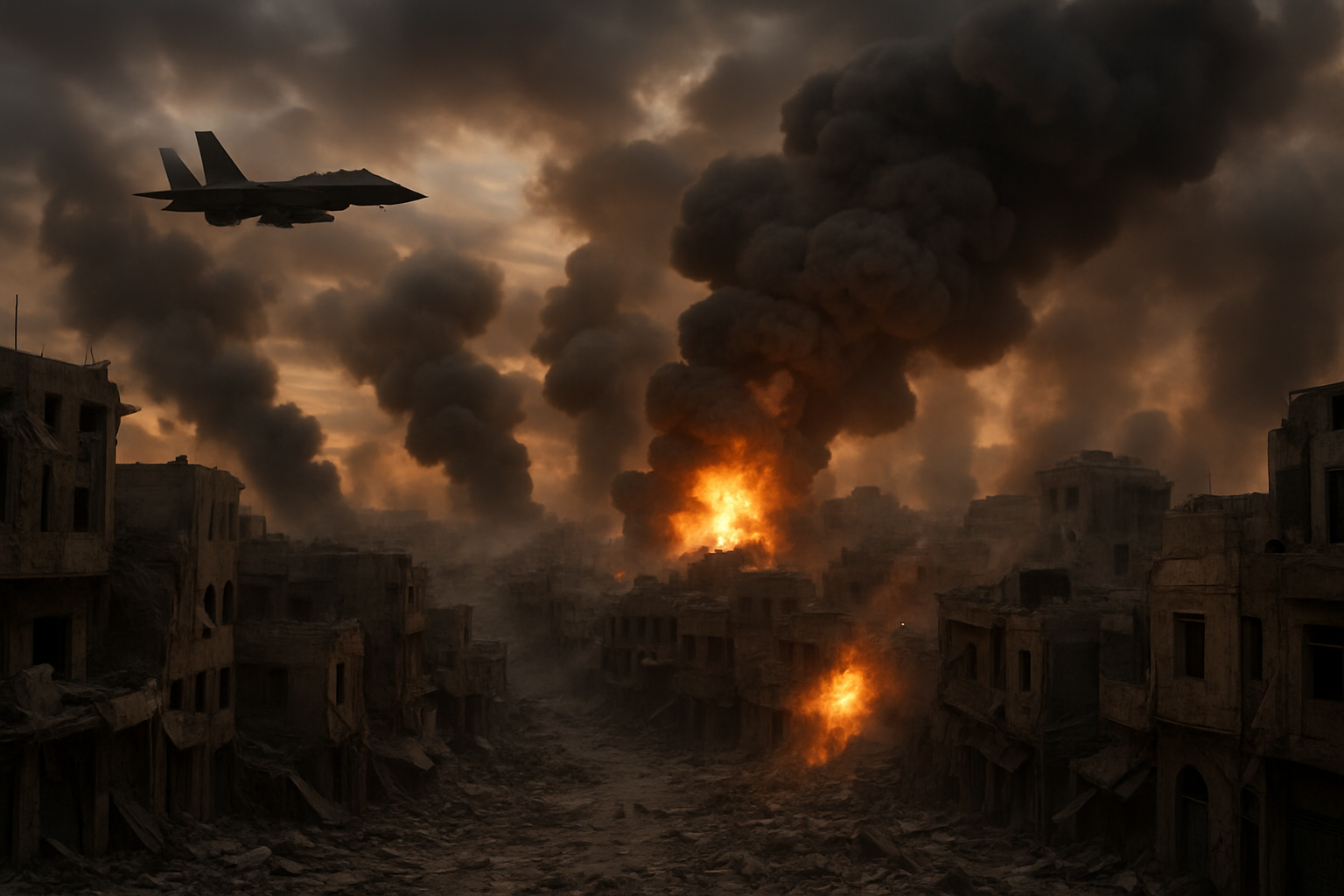
The Middle East war that began six days ago with the assassination of Iran's Supreme Leader Ali Khamenei has escalated into the most dangerous international crisis since the Cold War's end, with conflict now spanning from the Persian Gulf to the Indian Ocean and reaching European territory for the first time since World War II.
What started as "Operation Epic Fury" — the largest coordinated US-Israeli military operation since the 2003 Iraq invasion — has transformed into a global crisis affecting energy markets, aviation networks, and international stability mechanisms across multiple continents.
Historic Naval Strike Expands War Zone
In a dramatic escalation that brings the conflict far beyond Middle Eastern borders, the US submarine USS Charlotte torpedoed and sank the Iranian frigate IRIS Dena off the coast of Sri Lanka on Thursday, killing more than 80 crew members. Defense Secretary Pete Hegseth confirmed this marks the first enemy vessel sunk by a US submarine since World War II, describing it as a "quiet death" demonstrating America's "global military reach."
The Iranian frigate, returning from naval exercises with India, was struck by a torpedo approximately 800 kilometers off Sri Lanka's coast. While 32 crew members were rescued, 148 remain missing in what represents the conflict's expansion into international waters of the Indian Ocean.
Trump Demands Role in Iran's Leadership Selection
In an unprecedented assertion of American influence over a foreign nation's internal affairs, President Donald Trump declared Thursday that he must be "involved in the appointment" of Iran's next Supreme Leader. Speaking to Axios, Trump dismissed Khamenei's son Mojtaba as "a lightweight" and compared his desired role to his intervention in Venezuela, where interim president Delcy Rodriguez cooperates with the US under threat of violence.
"I have to be involved in the appointment, like with Delcy in Venezuela. Khamenei's son is unacceptable. We will have someone who can create harmony and peace in Iran."
— Donald Trump, US President
Trump's comments represent the most explicit assertion of regime change objectives since the war began, moving beyond military action to direct interference in Iran's constitutional succession process.
Global Aviation Crisis Reaches COVID-Scale Disruption
The simultaneous closure of airspace across eight Middle Eastern countries — Iran, Iraq, Israel, UAE, Qatar, Syria, Kuwait, and Bahrain — has created an aviation crisis of unprecedented scope. Over 18,000 flights have been cancelled worldwide, representing the most extensive disruption since COVID-19.
Dubai International Airport, the world's busiest with over 86 million passengers annually, remains completely shut down due to missile damage sustained during Iran's "Operation True Promise 4" retaliation. Major carriers including Emirates, Air France-KLM, Wizz Air, and Bulgaria Air have suspended operations indefinitely, stranding hundreds of thousands of passengers globally.
The closure has exposed the vulnerability of global aviation networks that rely heavily on Middle Eastern hubs for Europe-Asia connectivity. Alternative routing through Caribbean stopovers or trans-Pacific routes has dramatically increased costs and travel times, with recovery timelines uncertain and dependent on military rather than weather-related factors.
Energy Markets in Crisis as Strait of Hormuz Shuts Down
Oil prices have surged more than 10% past $80 per barrel following Iran's declaration that the Strait of Hormuz — through which 40% of global seaborne oil transits — is "unsafe" for shipping. Major shipping companies Maersk and MSC have suspended operations, leaving more than 150 tankers carrying crude oil and LNG anchored in the Persian Gulf, representing billions in stranded cargo.
Natural gas prices have spiked 24% in Europe and 78% in the United States, creating severe energy security concerns as Qatar has halted LNG production due to Iranian strikes on infrastructure. The crisis highlights the dangerous dependency on a single chokepoint for global energy supplies, with strategic petroleum reserves providing only temporary relief.
European Territory Under Attack for First Time Since WWII
The conflict reached European soil when Iranian drones struck RAF Akrotiri in Cyprus earlier this week, marking the first direct attack on European territory since World War II. The unprecedented nature of this assault has triggered a coordinated European naval response, with HMS Dragon, Spanish frigates, and vessels from Italy, France, the Netherlands, and Greece deploying to protect Cyprus.
Britain's Defense Secretary announced the deployment of four additional Typhoon fighter jets to Qatar and two AW159 Wildcat helicopters with anti-drone capabilities arriving in Cyprus on Friday. Prime Minister Keir Starmer declared the UK is "taking every measure" to protect Cyprus while urging a "negotiated settlement" as the "best way forward."
Nuclear Diplomacy's Complete Collapse
The military escalation represents the complete breakdown of what had been the most promising US-Iran diplomatic opening in years. Despite achieving "broad agreement on guiding principles" in Geneva talks — the most progress since the 2018 JCPOA collapse — fundamental disagreements over scope proved insurmountable.
Iran had maintained that ballistic missiles and regional proxies were "red lines" excluded from nuclear-only talks, while the US demanded comprehensive agreements including missiles, armed groups, and human rights. Iran continues enriching uranium at 60% purity with over 400 kilograms of material, approaching the 90% threshold needed for weapons-grade material.
The diplomatic failure occurs against the backdrop of broader nuclear governance crisis, with New START having expired on February 5 — the first time in over 50 years without US-Russia nuclear constraints — and China's rapid nuclear expansion. UN Secretary-General António Guterres has warned that nuclear risks are at their "highest in decades."
Regional Coalition Under Severe Strain
The unprecedented coalition of Saudi Arabia, UAE, Qatar, and Egypt that had backed diplomatic efforts is now severely strained as Iranian retaliation directly targets member territories. Egyptian President Abdel Fattah el-Sisi condemned attacks on "sisterly Arab countries," warning of "comprehensive chaos" spreading across the region.
Casualties from Iran's systematic retaliation include one civilian killed in Abu Dhabi, 32 foreign nationals injured in Kuwait airport drone strikes, and eight injured in Qatar despite successfully intercepting 65 missiles and 12 drones with Patriot systems. The UAE has reported six workers injured from drone debris in industrial zones.
Congressional Scrutiny Intensifies
Bipartisan lawmakers are demanding comprehensive answers from the Trump administration about strategy, costs, and the potential for ground troop deployment. Democratic Senator Richard Blumenthal expressed being "more concerned than ever" about "boots on the ground" after classified briefings.
The conflict's unpopularity is described by experts as "almost unprecedented" early in military operations, with opposition spanning traditional political divisions and including "much of Trump's base." Financial markets are emerging as a potential "ultimate constraint" on further escalation, with global economic disruption mounting daily.
Humanitarian Crisis Mounting
Iran's Red Crescent reports over 787 killed in US-Israeli strikes, while civilian casualties continue mounting on both sides. The tragic attack on an elementary school in Minab that killed 53-85 students and staff has become a symbol of the diplomatic failure's human cost, with international human rights organizations demanding Geneva Conventions investigations.
The largest coordinated international evacuation since the 2011 Arab Spring is underway, with Australia reporting 115,000 nationals trapped, Germany 30,000 tourists stranded, and multiple countries organizing emergency repatriation flights from the region.
Iranian Leadership Succession Crisis
Following the confirmed death of Supreme Leader Ali Khamenei on March 1, Iran faces its first leadership transition during wartime. A three-member transitional council comprising President Masoud Pezeshkian, judiciary head Gholamhossein Mohseni Ejei, and a Guardian Council representative is managing the country while the Assembly of Experts selects a permanent successor.
Mojtaba Khamenei, the deceased leader's son, has emerged as the favored candidate, which would represent the first hereditary succession in the Islamic Republic's history. CIA assessments suggest a Revolutionary Guards member is more likely to be chosen, indicating a potential hardline military shift in Iranian governance.
Template-Setting Crisis for the 21st Century
March 1-5, 2026, represents a watershed moment in Middle Eastern geopolitics with global implications extending decades beyond the current crisis. The rapid transition from diplomatic framework to military escalation demonstrates the fragility of modern crisis management in the multipolar era.
Success in containing the escalation could provide a template for nuclear crisis resolution and strengthen international diplomatic credibility. Failure may accelerate military solutions to international disputes, encourage nuclear proliferation elsewhere, and fundamentally reshape approaches to conflict resolution for the 21st century.
The crisis tests regional war prevention, global energy security, nuclear governance credibility, and international law enforcement mechanisms simultaneously. As the conflict enters its sixth day, the stakes couldn't be higher for the post-World War II international order and the principles that have governed global stability for nearly eight decades.
With energy markets in turmoil, aviation networks paralyzed, and diplomatic institutions strained to their limits, the coming days will determine whether this remains a contained regional confrontation or escalates into a broader Middle Eastern war with worldwide implications that could reshape international relations for generations to come.