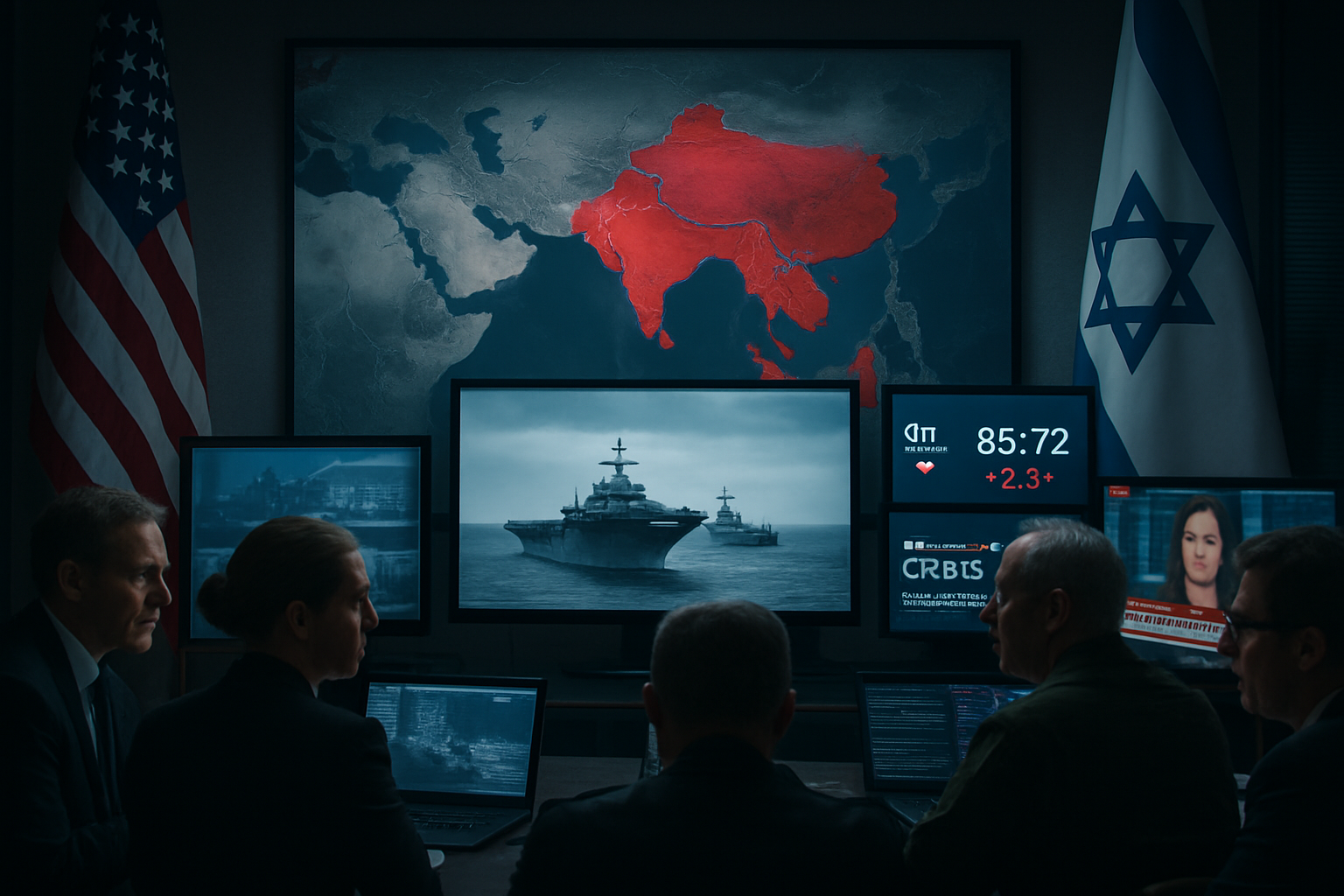
US President Donald Trump has issued Iran a stark 48-hour ultimatum to reopen the Strait of Hormuz or face unprecedented military action, as the search continues for a missing American pilot whose F-15 fighter jet was shot down over Iranian territory on Friday.
In a Truth Social post Saturday morning, Trump warned: "Remember when I gave Iran ten days to make a deal or open the Strait of Hormuz? Time is running out—48 more hours before hell comes to them. Glory to GOD." The ultimatum refers to Trump's March 26 deadline, which expires Monday evening at 8 PM local time.
Major Military Developments
The escalation comes as US forces continue an intensive search for the missing airman from the F-15E Strike Eagle that was downed Friday evening in southwestern Iran. While one pilot was successfully rescued by Black Hawk helicopters the same day, the navigator remains missing more than 24 hours later, creating a high-stakes race against time.
Iranian Revolutionary Guard forces have reportedly deployed across the crash site region, with Tehran offering a 57,000 euro reward for information leading to the missing American's capture. The prospect of Iran taking a US service member prisoner has dramatically raised the stakes for both sides.
According to Spanish news reports, US forces are "redoubling efforts" to locate the missing airman, with the Pentagon describing it as a priority rescue mission. The incident marks the first confirmed US aircraft loss in the six-week conflict that has become the most dangerous international crisis since the Cold War.
Unprecedented Military Commitment
Intelligence sources reveal that the next phase of US operations will deploy nearly the entire American inventory of stealthy JASSM-ER cruise missiles, with the $1.5 million weapons being redistributed from Pacific stockpiles to Central Command bases. The order to reallocate these advanced munitions was issued in late March, according to sources with direct knowledge.
The military commitment represents an unprecedented escalation of Operation Epic Fury, which has already cost $11.3 billion in its first week alone. US forces have struck over 11,000 targets across Iran using a dual-carrier deployment of the USS Gerald R. Ford and USS Abraham Lincoln, representing approximately one-third of the active US Navy fleet.
Strait of Hormuz Crisis
Iran's closure of the Strait of Hormuz through naval mining has created a global energy crisis, with the strategic waterway carrying 40% of the world's seaborne oil transit now effectively blocked. Oil prices have surged past $100 per barrel for the first time since 2014, with some analysts warning of potential spikes to $200 if the crisis continues.
The International Energy Agency has authorized its largest strategic reserve release in 50 years—400 million barrels—in an attempt to stabilize global markets. Over 150 oil tankers worth billions in cargo remain stranded in the Persian Gulf, while major shipping companies Maersk and MSC have suspended all operations in the region.
The energy crisis has triggered a global aviation emergency, with over 18,000 flights cancelled worldwide since the conflict began—the most extensive disruption since COVID-19. Dubai International Airport, the world's busiest with 86 million passengers annually, remains shuttered due to missile damage.
Domestic Political Pressure
The US State Department has also moved against Iranian nationals within American borders, revoking green cards and visas for at least four individuals connected to Iran's government. Among those arrested are the niece and grandniece of slain Revolutionary Guards General Qassem Soleimani, who was killed in a 2020 US drone strike.
Secretary of State Marco Rubio determined that Hamideh Soleimani Afshar and her daughter were no longer eligible for lawful permanent resident status. The State Department accused Afshar of being an "outspoken supporter" of Iran while living a "lavish lifestyle" in Los Angeles and promoting Iranian propaganda.
Iranian Response and Regional Impact
Iran has responded to the escalating pressure with "Operation True Promise 4," systematic attacks across the region that have killed civilians and damaged critical infrastructure. The Revolutionary Guard has declared "no red lines remain" in their targeting of US and Israeli assets.
Saturday's strikes resulted in five deaths at a petrochemical facility in southwestern Iran, while Iranian officials reported that US-Israeli bombardments have damaged 60% of a critical bridge in Karaj and rendered a psychiatric hospital in Tehran non-functional.
The conflict has also devastated Iran's educational system, with authorities reporting that 30 universities have been hit by airstrikes since the war began, killing five professors and over 60 students. The targeting of civilian infrastructure has drawn international condemnation and calls for Geneva Conventions investigations.
Hereditary Succession Crisis
The conflict has unfolded during Iran's most significant political transition since 1979. Following the death of Supreme Leader Ali Khamenei in the initial US-Israeli strikes on March 1, his son Mojtaba Khamenei has assumed power in the first hereditary succession in the Islamic Republic's 47-year history.
The transition has consolidated Revolutionary Guards control over Iranian governance, marking a shift from clerical to military leadership during active warfare. US intelligence assessments suggest this change indicates a more hardline and militaristic approach to the conflict.
International Implications
The crisis has strained traditional alliances and created new geopolitical fault lines. NATO faces its greatest test as Turkey's President Erdogan described the war as creating a "geostrategic deadlock" in a conversation with Secretary-General Mark Rutte.
For the first time since World War II, European territory has been attacked, as Iranian drones struck RAF Akrotiri in Cyprus. This has prompted an unprecedented naval coalition response from the UK, Spain, Italy, France, Netherlands, and Greece to protect European interests.
The nuclear diplomacy framework established in Geneva earlier this year has completely collapsed despite initial progress. Iran continues uranium enrichment at 60% purity with over 400kg of material, approaching the 90% weapons-grade threshold necessary for nuclear weapons.
Global Economic Disruption
The conflict has exposed fundamental vulnerabilities in global supply chains dependent on Persian Gulf logistics. Manufacturing in automotive, electronics, and textiles sectors faces severe disruption, while natural gas prices have surged 24% in Europe and 78% in the United States.
Financial markets have experienced their worst decline since the 2008 crisis, with Pakistan's stock exchange recording its largest single-day drop in history at -8.97%. The aviation industry faces its most comprehensive disruption since COVID-19, with eight Middle Eastern countries maintaining simultaneous airspace closures.
Historical Significance
UN Secretary-General António Guterres has called the crisis "the greatest test of multilateral cooperation in crisis management in the modern era." The rapid transition from diplomatic framework to military confrontation demonstrates what experts describe as the fragility of crisis management in the multipolar era.
The stakes extend far beyond the immediate region, affecting global energy security, nuclear governance credibility, and international law enforcement. Success in containing the crisis could provide a framework for future nuclear crisis resolution, while failure might accelerate military solutions and encourage nuclear proliferation globally.
As Trump's 48-hour deadline approaches, the world watches to see whether diplomatic solutions can still emerge from what has become the most dangerous international crisis since the end of the Cold War. The search for the missing American pilot continues to add urgency to an already explosive situation that will likely define 21st-century approaches to conflict resolution for decades to come.