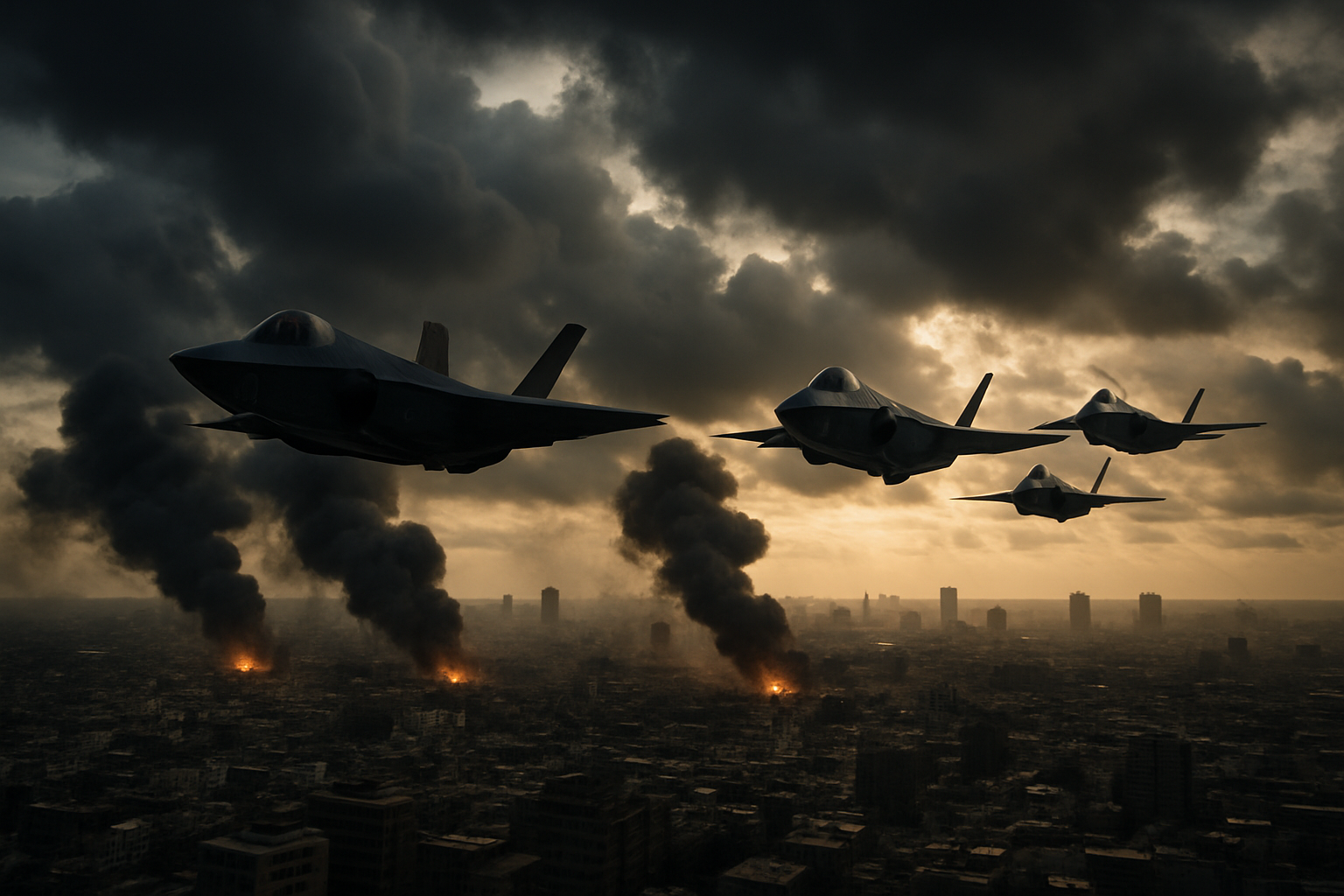
The US-Israeli military campaign against Iran has entered its seventh day with unprecedented escalation, as President Donald Trump claimed the right to participate in selecting Iran's next Supreme Leader while American forces expanded operations from the Persian Gulf to the Indian Ocean, sinking an Iranian naval vessel in the first submarine attack since World War II.
The conflict, designated "Operation Epic Fury" by US forces, represents the largest coordinated military operation in the Middle East since the 2003 Iraq invasion. Over 2,000 Iranian targets have been struck using a dual-carrier deployment of the USS Gerald R. Ford and USS Abraham Lincoln, representing approximately one-third of the US Navy's active fleet positioned 800 kilometers from Iran's coast.
Trump's Unprecedented Political Intervention
In a dramatic escalation of regime change rhetoric, President Trump told Reuters on Thursday that he wants to be "involved in the process of choosing the person who is going to lead Iran into the future." Trump specifically rejected Mojtaba Khamenei, son of the late Supreme Leader Ali Khamenei, as a potential successor, dismissing him as a "lightweight."
"We want to be involved in the process of choosing the person who is going to lead Iran into the future. I have to be involved in the appointment, like with Delcy," Trump said, drawing a comparison to Venezuela's interim leadership.
— President Donald Trump, Reuters Interview
The statement represents the most direct assertion of American involvement in Iranian internal affairs since the 1979 Islamic Revolution. Trump also encouraged Iranian Kurdish forces to go on the offensive, stating he would be "all for it" but declined to specify whether the United States would provide air cover for such operations.
Naval Warfare Expands to Indian Ocean
The conflict expanded beyond traditional Middle Eastern boundaries when the USS Charlotte, an American submarine, torpedoed and sank the Iranian frigate IRIS Dena approximately 800 kilometers off Sri Lanka's coast. Defense Secretary Pete Hegseth confirmed the attack killed over 80 crew members, calling it a "quiet death" that demonstrated America's "global military reach."
The naval strike marks the first enemy vessel sunk by a US submarine since World War II and represents a significant expansion of the conflict zone. The Iranian frigate was returning from naval exercises in India when it was struck, with only 32 crew members rescued from the vessel carrying 148 personnel.
Global Aviation and Economic Crisis
The war has triggered the most extensive aviation crisis since COVID-19, with over 18,000 flights cancelled worldwide as eight Middle Eastern countries—Iran, Iraq, Israel, UAE, Qatar, Syria, Kuwait, and Bahrain—simultaneously closed their airspace. Dubai International Airport, the world's busiest hub, remains completely shut down due to missile damage.
Major airlines including Emirates, Air France-KLM, Wizz Air, and Bulgaria Air have suspended operations indefinitely, affecting hundreds of thousands of passengers globally and severely disrupting the critical Europe-Asia flight corridor.
Energy markets have experienced severe disruption, with oil prices surging 10% past $80 per barrel after Iran declared the Strait of Hormuz—through which 40% of global seaborne oil transits—to be "unsafe." Natural gas prices have jumped 24% in Europe and 78% in the United States. Over 150 tankers worth billions in cargo remain anchored in the Persian Gulf as major shipping companies Maersk and MSC have suspended operations.
Iranian Succession Crisis
Following the confirmed death of Supreme Leader Ali Khamenei on March 1, Iran has activated its constitutional succession mechanisms. A three-member transitional council consisting of President Masoud Pezeshkian, judiciary head Gholamhossein Mohseni-Ejei, and Guardian Council representative Ayatollah Alireza Arafi is currently governing the country.
The Assembly of Experts, comprising 88 clerics, is meeting under wartime conditions to select a permanent successor. CIA assessments suggest a Revolutionary Guards member is likely to be chosen, indicating a potential shift toward more hardline military influence in Iran's governance structure. This would mark the first time in the Islamic Republic's history that succession occurs during active military conflict.
Mojtaba Khamenei, the late Supreme Leader's son, had emerged as a favored candidate, which would have represented the first hereditary succession in Islamic Republic history. However, Trump's explicit rejection of this possibility adds a new dimension to Iran's internal political crisis.
Massive Iranian Retaliation Campaign
Iran has responded with "Operation True Promise 4," with the Islamic Revolutionary Guard Corps declaring that "no red lines remain" and systematically targeting US and Israeli assets across the region. The retaliation campaign has caused casualties across multiple countries:
- UAE: 1 civilian killed in Abu Dhabi from missile debris, with Dubai International Airport completely shut down
- Kuwait: 32 foreign nationals injured in airport drone strikes
- Qatar: 8 people injured from fragments despite successful interception of 65 missiles and 12 drones using Patriot defense systems
- Israel: 9 civilians killed and 28 wounded in Beit Shemesh residential strikes
- Cyprus: RAF Akrotiri base attacked, marking the first strike on European territory since World War II
The Iranian attacks have severely strained the unprecedented regional coalition of Saudi Arabia, UAE, Qatar, and Egypt that had previously supported diplomatic efforts. Egyptian President Abdel Fattah el-Sisi condemned the attacks on "sisterly Arab countries," warning of "comprehensive chaos" in the region.
Collapse of Nuclear Diplomacy
The military escalation followed the complete breakdown of nuclear negotiations despite achieving what Iranian Foreign Minister Abbas Araghchi had described as "broad agreement on guiding principles"—representing the most significant progress since the 2018 collapse of the Joint Comprehensive Plan of Action (JCPOA).
The fundamental disagreement centered on scope: Iran insisted on excluding ballistic missiles and regional proxy groups as "red lines" in nuclear-only talks, while US Secretary of State Marco Rubio demanded a comprehensive agreement addressing missiles, armed groups, and human rights issues.
Iran continues to enrich uranium at 60% purity—significantly above the JCPOA limit of 3.67% and approaching the 90% threshold needed for weapons-grade material. Intelligence sources confirm Iran possesses over 400 kilograms of enriched uranium, sufficient for multiple weapons if weaponized.
International Response and Evacuations
The conflict has triggered the largest coordinated international evacuation since the Arab Spring of 2011. Australia reports 115,000 nationals trapped in the region, while Germany has 30,000 tourists stranded. Multiple countries including Sweden and Serbia have ordered immediate evacuations from Iran, citing "extremely uncertain" security conditions.
The European Union has activated its ESTIA evacuation plan for the first time, coordinating the removal of European and third-country nationals from Cyprus and surrounding areas.
UN Secretary-General António Guterres has declared the situation "a serious threat to international peace and security," while Russia has condemned what it calls "reckless actions by Washington and West Jerusalem" as violations of international law. China has issued its strongest condemnation in years, calling the operations a "serious violation of Iran's sovereignty."
First American Casualties
US Central Command confirmed the first American military casualties of the operation on March 1, with three service members killed and five wounded—the first confirmed US deaths in the largest Middle East military operation since 2003. The Pentagon statement noted that "major combat operations continue and our responsive actions are ongoing," suggesting the potential for prolonged regional conflict.
Congressional Scrutiny Intensifies
Bipartisan lawmakers on Capitol Hill are demanding answers about the administration's Iran war strategy, costs, and potential ground troop deployment. Senator Richard Blumenthal expressed being "more concerned than ever" about the possibility of "boots on the ground" following classified briefings.
The conflict's unpopularity has been described as "almost unprecedented" for an operation in its early stages, with financial markets emerging as a potential "ultimate constraint" on conflict escalation as global economic disruption spreads.
Nuclear Governance Crisis Context
The Iran crisis unfolds against the backdrop of broader nuclear governance breakdown. The New START treaty between the US and Russia expired on February 5, marking the first time in over 50 years without bilateral nuclear constraints. Combined with China's nuclear expansion and Iran's uranium enrichment, UN officials warn that nuclear risks are at their "highest level in decades."
Template-Setting Historical Moment
March 6, 2026, represents what analysts describe as the most dangerous moment since the Cold War's end. The rapid transition from diplomatic breakthrough to military confrontation demonstrates the fragility of modern crisis management in a multipolar era.
The conflict's outcome will likely serve as a template for 21st-century approaches to nuclear crises, territorial sovereignty enforcement, and the balance between diplomatic and military solutions. Success in containing the escalation could provide a framework for future crisis resolution, while failure may accelerate military approaches to international disputes, encourage global nuclear proliferation, and undermine diplomatic credibility worldwide.
Regional and Global Implications
The war's effects extend far beyond the Middle East, disrupting global supply chains, energy markets, and aviation networks. The simultaneous closure of multiple countries' airspace has forced complex international flight rerouting, while the vulnerability of Persian Gulf trade routes has exposed the fragility of global energy architecture.
Stock markets have crashed worldwide, with Pakistan's KSE-100 experiencing its largest single-day decline in history at -8.97%, while Dow futures dropped 400-570 points. Qatar has halted LNG production, affecting European gas supplies already strained by ongoing geopolitical tensions.
As the conflict enters its second week, the stakes continue to escalate: regional war prevention versus expansion, global energy security, nuclear governance credibility, and the fundamental principles of post-World War II international order are all being tested simultaneously. The decisions made in the coming days and weeks will reverberate through international relations for decades, determining whether diplomacy or military force becomes the preferred template for resolving 21st-century conflicts.