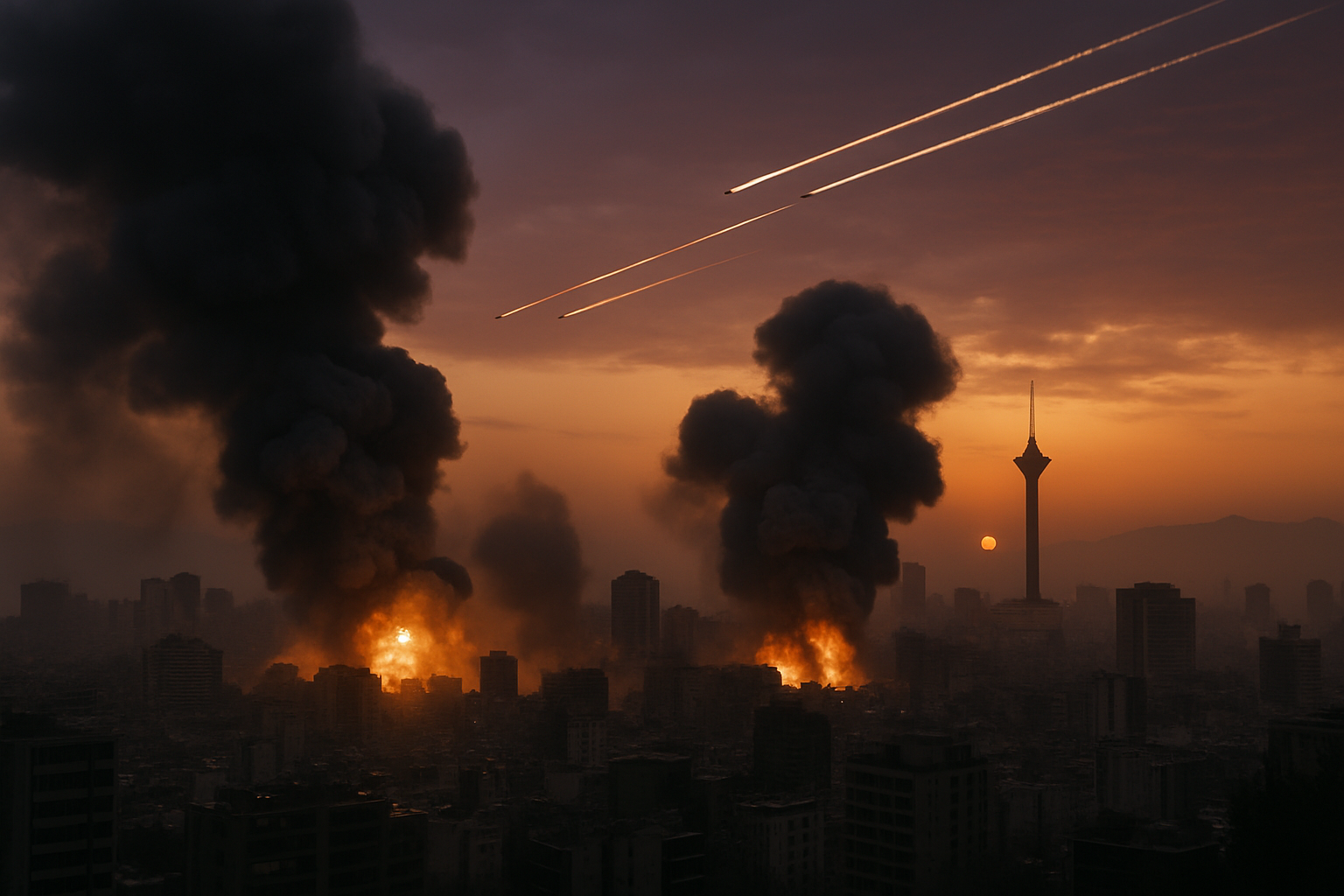
The United States and Israel launched coordinated military strikes against Iran early Saturday, targeting Iranian government facilities and military infrastructure in what President Donald Trump called "Operation Epic Fury," dramatically escalating tensions in the Middle East and triggering immediate Iranian retaliation across the region.
Explosions were reported across multiple Iranian cities, including Tehran, with Iranian state media IRNA confirming "heavy smoke rising over the capital." Israeli Defense Minister Israel Katz announced the strikes as a "preemptive attack to eliminate threats against the State of Israel," while President Trump declared the United States had begun "major combat operations" against the Islamic Republic.
The strikes represent the most significant military escalation between the United States, Israel, and Iran since the 1979 Iranian revolution, coming after the complete breakdown of nuclear negotiations despite recent diplomatic progress in Geneva talks.
Operation Epic Fury: Coordinated Military Campaign
In a video posted to his Truth Social platform from his Florida residence, Trump announced the launch of what he termed "Operation Epic Fury," vowing to "destroy their missiles and raze their missile industry to the ground" and "annihilate" Iran's navy. The president made clear the goal extended beyond military objectives to regime change, urging Iranians to "take over your government" when the operations conclude.
"We are going to destroy their missiles and raze their missile industry to the ground. It will be totally obliterated. We're going to annihilate their navy," Trump declared. "When we are finished, take over your government. It will be yours to take. This will be probably your only chance for generations."
Israeli officials confirmed they believe the strikes have killed several senior Iranian officials, though Tehran has not confirmed these claims. An Israeli source briefed on military operations indicated that Iran's Supreme Leader, Ayatollah Ali Khamenei, was among those targeted, though a later report suggested he had been moved to a secure location prior to the attacks.
Immediate Iranian Retaliation
Iran's response was swift and comprehensive. The Islamic Revolutionary Guard Corps launched what it described as a "first wave" of drones and missiles targeting Israel, while also striking U.S. military installations across the region. Iranian officials declared that "no red lines remain" and that all U.S. and Israeli assets in the region were now "legitimate targets."
Explosions were reported in multiple Gulf Arab states, including Qatar, UAE, Bahrain, Kuwait, and Jordan, as Iran carried out its threatened retaliation. The Iranian missile strikes prompted several countries to intercept incoming projectiles, with U.S. air defenses reportedly shooting down a drone over a military base near Erbil airport.
Iranian Foreign Minister Abbas Araghchi, speaking live on NBC News from Tehran, dismissed reports of Khamenei's death, stating the Supreme Leader was "still alive as far as I know" and confirming that "two commanders were killed in the strikes" but other senior officials had survived.
Collapse of Nuclear Diplomacy
The military strikes came despite what had appeared to be the most significant diplomatic progress in years. Geneva talks in recent weeks had achieved what Iranian Foreign Minister Araghchi described as "broad agreement on guiding principles" - the most substantial progress since the collapse of the Joint Comprehensive Plan of Action (JCPOA) in 2018.
However, fundamental disagreements persisted. Iran maintained that ballistic missiles and regional proxy activities were "red lines" that would be excluded from any nuclear-only agreement. The United States, led by Secretary of State Marco Rubio, insisted on a comprehensive agreement that would address missiles, armed groups, and human rights issues alongside nuclear concerns.
Iran continues to enrich uranium at 60% purity - far above the 3.67% limit set by the original nuclear deal and approaching the 90% threshold required for weapons-grade material. Former IAEA inspector Dr. Yusri Abu Shadi has confirmed that Iran possesses over 400 kilograms of enriched uranium, making nuclear weapons capability "easily achievable."
Unprecedented Military Buildup
The strikes followed weeks of unprecedented U.S. military buildup in the Middle East. The deployment of two aircraft carrier strike groups - USS Gerald R. Ford and USS Abraham Lincoln - represented the largest American naval presence in the region since the 2003 Iraq invasion, with approximately one-third of the active U.S. Navy fleet concentrated within 800 kilometers of Iran's coast.
Pentagon officials had briefed the White House that forces could be ready for "potentially weeks-long operations" ranging from nuclear facilities to Revolutionary Guard infrastructure, expecting Iranian retaliation cycles. Recent military incidents, including a U.S. F-35C shooting down an Iranian Shahed-139 drone near the Abraham Lincoln, had escalated tensions in the strategically vital Strait of Hormuz.
Global and Regional Response
The strikes triggered immediate international alarm, with the United Nations Security Council scheduling an emergency session for Saturday. The meeting was requested by France, Bahrain, China, Russia, and Colombia, according to Russia's permanent UN mission.
"The reckless actions by Washington and West Jerusalem against a sovereign UN member state constitute a direct violation of the fundamental principles and norms of international law," the Russian mission stated, warning that the strikes risk undermining peace and stability across the Middle East.
Despite the military escalation, an unprecedented regional coalition of Arab states - including Saudi Arabia, UAE, Qatar, and Egypt - had backed the diplomatic process, representing extraordinary Middle Eastern consensus for conflict prevention. This coalition now faces the challenge of responding to the collapse of negotiations they had supported.
European allies issued urgent travel warnings, with the UK, France, Germany, and Poland advising against travel to Israel and the broader region. Cyprus advised avoiding Iran and Gaza entirely, while Turkish Airlines canceled flights to Tehran.
Aviation Crisis and Economic Impact
The strikes caused immediate widespread disruption to global aviation. Iran, Iraq, Israel, UAE, and Qatar all closed their airspace to civilian traffic, with flight tracking showing Iranian and Iraqi airspace completely empty of commercial aircraft.
Major carriers including Emirates, Air France-KLM, Wizz Air, and others suspended flights to key Middle Eastern destinations. The disruption affects hundreds of thousands of passengers worldwide, as the Middle East serves as a critical connecting hub between Europe and Asia.
Oil prices rose immediately on the news, with the strategic Strait of Hormuz - through which 40% of global oil transit passes - now potentially threatened. The economic implications extend far beyond the immediate region, with global supply chains facing potential disruption.
Nuclear Governance Crisis
The escalation comes at a particularly precarious moment for global nuclear governance. The New START treaty between the United States and Russia expired on February 5, marking the first time in over 50 years without nuclear constraints between the superpowers. Combined with China's nuclear expansion and the Iran crisis, UN Secretary-General António Guterres has warned that nuclear risks are at their "highest in decades."
The collapse of Iran diplomacy despite months of intensive negotiations raises fundamental questions about the viability of diplomatic solutions to modern nuclear crises. The precedent could influence how future territorial and nuclear disputes are resolved, potentially accelerating military over diplomatic solutions globally.
Israeli Security Concerns
For Israel, the strikes represent the culmination of years of warnings about Iran's nuclear program and regional activities. Netanyahu-Trump coordination had established clear Israeli red lines requiring any agreement to include limitations on ballistic missiles and ending Iranian support for proxy groups including Hezbollah, Hamas, and the Houthis.
Israeli officials view nuclear-only frameworks as insufficient to address what they consider existential security threats from Iran's integrated missile and proxy network. The country has declared a state of emergency and activated air raid sirens nationwide, with schools closed and the population ordered to seek shelter.
Implications for Regional Order
The strikes mark a fundamental shift in Middle Eastern geopolitics, moving from proxy conflicts and shadow operations to direct state-on-state confrontation. The outcome will likely reshape the region's security architecture for decades to come.
For Iran, the regime faces its most serious external threat since the 1980s Iran-Iraq War, while simultaneously dealing with severe domestic unrest. Over 42,000 arrests have been made since 2022 protests, with Nobel laureate Narges Mohammadi sentenced to additional prison time even during the recent diplomatic talks.
The international community now faces the challenge of managing a conflict that threatens to destabilize global energy markets, undermine nuclear non-proliferation efforts, and potentially spark a wider regional war involving multiple nations and proxy groups.
Looking Ahead
As "Operation Epic Fury" continues, the world watches to see whether this represents a limited military action designed to pressure Iran back to negotiations, or the beginning of a sustained campaign aimed at regime change as Trump's rhetoric has suggested.
The stakes could not be higher: regional war prevention, global energy security, nuclear governance credibility, and the future of diplomatic solutions to international crises all hang in the balance. The template being set in the Persian Gulf will likely influence international approaches to conflict resolution for the 21st century.
With Iranian retaliation already underway and both sides appearing committed to their positions, the coming hours and days will be critical in determining whether this crisis can be contained or will escalate into the broader Middle Eastern conflict that diplomats and leaders worldwide have worked desperately to prevent.