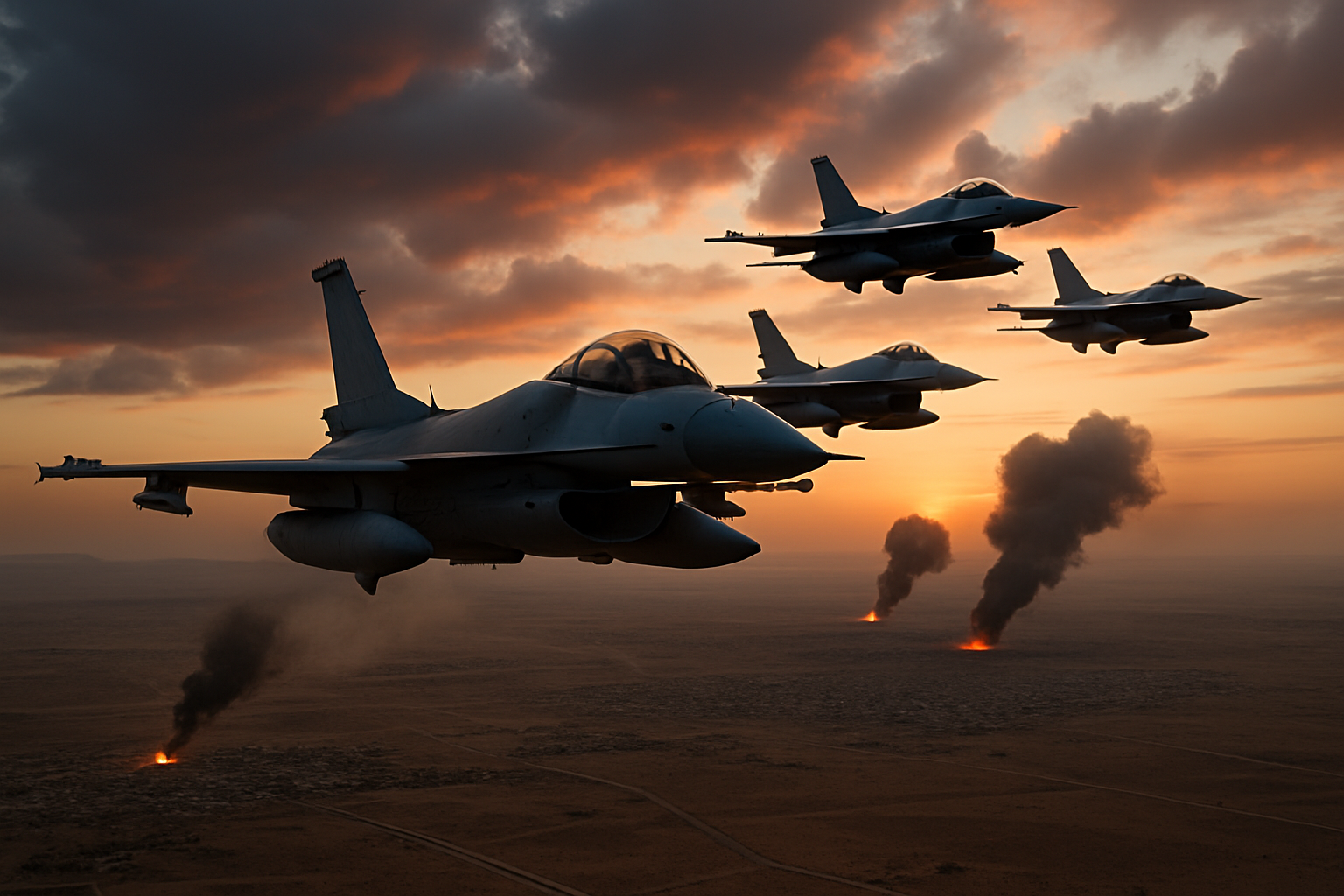
The United States and Israel launched coordinated military strikes against Iran on Saturday morning in "Operation Epic Fury," marking the most significant escalation in the Middle East since the 2003 Iraq invasion and dealing a devastating blow to months of intensive nuclear diplomacy.
Israeli Defense Minister Israel Katz announced the operation, declaring "The State of Israel launched a preemptive strike against Iran to eliminate threats against the State of Israel." Explosions were reported across Tehran, with Iranian state media IRNA confirming "heavy smoke rising over the capital."
The strikes come after the complete breakdown of nuclear negotiations that had achieved the most significant diplomatic progress since the 2018 JCPOA collapse. Despite reaching "broad agreement on guiding principles" in Geneva talks mediated by Switzerland and Oman, fundamental disagreements over scope proved insurmountable.
Claims of Iranian Leadership Targeted
In a dramatic televised address, Israeli Prime Minister Benjamin Netanyahu stated: "This morning, we destroyed in a surprise attack the complex of the tyrant Khamenei at the heart of Tehran," adding there are "many signs that this tyrant is no longer." The Israeli military claimed to have killed Mohammad Pakpour, chief of the Revolutionary Guards.
However, reports of Supreme Leader Ali Khamenei's death remain unconfirmed. Iranian Foreign Minister Abbas Araghchi dismissed the claims, stating Khamenei is "still alive as far as I know," while acknowledging "one or two commanders" were killed in the strikes.
Multiple sources, including unnamed Israeli officials speaking to international media, have claimed Khamenei was killed in strikes on his residential compound, but Iran continues to deny these reports as "psychological warfare."
Massive Military Buildup Precedes Strikes
The operation follows an unprecedented military buildup that saw the deployment of dual aircraft carriers - USS Gerald R. Ford and USS Abraham Lincoln - representing the largest U.S. naval presence in the Middle East since 2003. The deployment of approximately one-third of the active U.S. Navy fleet positioned 800 kilometers from Iran's coast had been building for weeks.
Pentagon sources had briefed the White House that forces could be ready for "potentially weeks-long operations" ranging from nuclear facilities to Revolutionary Guard infrastructure, expecting Iranian retaliation cycles.
"I don't think they want the consequences of not making a deal."
— President Donald Trump, aboard Air Force One
Trump had issued increasingly explicit warnings, culminating in a historic 10-day ultimatum warning that "bad things will happen" if no meaningful nuclear deal was reached.
Immediate Iranian Retaliation
Iran responded swiftly to the strikes, with the Islamic Revolutionary Guard Corps launching what officials called a "first wave" of missiles and drones targeting Israeli and U.S. installations across the Gulf region.
Explosions were reported in multiple countries: the UAE reported one civilian death in Abu Dhabi from missile debris, Kuwait Airport was struck by drones causing employee injuries, and Dubai experienced explosions from falling debris. Qatar successfully intercepted missiles using Patriot systems, while Bahrain's Fifth Fleet headquarters was also targeted.
Air raid sirens wailed across Israel as the population was ordered to seek shelter. Schools and most businesses were closed, with the health system suspending all non-essential services. Iranian officials declared that "no red lines remain" and all U.S. and Israeli assets in the region are now "legitimate targets."
Nuclear Diplomacy's Complete Collapse
The military escalation represents a dramatic failure of diplomatic efforts that had shown unprecedented promise. Geneva talks in February achieved "broad agreement on guiding principles" - described by Iranian Foreign Minister Abbas Araghchi as the most significant progress since the Joint Comprehensive Plan of Action (JCPOA) collapsed in 2018.
However, the same fundamental disagreement that has plagued negotiations for over a decade remained unresolved: Iran insisted on excluding ballistic missiles and regional proxies as "red lines" from nuclear-only talks, while U.S. Secretary of State Marco Rubio demanded a comprehensive agreement addressing missiles, armed groups, and human rights.
Iran had been enriching uranium to 60% purity - far above the 3.67% limit set by the JCPOA and approaching the 90% threshold needed for weapons-grade material. Former IAEA inspector Dr. Yusri Abu Shadi confirmed Iran possessed over 400 kilograms of enriched uranium, making nuclear weapons capability "easily achievable."
Trump's Regime Change Appeal
In an unprecedented diplomatic move, President Trump directly addressed the Iranian people, urging them to "take control of your country" after military operations conclude. "Your moment of freedom has arrived," Trump declared, representing the most explicit call for regime change and a dramatic departure from traditional diplomatic approaches.
This marked an evolution in U.S. policy from nuclear-focused negotiations to comprehensive political transformation objectives, with Trump previously calling Iranian government overthrow "the best thing that could happen."
Regional Coalition Under Strain
The strikes have severely strained an unprecedented regional coalition that had backed the diplomatic process. Saudi Arabia, the UAE, Qatar, and Egypt had formed an extraordinary Middle Eastern consensus supporting negotiations - a remarkable unity that had helped maintain pressure for a peaceful resolution.
Multiple countries issued emergency travel advisories and began evacuating diplomatic personnel. The U.S. had already authorized the departure of non-essential embassy staff from Israel, with Ambassador Mike Huckabee advising staff to leave "today."
Sweden and Serbia issued immediate evacuation orders for their citizens in Iran, citing an "extremely uncertain security situation."
Global Aviation Crisis
The military operations triggered an immediate global aviation crisis, with Iran, Iraq, Israel, the UAE, and Qatar all closing their airspace to civilian traffic. Flight tracking services showed Iranian and Iraqi airspace completely empty.
Major airlines suspended operations across the Middle East: Emirates and Etihad Airways faced operational paralysis, Qatar Airways halted Doha flights, and European carriers including Air France-KLM, Bulgaria Air, and Wizz Air suspended services to the region until at least early March.
The Middle East serves as a critical connecting hub between Europe and Asia, and the comprehensive airspace closures affected hundreds of thousands of passengers worldwide, representing the most extensive regional aviation disruption since the COVID-19 pandemic.
Emergency UN Security Council Session
The United Nations Security Council has been called into emergency session at the request of France, China, Russia, Colombia, and Bahrain. Russia condemned what it called "reckless actions by Washington and West Jerusalem" as a direct violation of international law principles.
UN Secretary-General António Guterres had previously warned that nuclear risks were at their "highest in decades," particularly following the expiration of the New START treaty between the U.S. and Russia on February 5 - the first time in over 50 years without nuclear constraints between the superpowers.
Economic Shockwaves
Oil prices rose immediately on news of the strikes, with concerns about the Strait of Hormuz - through which 40% of global oil transit passes. Iran had previously threatened to close this critical waterway if attacked.
The Persian Gulf region's stability is crucial for global energy security, and the escalation raises fears of broader regional conflict that could disrupt worldwide supply chains far beyond the immediate Middle East area.
School Attack Tragedy
Among the most tragic developments was a strike on a girls' elementary school in Minab, in Iran's southern Hormozgan province, which killed between 53 and 85 students and staff according to varying reports from Iranian authorities. The attack on the school during regular hours when it was filled with young schoolgirls has become a symbol of the human cost of the diplomatic failure.
Iranian President Masoud Pezeshkian condemned the strike as a "barbaric crime," while international human rights organizations demanded investigations into potential Geneva Conventions violations for targeting civilian educational infrastructure.
Template-Setting Implications
The rapid transition from diplomatic breakthrough to military confrontation within days represents a critical test of international crisis management mechanisms in the multipolar era. The failure of intensive negotiations that had achieved the most progress in years raises questions about the viability of diplomatic solutions to modern nuclear crises.
This breakdown may influence how future territorial and nuclear disputes are approached globally, potentially setting a precedent that favors military solutions over diplomatic engagement. The stakes extend far beyond the Middle East, affecting global nuclear governance, territorial sovereignty enforcement, and international law credibility for the 21st century.
Looking Ahead
As Operation Epic Fury continues, the international community faces urgent challenges in preventing further escalation while addressing the underlying issues that led to this dramatic diplomatic breakdown. Iran's declaration that "no red lines remain" suggests the potential for broader conflict that could reshape Middle Eastern geopolitics for decades.
The coming hours and days will be decisive in determining whether this represents a contained military action or the beginning of a broader regional war with global implications for energy security, nuclear governance, and the credibility of diplomatic solutions to international crises.
The world watches as one of the most promising diplomatic openings between the U.S. and Iran in years has collapsed into the largest military confrontation in the region since 2003, with consequences that will reverberate far beyond the Middle East.