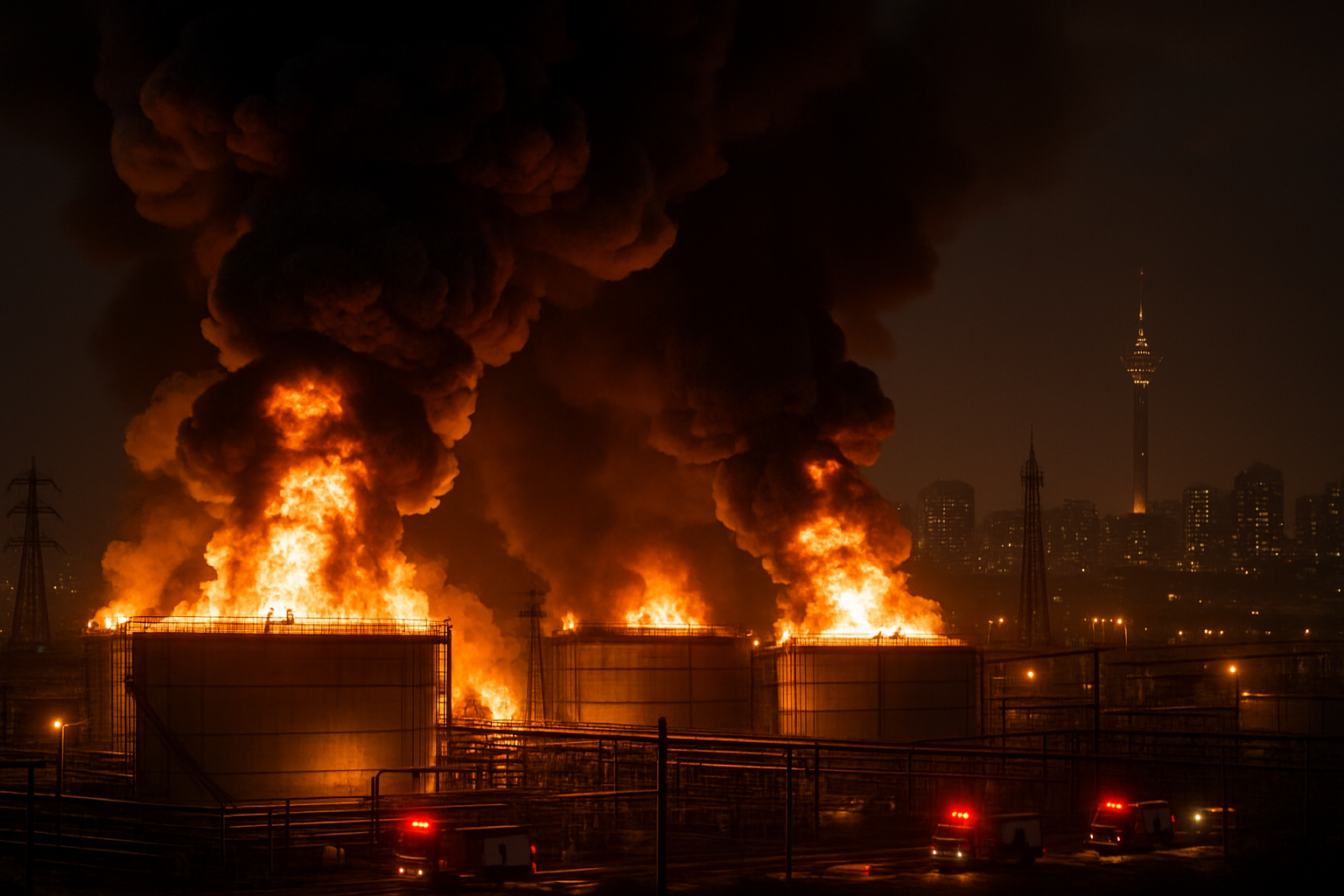
American and Israeli warplanes carried out devastating coordinated strikes on Iranian oil storage facilities on the outskirts of Tehran early Sunday morning, triggering massive explosions and fires that have blanketed Iran's capital with toxic black smoke, according to multiple international sources.
The attacks, part of the ongoing "Operation Epic Fury" campaign, targeted five strategic petroleum installations including four large-capacity storage depots and a key transport center, according to Iranian National Oil Distribution Company Director Keramat Veis Karami. The strikes represent a significant escalation in the second week of what has become the most dangerous international crisis since the end of the Cold War.
Apocalyptic Scenes in Tehran
Nearly 10 million residents of Tehran awakened to dense, toxic black clouds after the overnight strikes devastated the city's oil infrastructure. Witnesses described scenes of "apocalyptic morning" as black, oily rain began falling across the metropolitan area, creating hazardous conditions for millions of civilians.
Video footage from the Iranian capital shows walls of black smoke and massive flames rising from the Shahran oil depot, with one resident telling BBC: "It was like night turned into day." The fires have spread to nearby Koohsar Boulevard, where witnesses report flames engulfing residential buildings and commercial shops.

Iran's state oil company confirmed that while significant damage occurred to storage facilities, emergency crews have managed to contain the flames at most locations. However, the environmental and health impacts for Tehran's population remain severe, with authorities advising residents to remain indoors and avoid exposure to the toxic smoke.
Strategic Military Escalation
The oil facility strikes mark a dramatic shift in targeting strategy from previous military operations focused primarily on defensive installations and government facilities. According to CNN sources, oil infrastructure has become "more exposed" as the conflict enters what military analysts describe as its "second phase."
President Donald Trump has demanded Iran's "unconditional surrender," representing a complete rejection of any diplomatic solution. Speaking via Truth Social, Trump declared "no deal with Iran except UNCONDITIONAL SURRENDER!" - a dramatic escalation from earlier hints at potential negotiations. The President has also claimed the right to personally choose Iran's next Supreme Leader, rejecting the candidacy of Mojtaba Khamenei as a "lightweight."
"We are achieving rapid victories in Iran and American strikes will continue until unconditional surrender."
— President Donald Trump, Truth Social
Regional Retaliation Intensifies
Iran's Islamic Revolutionary Guard Corps (IRGC) has escalated its "Operation True Promise 4" retaliatory campaign, launching the 27th wave of strikes against US and Israeli targets across the region. The Iranian military has declared that "no red lines remain" in their systematic targeting of American facilities throughout the Middle East.
The conflict has already expanded beyond traditional Middle Eastern boundaries, with Iranian forces conducting the first attack on European territory since World War II when drones struck RAF Akrotiri in Cyprus. This unprecedented expansion has prompted an international naval coalition response, with HMS Dragon, Spanish frigates, and vessels from Italy, France, Netherlands, and Greece deploying to protect European territories.
Global Economic Disruption
The targeting of Iran's energy infrastructure has created worldwide economic shockwaves. Oil prices have surged over 10% past $80 per barrel, while Iran has declared the Strait of Hormuz - through which 40% of global seaborne oil transits - as "unsafe for shipping." More than 150 tankers worth billions in cargo remain stranded in the Persian Gulf as major shipping companies Maersk and MSC have suspended operations.
Natural gas prices have increased 24% in Europe and 78% in the United States, with Qatar halting LNG production due to Iranian infrastructure attacks. The crisis has caused Pakistan's stock market to crash 8.97% in its largest single-day decline in history, while global aviation remains paralyzed with over 18,000 flights cancelled worldwide.
Humanitarian Crisis Mounts
The conflict has created the largest international evacuation since the Arab Spring of 2011, with Australia reporting 115,000 nationals trapped in the region and Germany working to evacuate 30,000 stranded tourists. The European Union has activated its ESTIA evacuation plan for Cyprus for the first time in its history.
Iranian casualties continue mounting, with the Iranian Red Crescent reporting over 787 civilians killed in US-Israeli strikes. International human rights organizations have demanded investigations into potential Geneva Convention violations, particularly following the Minab school attack that killed between 53-85 students and staff.
Iranian Leadership Crisis
Following the confirmed death of Supreme Leader Ali Khamenei on March 1st, Iran continues to operate under a three-member transitional council consisting of President Masoud Pezeshkian, Judiciary Chief Mohseni Ejei, and a Guardian Council representative. The Assembly of Experts is working to select a permanent successor under unprecedented wartime conditions.
CIA assessments suggest a Revolutionary Guards member is likely to be chosen as the next Supreme Leader, indicating a significant shift toward hardline military influence in Iranian governance. This potential change comes as Trump has explicitly stated his intention to be "involved in the appointment" of Iran's next leader.
Nuclear Diplomacy Collapsed
The current crisis emerged despite significant diplomatic progress in Geneva talks that had achieved a "broad agreement on guiding principles" - the most substantial progress since the JCPOA collapse in 2018. However, fundamental disagreements over scope proved insurmountable, with Iran excluding ballistic missiles and regional proxies as "red lines" while the US demanded comprehensive agreements covering missiles, armed groups, and human rights issues.
Iran continues enriching uranium at 60% purity with over 400 kilograms of weapons-grade material, sufficient for multiple nuclear weapons if weaponized. The breakdown of diplomatic efforts has occurred against the backdrop of the broader nuclear governance crisis, with New START having expired on February 5th - marking the first time in over 50 years without US-Russia nuclear constraints.
Congressional Scrutiny Intensifies
Bipartisan lawmakers in Washington are demanding comprehensive answers on strategy, costs, and potential ground troop deployments. Senator Richard Blumenthal has expressed being "more concerned than ever" about the possibility of boots on the ground, while the conflict's unpopularity has been described as "almost unprecedented" for military operations in their early stages.
The financial markets have emerged as what analysts call the "ultimate constraint" on further escalation, with global economic disruption forcing policymakers to consider the broader implications of sustained military operations.
Template-Setting Historical Moment
Military and diplomatic analysts describe the March 2026 crisis as a "template-setting" moment for 21st-century international relations. The rapid transition from diplomatic breakthrough to military confrontation demonstrates the fragility of modern crisis management in the multipolar era.
The stakes extend far beyond the immediate Middle East region, affecting global energy security, nuclear governance credibility, international law enforcement, and the post-World War II international order. Success in containing the crisis could provide a framework for future nuclear dispute resolution, while failure may accelerate the preference for military solutions over diplomatic ones, reshaping international conflict resolution approaches for decades.
As the conflict enters its second week, the international community faces what UN Secretary-General António Guterres has called "the greatest test of multilateral cooperation and crisis management of the modern era." The decisions made in the coming days will reverberate through international relations for decades, determining whether diplomatic or military solutions become the preferred template for resolving territorial and nuclear disputes in the 21st century.