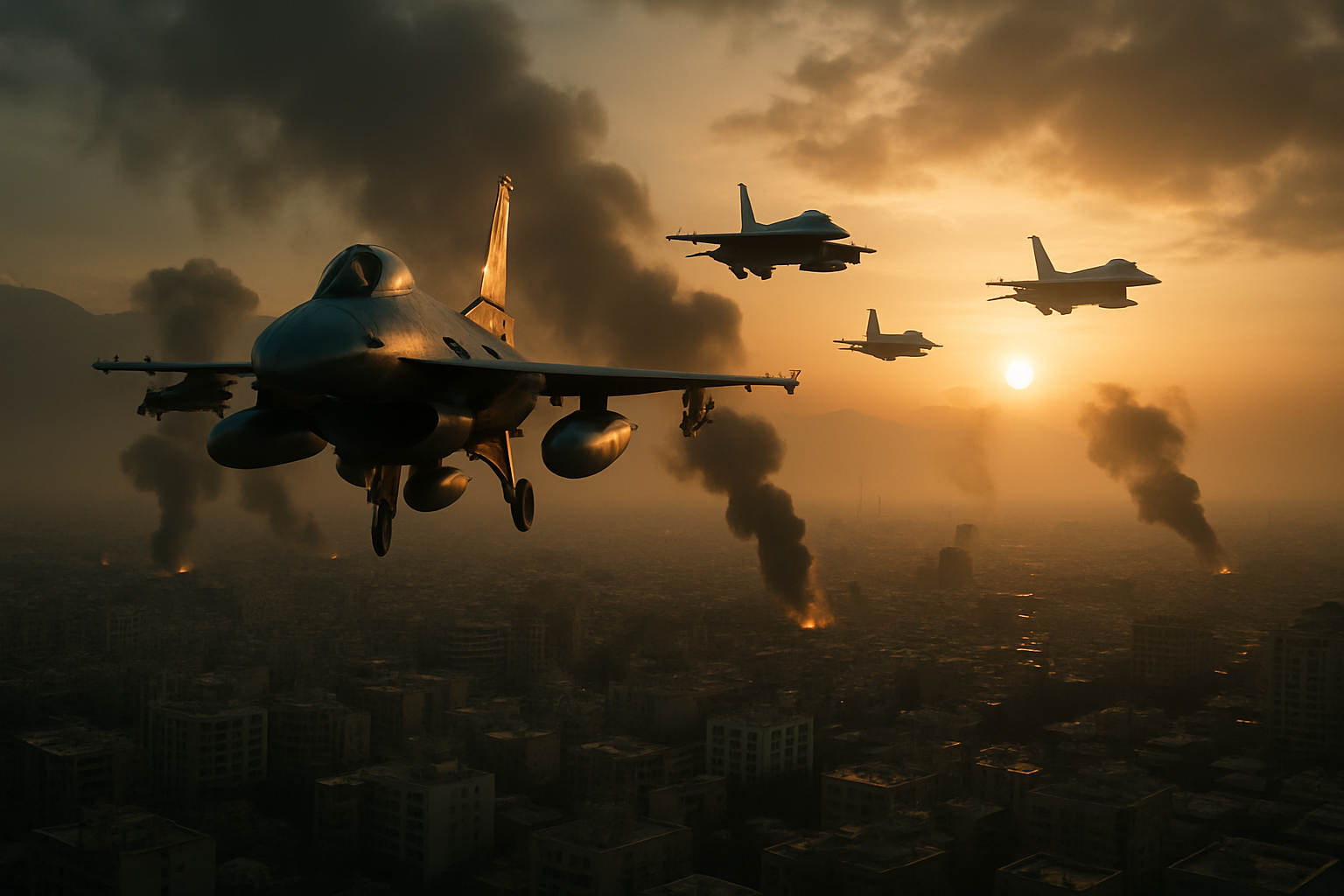
The United States and Israeli military campaign against Iran entered its seventh day on Friday, with the conflict expanding far beyond Middle Eastern boundaries as global aviation, energy markets, and diplomatic relations face historic disruption amid mounting casualties and escalating costs.
What began as coordinated airstrikes on February 28 has evolved into the most dangerous international crisis since the Cold War, with confirmed death of Iran's Supreme Leader Ali Khamenei on March 1, massive Iranian retaliation across the region, and unprecedented global economic consequences affecting millions worldwide.
Campaign Costs Surge as Military Objectives Expand
The first 100 hours of "Operation Epic Fury" have cost the United States approximately $3.7 billion, according to assessments by the Washington-based Center for Strategic and International Studies (CSIS). The staggering expenditure, averaging $891.4 million daily, primarily reflects the advanced weaponry deployed in the largest coordinated US-Israeli operation since the 2003 Iraq invasion.
American forces have utilized precision munitions worth $3.1 billion in the opening phase alone, while maintaining the largest Middle East naval presence in decades with dual-carrier deployment of the USS Gerald Ford and USS Abraham Lincoln - representing approximately one-third of the active US Navy fleet.
The campaign has struck over 2,000 targets across Iran, with confirmed elimination of senior Iranian leadership including Defense Minister Aziz Nasirzadeh, Islamic Revolutionary Guard Corps Chief Mohammad Pakpour, and dozens of high-ranking officials. Most significantly, Iranian state media confirmed on March 1 that Supreme Leader Ali Khamenei died "performing official duties" in his Tehran compound.
Global Aviation Crisis Unprecedented
The conflict has triggered the most extensive aviation disruption since COVID-19, with over 18,000 flights cancelled worldwide as eight countries simultaneously closed their airspace. Iran, Iraq, Israel, the UAE, Qatar, Syria, Kuwait, and Bahrain have suspended civilian air operations, creating a vast no-fly zone across the Middle East's critical Europe-Asia transit corridor.
Dubai International Airport, the world's busiest by international passenger traffic, remains completely shut down due to missile damage from Iranian retaliation strikes. Major carriers including Emirates, Air France-KLM, Wizz Air, and Bulgaria Air have suspended operations indefinitely, stranding hundreds of thousands of passengers globally.
The aviation industry faces complex rerouting challenges as traditional Middle Eastern hub operations collapse. Recovery timelines remain uncertain, dependent on military operations' resolution and infrastructure repairs that could take months to complete.
Energy Markets in Historic Turmoil
Oil prices have surged more than 10 percent past $80 per barrel as Iran declared the Strait of Hormuz "unsafe" for shipping, effectively threatening 40 percent of global oil transit. The strategic waterway, through which approximately 21 million barrels flow daily, has seen over 150 tankers stranded in the Persian Gulf with billions of dollars in cargo.
Major shipping companies Maersk and MSC have suspended operations through the strait, while natural gas prices have spiked 24 percent in Europe and 78 percent in the United States. Qatar, a major liquefied natural gas supplier, has halted production following Iranian infrastructure strikes, creating severe energy security concerns for European consumers facing potential household energy cost increases of £160 annually.
"The Persian Gulf crisis exposes the vulnerability of global energy supply chains to geopolitical disruption"
— Energy analyst speaking on condition of anonymity
Iranian Retaliation Spreads Regionally
Iran's "Operation True Promise 4" has systematically targeted US military installations and allied nations across the Middle East, with the Islamic Revolutionary Guard Corps declaring that "no red lines remain." The retaliation has caused casualties in multiple countries and marked the first attack on European territory since World War II.
Confirmed casualties include one civilian killed in Abu Dhabi from missile debris, 32 foreign nationals injured in drone strikes on Kuwait International Airport, and eight wounded in Qatar despite successful Patriot missile interceptions of 65 ballistic missiles and 12 drones. Most significantly, Iranian drones struck RAF Akrotiri in Cyprus, representing the first direct attack on European soil in over 80 years.
The regional coalition of Saudi Arabia, UAE, Qatar, and Egypt that had supported diplomatic engagement faces severe strain as Iranian strikes target member territories. Egyptian President Abdel Fattah el-Sisi condemned attacks on "sisterly Arab countries," warning of "comprehensive chaos" if escalation continues.
Nuclear Diplomacy Collapses Despite Progress
The military escalation followed the complete breakdown of nuclear negotiations despite achieving what Iranian Foreign Minister Abbas Araghchi had called "broad agreement on guiding principles" - the most significant diplomatic progress since the 2018 JCPOA collapse.
The fundamental disagreement that prevented breakthrough remained unchanged: Iran excluded ballistic missiles and regional proxy relationships as "red lines" from nuclear-only discussions, while the United States demanded comprehensive agreements including missiles, armed groups, and human rights conditions.
Iran continues uranium enrichment at 60 percent purity, approaching the 90 percent weapons-grade threshold, with over 400 kilograms of enriched uranium - sufficient material for multiple nuclear weapons if weaponized, according to former IAEA inspector Dr. Yusri Abu Shadi.
Trump Administration Signals Regime Change
President Donald Trump has made increasingly explicit statements about Iranian leadership change, telling NBC News that he wants to be "involved in the process of choosing the person who is going to lead Iran into the future." The president rejected Mojtaba Khamenei, the late Supreme Leader's son, as a "lightweight" while comparing the situation to US intervention in Venezuela.
Trump's statements represent the most direct assertion of regime change objectives since the 1979 Iranian Revolution, marking a clear evolution from nuclear-focused diplomacy to comprehensive political transformation goals. The administration has encouraged Iranian Kurdish forces to launch attacks against Iranian positions while declining to specify potential air support.
Defense Secretary Pete Hegseth warned that US attacks on Iran would "surge dramatically," predicting the campaign could continue for weeks. The Pentagon has refused to rule out ground troop deployment while maintaining that Iran has "lost everything that could be lost."
Historic Naval Warfare Escalation
The conflict expanded beyond Middle Eastern boundaries on Thursday when the US submarine USS Charlotte torpedoed and sank the Iranian frigate IRIS Dena off Sri Lanka, killing over 80 crew members. The attack marked the first enemy vessel sunk by a US submarine since World War II, according to Defense Secretary Hegseth, who described it as a "quiet death" demonstrating America's "global military reach."
The naval engagement occurred approximately 800 kilometers from the Sri Lankan coast as the Iranian vessel returned from naval exercises with India. Only 32 crew members were rescued from the 148-person complement, representing a significant escalation in casualties and geographic scope of the conflict.
Succession Crisis in Iran
Following Khamenei's confirmed death, Iran has activated constitutional succession protocols with a three-member transitional council comprising President Masoud Pezeshkian, judiciary head Ebrahim Raisi, and a Guardian Council representative managing state affairs during the selection process.
The 88-member Assembly of Experts faces the unprecedented challenge of selecting a new Supreme Leader during active warfare conditions. CIA assessments suggest a Revolutionary Guards member is likely to be chosen, indicating a potential hardline military shift from the traditional clerical leadership model.
Mojtaba Khamenei, the late leader's son, had emerged as a favored candidate representing the first potential hereditary succession in Islamic Republic history. However, Trump's explicit rejection of this candidacy adds an extraordinary international dimension to Iran's internal succession crisis.
Congressional Pressure Intensifies
Bipartisan lawmakers in Congress are demanding comprehensive briefings on military strategy, cost projections, and potential ground troop deployment. Democratic Senator Richard Blumenthal expressed being "more concerned than ever" about the possibility of "boots on the ground" following classified briefings.
The conflict faces "almost unprecedented" early unpopularity according to political analysts, with opposition spanning traditional political divisions including segments of Trump's base. Financial markets are emerging as a potential "ultimate constraint" on conflict escalation, with global stock markets experiencing significant volatility.
Pakistan's KSE-100 index suffered its largest single-day decline in history, falling 8.97 percent, while Dow futures dropped 400-570 points during peak crisis moments. The widespread economic disruption is creating domestic political pressure for conflict resolution.
International Response and Evacuation Operations
The crisis has triggered the largest coordinated international evacuation since the 2011 Arab Spring, with Australia reporting 115,000 nationals trapped in affected areas and Germany evacuating 30,000 tourists. Multiple embassy closures have been announced, with Sweden and Serbia ordering immediate evacuations from Iran citing "extremely uncertain" security conditions.
The European Union has activated its ESTIA emergency evacuation plan for Cyprus for the first time, while unprecedented naval coalitions are forming with HMS Dragon, Spanish frigates, and vessels from Italy, France, Netherlands, and Greece deploying to protect European territory.
UN Security Council emergency sessions continue, with Secretary-General António Guterres warning of a "serious threat to international peace and security." Russia has condemned what it calls "reckless actions by Washington and West Jerusalem," while China issued its strongest condemnation in years, calling the operations a "serious violation of Iran's sovereignty."
Global Economic Implications
Beyond energy market disruption, the conflict is exposing fundamental vulnerabilities in global supply chains dependent on Persian Gulf trade networks. Manufacturing sectors including automotive, electronics, and textiles face severe disruption as shipping routes connecting Asia and Europe through Middle Eastern hubs collapse.
The crisis has also affected planned business operations, with the postponement of significant IPOs including PayPal's $1.1 billion offering, demonstrating how geopolitical instability immediately impacts global financial markets and business confidence.
Nuclear Governance Crisis
The breakdown of Iran diplomacy occurs amid a broader nuclear governance crisis, with the New START treaty between the United States and Russia having expired on February 5 - the first time in over 50 years without bilateral nuclear constraints. Combined with China's nuclear expansion and UN warnings that nuclear risks are at their "highest in decades," the Iran crisis represents a template-setting moment for 21st-century conflict resolution.
The rapid transition from diplomatic breakthrough to military confrontation demonstrates the fragility of modern crisis management mechanisms in the multipolar era. Success in containing the current escalation could provide frameworks for future nuclear disputes, while failure may accelerate military solutions over diplomatic approaches globally.
Historical Significance and Future Implications
March 1-6, 2026, represents a watershed moment in Middle Eastern geopolitics with implications extending decades beyond current events. The confirmed death of Iran's Supreme Leader after 37 years in power, combined with the largest military operation in the region since 2003, fundamentally alters regional power balances and international approaches to conflict resolution.
The crisis tests multiple critical systems simultaneously: regional war prevention mechanisms, global energy security architecture, nuclear governance credibility, and international law enforcement in the post-World War II order. The template established by current crisis management approaches will influence international responses to future territorial disputes and nuclear proliferation challenges.
As the conflict enters its second week, the stakes continue to escalate. The coming days will determine whether the crisis can be contained as a regional confrontation or will expand into a broader Middle Eastern war with worldwide implications for energy markets, supply chains, diplomatic precedents, and the fundamental principles of international stability that have governed global relations for over 75 years.
The most dangerous international crisis since the Cold War's end continues to evolve, with each day bringing new challenges to global stability mechanisms and testing the resilience of international institutions designed to prevent exactly this type of escalating conflict. The world watches as events unfold that will likely reshape international relations for decades to come.