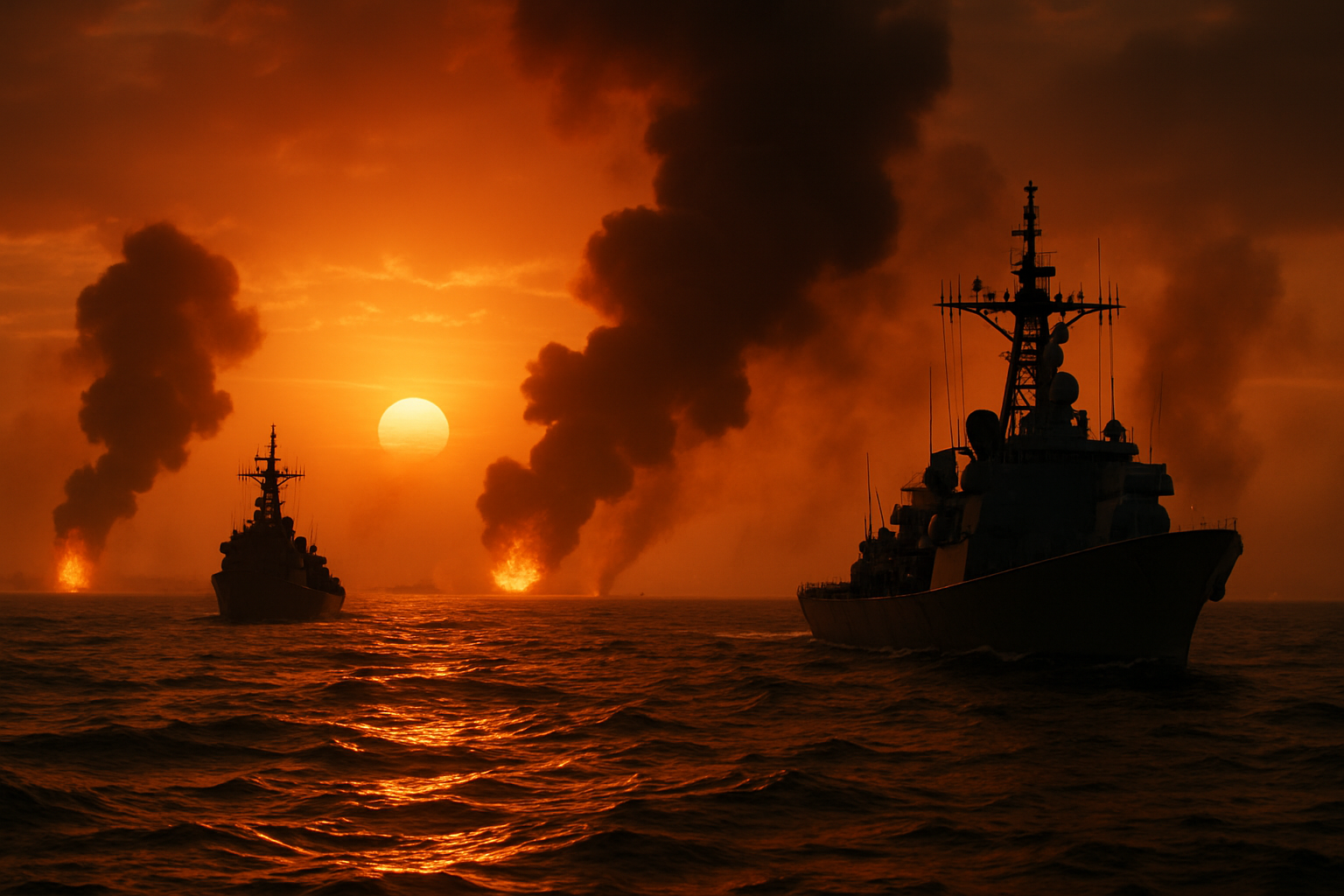
One month into the devastating US-Israeli war against Iran, the conflict has reached its most dangerous phase yet with Iranian hypersonic missiles striking civilian areas near Jerusalem, killing 19 people, while the United States deploys 3,500 additional marines and sailors to the region aboard the amphibious assault ship USS Tripoli.
The escalation comes as Operation Epic Fury, the largest coordinated military campaign since the 2003 Iraq invasion, has now targeted over 11,000 sites across Iran according to Danish military sources, while Tehran's Revolutionary Guard continues its systematic retaliation under "Operation True Promise 4," declaring that "no red lines remain."
Iranian Missiles Penetrate Israeli Defenses
Saturday evening's strike on Eshtaol, a town in the Jerusalem area, marked a significant escalation in Iranian targeting capabilities. The attack, which wounded 19 people according to Israeli medics, demonstrated Iran's ability to penetrate Israel's sophisticated air defense systems using advanced Khorramshahr-4 and Qadr missiles equipped with cluster warheads.
Two additional missile impacts were detected near Eilat, though no casualties were reported there. The strikes came as Hezbollah continued its intensive bombardment of northern Israel, with the Israeli Defense Forces reporting approximately 250 rockets fired at Israeli targets in the past 24 hours alone.
The timing of the attacks coincides with what Al Jazeera reports as key developments in the first month of the war, including the confirmed death of Iran's Supreme Leader Ali Khamenei on March 1st and the unprecedented hereditary succession of his son Mojtaba to the position—the first such transition in the Islamic Republic's 47-year history.
US Military Deployment Signals Potential Ground Operations
The arrival of USS Tripoli in Middle Eastern waters, confirmed by US Central Command, has fueled speculation about potential American ground operations against Iran. The amphibious assault ship carries approximately 3,500 Marines and sailors, along with "transport and strike fighter aircraft, as well as amphibious assault and tactical assets," according to CENTCOM's social media announcement.
Romanian defense analysts suggest that if President Trump authorizes additional deployments, the US could soon have over 17,000 ground troops "at Iran's doorstep." While this figure remains far below the 150,000 troops used for the Iraq invasion in 2003, military experts note these forces could be sufficient to "occupy strategic territories on the continent, secure Tehran's uranium stockpiles, or capture an island."
The deployment comes amid growing congressional scrutiny of the war's costs and objectives. The Pentagon has already spent $11.3 billion in the first week alone, with 150 US troops wounded and 3 confirmed dead—the first American casualties in the largest Middle East operation since 2003.
Iran-Backed Houthis Enter the Conflict
In a dramatic expansion of the conflict's geographical scope, Yemen's Houthi rebels have officially joined the war with their first missile attack targeting "sensitive Israeli military sites" in southern Israel, according to Houthi spokesperson Yahya Saree. This development opens a new front that threatens critical Red Sea shipping routes already disrupted by the broader conflict.
The Houthis' entry follows a pattern of Iranian proxy engagement, with Hezbollah already having abandoned its November 2024 ceasefire with Israel to join the retaliation for Khamenei's death. Lebanon has since reported over 800 killed and 832,000 displaced in what represents the worst violence since the 2006 war.
Global Economic and Aviation Crisis Deepens
The conflict has triggered the most severe global aviation crisis since COVID-19, with over 18,000 flights cancelled worldwide as eight Middle Eastern countries maintain simultaneous airspace closures. Dubai International Airport, the world's busiest with 86 million annual passengers, remains completely shut down due to missile damage.
Energy markets continue in turmoil with oil prices surging past $100 per barrel as Iran maintains its mining of the Strait of Hormuz, which carries 40% of global seaborne oil transit. The International Energy Agency has released a record 400 million barrels from strategic reserves—the largest intervention in the agency's 50-year history.
Egyptian military expert Brigadier General Dr. Hisham Al-Halabi warns that the war has seen the deployment of "heavy destructive weapons" with ammunition reaching up to 13 tons per projectile, indicating the unprecedented scale of the military engagement.
"Tehran shows no signs of willingness to capitulate. The US may need to consider a ground operation against Iran if the current campaign fails to achieve decisive results."
— Nate Swanson, Former State Department Official
Nuclear Diplomacy Completely Collapsed
The current crisis emerged from the complete breakdown of Geneva nuclear negotiations despite achieving what Iranian Foreign Minister Abbas Araghchi called "broad agreement on guiding principles"—the most significant diplomatic progress since the 2018 collapse of the Iran nuclear deal.
The fundamental disagreement proved insurmountable: Iran insisted on nuclear-only discussions while excluding ballistic missiles and proxy relationships as "red lines," while the US demanded comprehensive agreements covering missiles, armed groups, and human rights issues.
Iran continues uranium enrichment at 60% purity with over 400 kilograms of weapons-grade material—sufficient for multiple nuclear weapons if weaponized. The crisis unfolds amid the broader collapse of nuclear governance frameworks, with the New START treaty between the US and Russia having expired in February—the first time in over 50 years without bilateral nuclear constraints between the superpowers.
Regional Coalition Under Severe Strain
The unprecedented coalition of Saudi Arabia, UAE, Qatar, and Egypt that had supported diplomatic engagement with Iran now faces severe strain as Tehran's retaliatory strikes have directly targeted their territories. Egyptian President Abdel Fattah el-Sisi condemned attacks on "sisterly Arab countries" and warned of "comprehensive chaos" spreading across the region.
The UAE has reported one civilian killed in Abu Dhabi from missile debris, Kuwait has seen 32 foreign nationals injured in airport drone strikes, and Qatar intercepted 65 missiles and 12 drones using Patriot systems, with 8 people injured by fragments.
In an unprecedented development, Iranian drones struck RAF Akrotiri in Cyprus—the first attack on European territory since World War II—prompting an extraordinary naval coalition response with HMS Dragon, Spanish frigates, and vessels from Italy, France, the Netherlands, and Greece deploying to protect European interests.
Congressional Opposition Mounts
On Capitol Hill, bipartisan lawmakers are demanding comprehensive answers about the war's strategy, costs, and potential for ground troop deployment. Senator Richard Blumenthal expressed being "more concerned than ever" about the possibility of American boots on the ground, while the conflict's unpopularity has reached what analysts describe as "almost unprecedented" levels, with only 25% of Americans supporting the military operations.
The Pentagon has quietly prepared operations extending through September, far beyond the initial 4-6 week timeline suggested by the White House. Financial markets have emerged as what experts call the "ultimate constraint" on further escalation, with Pakistan's stock exchange suffering its largest single-day decline in history at -8.97%.
Humanitarian Crisis and War Crimes Allegations
Iran's Red Crescent reports over 787 civilian casualties from US-Israeli strikes, including the devastating attack on a girls' school in Minab that killed between 53-85 students and staff. The Pentagon has confirmed US responsibility for an elementary school strike that killed 165-185 students, attributing the tragedy to "outdated targeting data."
International human rights organizations are calling for Geneva Conventions investigations into potential war crimes, while the largest coordinated evacuation since the 2011 Arab Spring is underway, with Australia reporting 115,000 nationals trapped in the region and Germany struggling to extract 30,000 stranded tourists.
Trump's Regime Change Demands
President Trump has escalated his rhetoric to demand Iran's "unconditional surrender" while claiming the right to personally choose Iran's next Supreme Leader. He has explicitly rejected Mojtaba Khamenei as a "lightweight," marking the most direct assertion of American control over Iranian internal affairs since the 1979 revolution.
This represents a significant evolution from the initially nuclear-focused objectives to comprehensive political transformation, effectively eliminating any remaining diplomatic solutions to the crisis.
Historical Significance and Global Implications
UN Secretary-General António Guterres has described the crisis as the "greatest test of multilateral cooperation and crisis management in the modern era." The rapid transition from diplomatic framework to military escalation demonstrates what experts call the fragility of crisis management in the multipolar era.
The conflict's template-setting significance extends far beyond the Middle East, potentially establishing precedents for 21st-century approaches to territorial disputes, nuclear proliferation, and international law enforcement that will reverberate for decades.
As former State Department official Nate Swanson noted, Tehran shows no signs of capitulation, raising the specter of an even more dramatic escalation as the war enters its second month. The stakes now include regional war prevention, global energy security, nuclear governance credibility, and the fundamental principles of the post-World War II international order—all being tested simultaneously in what historians may regard as the most dangerous moment since the end of the Cold War.