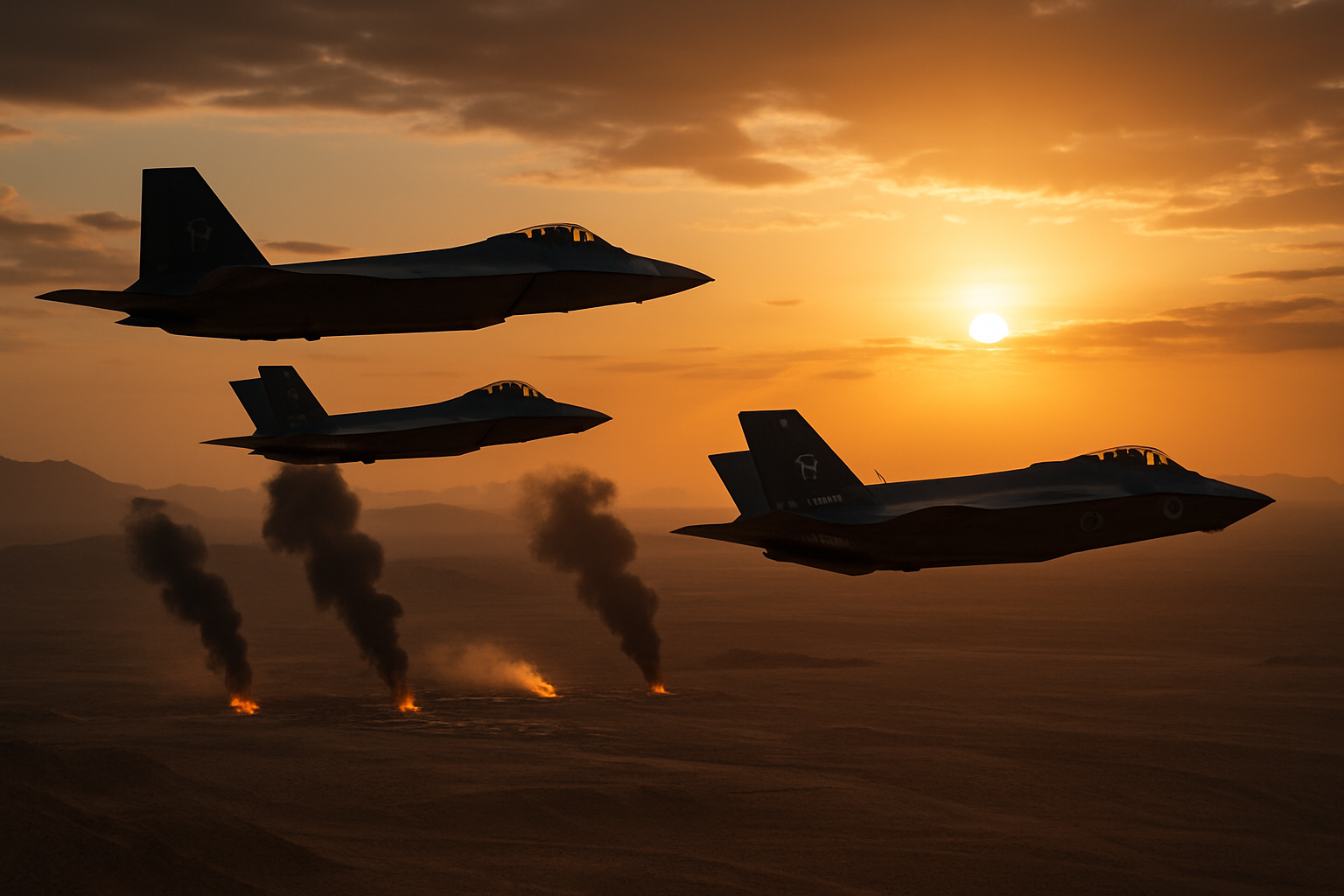
The United States and Israel launched coordinated military strikes against Iran on Saturday in what President Donald Trump announced as "Operation Epic Fury," marking the most significant escalation in Middle East tensions since the 2003 Iraq invasion and triggering immediate Iranian retaliation across the Gulf region.
The massive military operation, conducted after the complete breakdown of nuclear negotiations despite recent diplomatic progress, represents the largest coordinated Western military action in the Middle East in over two decades. Within hours of the initial strikes, Iran launched "first wave" retaliatory attacks against multiple Arab nations and US installations, creating a regional crisis that has disrupted global aviation and energy markets.
Scale and Scope of Military Operations
President Trump announced the operation from his Mar-a-Lago resort, describing it as "major combat operations" aimed at "destroying Iranian missiles and annihilating its navy." The strikes involved unprecedented US military assets, including the dual-carrier deployment of USS Gerald R. Ford and Abraham Lincoln – representing approximately one-third of the active US Navy fleet positioned 800 kilometers from Iran's coast.
Israeli Defense Minister Israel Katz confirmed the coordinated nature of the operation, stating Israel had launched "preemptive strikes to eliminate threats against the State of Israel." Multiple explosions were reported across Tehran, with Iranian state media IRNA confirming "heavy smoke rising over the capital."
"My administration has taken every possible step to minimize the risk to U.S. personnel in the region. Even so, and I do not make this statement lightly, the Iranian regime seeks to kill."
— President Donald Trump, Truth Social statement
The Pentagon had prepared for "weeks-long operations" targeting nuclear facilities, Revolutionary Guard infrastructure, and Iranian naval assets. Intelligence sources confirmed the strikes represented the culmination of months of military planning following Trump's explicit warnings that "bad things will happen" if Iran failed to reach a meaningful nuclear agreement.
Controversial Claims About Iranian Leadership
In a dramatic development, President Trump and Israeli Prime Minister Benjamin Netanyahu both claimed that Iran's Supreme Leader Ayatollah Ali Khamenei was killed in the strikes, with Trump posting on Truth Social that "Khamenei, one of the most evil people in History, is dead."
However, Iranian officials vehemently denied these reports. Foreign Minister Abbas Araghchi stated the Supreme Leader was "still alive as far as I know" while acknowledging that "one or two commanders" had been killed in the attacks. Iranian media called the death claims "psychological warfare."
The conflicting reports highlight the information warfare challenges during active military operations. Iran imposed strict communications control in Tehran, with mobile services disrupted and roads blocked, making independent verification extremely difficult.
Immediate Iranian Retaliation
Iran's response was swift and extensive. The Islamic Revolutionary Guard Corps (IRGC) launched what officials called a "first wave" of missile and drone strikes against multiple targets across the Gulf region.
The casualties and damage from Iranian retaliation were significant:
- UAE: One civilian killed in Abu Dhabi from falling missile debris
- Kuwait: Airport struck by drones, causing employee injuries and site evacuations
- Dubai: Explosions and fire at Fairmont Palm hotel from falling debris
- Qatar: All incoming missiles intercepted by Patriot missile systems
- Bahrain: US Fifth Fleet headquarters targeted but damage unclear
Iranian officials declared that "no red lines remain," with Foreign Minister Araghchi stating that all US and Israeli assets in the region would be considered "legitimate targets." The IRGC claimed over 200 US military casualties across regional bases, though these figures remain unverified.
Global Aviation and Economic Crisis
The military escalation immediately created a global aviation crisis as Iran, Iraq, Israel, UAE, and Qatar closed their airspace to civilian traffic. Flight tracking data showed Iranian and Iraqi airspace completely empty of commercial aircraft.
Major international carriers suspended operations across the Middle East:
- Emirates and Etihad faced operational crisis as UAE airspace closed
- Qatar Airways halted all operations
- Air France-KLM, Bulgaria Air, and Wizz Air suspended Middle East flights until March
- Turkish Airlines cancelled all Tehran flights
The disruption affects hundreds of thousands of passengers worldwide, as the Middle East serves as a critical hub for Europe-Asia connecting flights. Oil prices rose immediately on concerns about the Strait of Hormuz, through which 40% of global oil transit passes.
Collapse of Nuclear Diplomacy
The military strikes followed the dramatic collapse of nuclear negotiations despite recent breakthroughs. Just days before the attacks, Iranian FM Abbas Araghchi had announced "broad agreement on guiding principles" in Geneva talks – described as the most significant progress since the 2018 JCPOA collapse.
However, fundamental disagreements persisted. Iran maintained that ballistic missiles and regional proxies were "red lines" that should be excluded from nuclear-only talks, while US Secretary of State Marco Rubio insisted on a comprehensive agreement including missiles, armed groups, and human rights concerns.
Iran continues enriching uranium at 60% purity – approaching the 90% weapons-grade threshold – with former IAEA inspector Dr. Yusri Abu Shadi confirming that Iran possesses over 400 kilograms of enriched uranium, making weapons development "easily achievable."
Trump's Regime Change Appeal
In an unprecedented diplomatic move, President Trump directly addressed the Iranian people, urging them to "take control of their country" after military operations conclude. This represents the most explicit call for regime change from a US president since the 1979 Iranian Revolution.
"Your moment of freedom has arrived. The great Iranian people deserve better than the corrupt regime that has oppressed them for decades."
— President Trump, addressing Iranian people
This marked a significant evolution in US policy from nuclear-focused negotiations to comprehensive political transformation objectives. Reports emerged of celebrations in some Iranian cities, though these could not be independently verified due to communication restrictions.
Tragic School Attack
One of the most controversial aspects of the strikes was an attack on an elementary school in Minab, southern Iran, which killed between 53 and 108 students and staff according to varying reports. Iranian President Masoud Pezeshkian condemned the attack as a "barbaric crime" and "another black page in the record of countless crimes committed by the aggressors."
There has been no confirmation by the US or Israel of deliberately targeting the school, which was located near a base of Iran's Revolutionary Guard Corps. International human rights organizations have demanded investigations under Geneva Convention protocols regarding the protection of civilian targets.
International Response and UN Emergency Session
The United Nations Security Council convened an emergency session following a request by France, China, Russia, Colombia, and Bahrain. Russia condemned what it called "reckless actions by Washington and West Jerusalem" as a direct violation of international law principles.
Multiple countries issued immediate travel warnings and embassy evacuations:
- Sweden and Serbia ordered immediate citizen evacuations from Iran
- US authorized non-essential embassy staff departure from Israel
- UK, France, Germany, and Poland issued travel warnings for the region
The unprecedented Arab coalition of Saudi Arabia, UAE, Qatar, and Egypt that had supported diplomatic efforts now faces the challenge of responding to attacks on member territories while maintaining regional stability.
Regional Coalition Under Strain
The strikes have severely tested the extraordinary regional consensus that had backed diplomatic efforts. Egypt condemned Iran for targeting "sisterly Arab countries" and warned of "comprehensive chaos" if the conflict expands.
Saudi Arabia called the Iranian retaliation "blatant and cowardly" but confirmed that its defenses had successfully intercepted incoming missiles. The kingdom faces the delicate balance of maintaining its diplomatic position while protecting its territory from Iranian attacks.
Nuclear Governance Crisis Context
The crisis occurs against the backdrop of a broader nuclear governance crisis. The New START treaty between the US and Russia expired on February 5, marking the first time in over 50 years without nuclear constraints between the superpowers. Combined with China's nuclear expansion, the collapse of Iran diplomacy raises serious questions about the viability of diplomatic solutions for modern nuclear crises.
UN Secretary-General António Guterres had warned that nuclear risks were at their "highest in decades" even before the current crisis. The breakdown of the most promising US-Iran diplomatic opening in years creates a dangerous precedent for resolving nuclear disputes through military rather than diplomatic means.
Historical Significance and Implications
Military analysts describe the operation as potentially marking a turning point in Middle East conflict dynamics. The rapid transition from diplomatic framework to military escalation within days demonstrates the fragility of modern crisis management mechanisms in the multipolar era.
The stakes extend far beyond the immediate region. Success in containing the escalation could provide a framework for nuclear crisis resolution, while failure may accelerate military solutions that reshape regional geopolitics for decades to come.
The template-setting nature of this crisis affects global precedents for territorial sovereignty enforcement, international law credibility, and the balance between diplomatic and military approaches to international disputes.
Looking Forward
As the situation continues to evolve, the immediate focus remains on preventing further escalation while managing the humanitarian and economic consequences of the current crisis. The coming days will be crucial in determining whether diplomatic channels can be restored or whether the Middle East faces a prolonged period of military confrontation.
The operation represents the largest military action in the region since the 2003 Iraq invasion and marks a historic inflection point in US-Iran relations that began with the 1979 Iranian Revolution. The full consequences of this dramatic escalation will likely unfold over the coming weeks and months, with implications that extend far beyond the immediate participants to affect global security architecture and international crisis management for years to come.