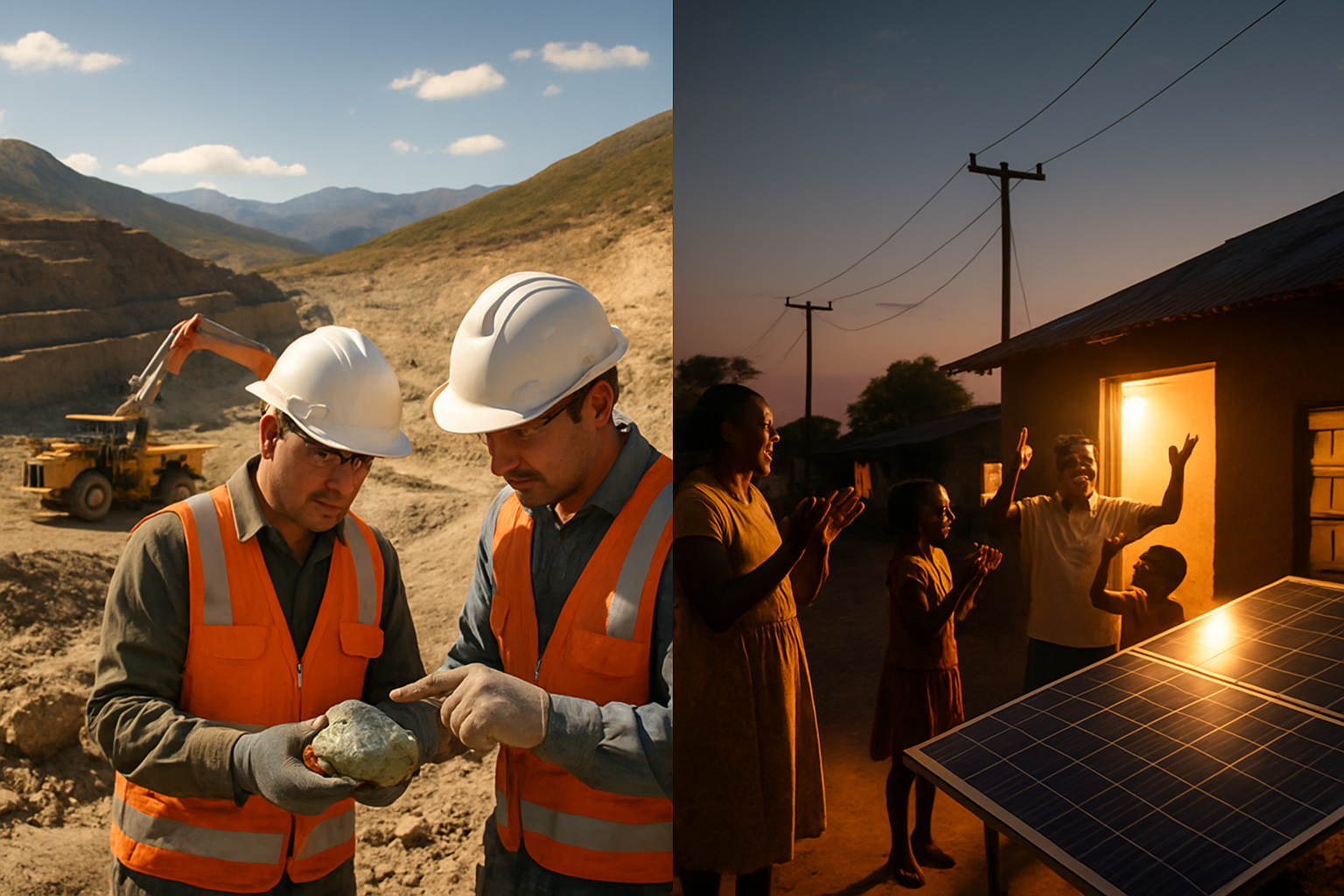
Two transformative energy initiatives are reshaping the global landscape, as the United States commits over $1 billion to secure critical mineral supplies from Latin America while international partners launch the ambitious Mission 300 program to bring electricity to 300 million Africans by 2030.
According to a comprehensive report from White & Case legal firm, the Trump administration has dramatically expanded its financial and diplomatic strategy across South America since January 2025, committing more than $1 billion in investments targeting critical minerals essential for defense, technology, and energy transition. This represents a fundamental shift designed to break American dependence on Chinese supply chains for strategic materials.
Breaking China's Critical Minerals Stranglehold
The investment strategy encompasses loans, equity stakes, and advance purchase contracts designed to channel South American lithium, copper, and rare earth elements into supply chains aligned with US strategic interests. The deployment spans from Goiás state in Brazil to Salta province in Argentina, with renewed focus extending to Santiago, Chile.
This initiative directly challenges China's dominance in critical materials, where Beijing controls approximately 60% of global production and 90% of refining capacity for lithium, cobalt, and rare earth elements essential for renewable energy infrastructure and electric vehicles. The US-EU-Japan Critical Minerals Partnership, now encompassing 55 countries, represents the most comprehensive Western response to Chinese supply chain control.
"The change represents more than just energy considerations," notes the White & Case analysis. The strategy aims to establish alternative supply networks that reduce Western vulnerability to Chinese market manipulation and geopolitical pressure.
Strategic Minerals Across Latin America
The $1 billion commitment builds on successful bilateral agreements already established with Argentina, which has become a major lithium partner with record $6 billion in mining exports during 2025. The investments target key mineral deposits across multiple countries, from Brazilian graphite operations to Chilean copper mines and Argentine lithium salt flats.
These developments occur within the broader context of the February 2026 Critical Minerals Ministerial in Washington D.C., where Secretary of State Marco Rubio hosted invitation-only summit building on the trilateral US-EU-Japan alliance. The initiative has attracted participation from seven African countries as alternative suppliers: Angola, Democratic Republic of the Congo, Guinea, Kenya, Morocco, Sierra Leone, and Zambia.
Africa's Historic Electrification Campaign
Meanwhile, across the Atlantic, The Rockefeller Foundation is spearheading one of Africa's most ambitious energy initiatives through Mission 300. Cassady Walters, Vice President for Power at the foundation, explains how strategic "seed capital" and strengthened institutional frameworks are transforming political commitments into implementable energy projects.
Ethiopia's Energy Compact alone carries a price tag exceeding $9 billion, while a $10 million investment in the country's Compact Delivery and Monitoring Unit (CDMU) serves as crucial "seed capital" to unlock these massive financial requirements. The approach demonstrates how relatively modest upfront investments can catalyze much larger infrastructure developments.
"The USD10 million acts strategically as seed capital," Walters explains, describing how these units bridge the critical gap between financing availability, policy implementation, and actual project delivery. The initiative aims to bring electricity access to 300 million people across Africa by 2030, addressing one of the continent's most pressing development challenges.
Technological Innovation and Infrastructure
Both initiatives emphasize cutting-edge technological integration. The Latin American mineral operations incorporate digital monitoring, smart logistics, and advanced waste management systems that represent evolution from traditional extractive models toward comprehensive development benefiting local communities.
Similarly, Mission 300 focuses on innovative solutions including solar-powered micro-grids that can leapfrog traditional electricity infrastructure. These projects emphasize community ownership and local capacity building, ensuring sustainable development rather than dependency relationships.

Geopolitical Implications and Challenges
The timing of these parallel initiatives reflects broader geopolitical competition over energy resources and infrastructure. As China announced zero-tariff access for 53 African countries beginning May 1, 2026, Western partners are responding with alternative frameworks emphasizing governance standards and environmental compliance.
The US strategy faces implementation challenges requiring billions in additional investment and years of infrastructure development to establish alternative supply chains. Environmental concerns about expanded Western mining operations must be balanced against strategic necessity, while competition with established Chinese relationships and cost advantages remains formidable.
Success depends on sustained political commitment across electoral cycles, continued cooperation between international partners, and effective community engagement in both Latin America and Africa.
Economic Multiplier Effects
Both initiatives promise significant economic multiplier effects extending far beyond their immediate sectoral impacts. The Latin American mineral investments are expected to create thousands of specialized jobs across mining, processing, and logistics sectors while generating substantial export revenues for participating countries.
Mission 300's electricity access expansion could unlock economic development across multiple sectors, from agricultural processing to small-scale manufacturing, while improving healthcare delivery and educational opportunities in previously unconnected communities.
The African Finance Corporation reports that the continent holds $29.5 trillion in mineral reserves representing 20% of the global total, with $8.6 trillion remaining untapped. This suggests enormous potential for coordinated development initiatives that combine infrastructure investment with resource development.
Climate Change Context
These developments occur during a period of unprecedented climate urgency, with January 2026 marking the 18th consecutive month of temperatures exceeding 1.5°C above pre-industrial levels. This sustained warming pattern demonstrates that human-induced climate change is overriding natural variability, creating immediate pressure for rapid clean energy deployment.
Both the US critical minerals strategy and Africa's electrification drive directly address climate adaptation and mitigation needs. Secure supplies of lithium, cobalt, and rare earth elements are essential for manufacturing renewable energy systems and electric vehicles, while expanded electricity access enables economic development patterns that can leapfrog carbon-intensive infrastructure.
Implementation Pathways Forward
The success of these parallel initiatives will largely determine global energy security and climate action capacity over the coming decade. Key factors include maintaining international cooperation despite shifting political landscapes, ensuring environmental and social governance standards, and building local institutional capacity.
For Latin American mineral development, this means establishing transparent governance frameworks that ensure community benefits while maintaining investment attractiveness. African electrification success requires sustained financing commitments and technical capacity building that creates self-reinforcing development cycles.
"Despite our challenges, Africa stands on the threshold of true integration. Our success hinges on our collective will to align national reforms with continental goals."
— Emmanuel Armah-Kofi Buah, Ghana Mining Minister
The convergence of US strategic mineral investments and African electrification initiatives represents a crucial test of whether democratic governance and market-based approaches can effectively compete with authoritarian development models while delivering tangible improvements to local communities. Success could establish templates for sustainable development that balance strategic competition with human development needs during humanity's most critical decade for climate action.
As both initiatives advance through 2026, their implementation will provide essential insights into effective approaches for energy security, development cooperation, and climate adaptation in an increasingly multipolar world. The stakes extend far beyond immediate energy considerations to encompass fundamental questions about governance, development, and international cooperation in the 21st century.