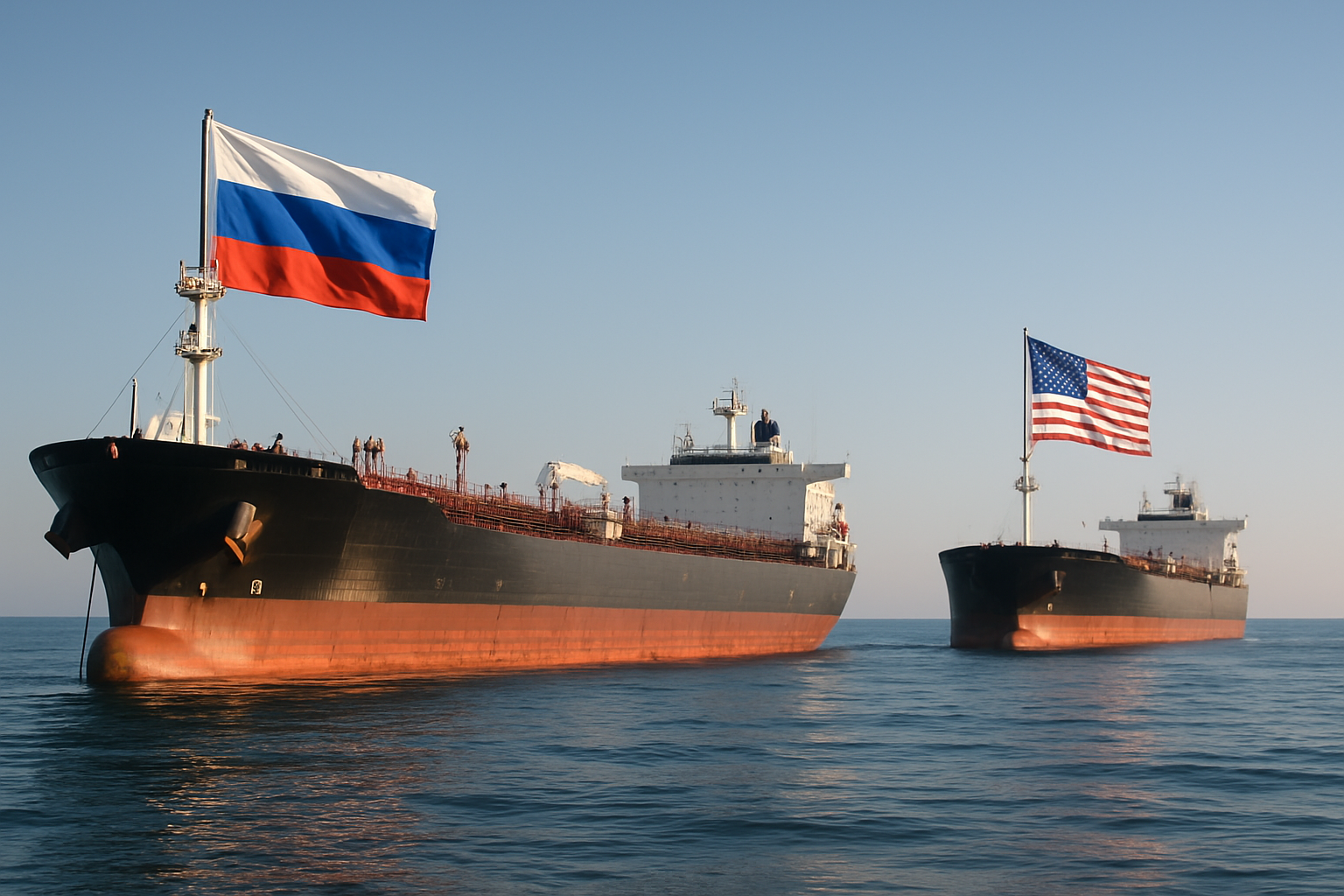
The United States Treasury Department has authorized a temporary 30-day waiver allowing countries to purchase Russian oil already loaded on vessels, marking a significant policy reversal as global energy markets face the most severe crisis in decades.
The license, effective until April 11, permits transactions with Russian fuel that was loaded onto ships before March 12, according to Russian state media TASS. This represents the first easing of Russian energy sanctions since the Ukraine conflict began, highlighting the dire state of global energy supplies.
Global Energy Crisis Forces Policy Reversal
The decision comes as oil prices have surged past $100 per barrel for the first time since 2022, with Brent crude reaching a peak of $119.50 and West Texas Intermediate jumping a record 18.98% to $108.15. The crisis has been triggered by Iran's Revolutionary Guard closure of the Strait of Hormuz, which handles 40% of global seaborne oil transit.
According to multiple international sources, Energy Secretary Christopher Wright has been considering lifting additional Russian oil sanctions to help ease the global supply shortage. Italian media reports suggest the Treasury Secretary described this as a measure for a "brief and limited period."
The International Energy Agency has announced the largest strategic petroleum reserve release in its 50-year history, with 400 million barrels from 32 member countries being deployed to stabilize markets. Japan alone is releasing 80 million barrels starting March 16, the first such deployment since the 2011 Fukushima disaster.
Middle East Conflict Disrupts Global Supply Chain
The immediate catalyst for the sanctions relief appears to be the ongoing Iran crisis, which has created unprecedented disruptions to global energy infrastructure. The conflict has resulted in:
- Over 18,000 flights cancelled worldwide – the most extensive aviation disruption since COVID-19
- Eight Middle Eastern countries simultaneously closing their airspace
- Dubai International Airport, the world's busiest, shut down from missile damage
- 150+ oil and LNG tankers stranded in the Persian Gulf worth billions in cargo
- Major shipping companies Maersk and MSC suspending all Persian Gulf operations
Natural gas prices have exploded by 24% in Europe and 78% in the US, reaching €47.32/MWh – the highest levels since February 2025. Qatar has halted LNG production at its Ras Laffan and Mesaid facilities, which account for approximately 20% of global LNG exports.
Strategic Reserves Deployment Insufficient
Despite the historic IEA reserve release, energy analysts warn that strategic petroleum reserves can only provide temporary relief. Qatar Energy Minister Saad Al Kaabi has warned that Gulf states may be forced to declare force majeure "within weeks" if the situation continues, with oil potentially approaching $150 per barrel that could "bring down economies of the world."
The crisis has exposed the dangerous over-dependence on strategic chokepoints for global energy security. The 21-mile-wide Strait of Hormuz represents a single-point failure for modern logistics, with no realistic alternatives for the massive volumes of oil and gas that transit through the waterway daily.
Global Economic Impact
Financial markets worldwide have crashed in response to the energy crisis. Pakistan's KSE-100 index fell 8.97% in its largest single-day decline in history, while South Korea's KOSPI dropped 12%, triggering circuit breakers. The Korean won has fallen to a 17-year low as foreign capital flees.
Consumer impacts are being felt globally:
- Sweden: Electricity prices up 10-20 öre, gasoline increased by 1-2 kronor
- Ireland: Heating oil approaching €2/liter, described as "brazen rip-offs"
- Bangladesh: Fuel rationing for 170 million people
- Bosnia-Herzegovina: Reduced to just 2 days of gas reserves
- Pakistan: Fuel prices at Rs321.17/liter, the highest in South Asia
Nuclear Diplomacy Breakdown
The energy crisis stems from the complete breakdown of US-Iran nuclear negotiations, despite achieving what was described as "broad agreement on guiding principles" during Geneva talks – the most progress since the 2018 JCPOA collapse.
The fundamental disagreement remained unchanged: Iran excluded ballistic missiles and regional proxies as "red lines," demanding nuclear-only talks, while the US insisted on comprehensive agreements including missiles, armed groups, and human rights issues.
This diplomatic failure led to Operation Epic Fury, the largest US-Israeli coordinated military campaign since the 2003 Iraq invasion, using dual-carrier deployment with the USS Gerald R. Ford and USS Abraham Lincoln.
Template-Setting Crisis for 21st Century
Energy security experts describe this as the most dangerous international crisis since the Cold War's end. Samuel Ciszuk noted this is "the most severe energy security crisis in decades, exposing single-chokepoint vulnerabilities." Damien Boey warned that "the situation is going on longer than people initially thought, with financial markets becoming the ultimate constraint on prolonged conflict."
The crisis occurs against the backdrop of broader nuclear governance breakdown, with New START expiring on February 5 – marking the first time in over 50 years without US-Russia nuclear constraints. UN Secretary-General António Guterres has warned that nuclear risks are at their "highest in decades."
Long-Term Implications for Energy Architecture
The temporary lifting of Russian oil sanctions represents more than crisis management – it signals the need for fundamental energy architecture transformation. The crisis has highlighted the urgent need to reduce dependence on volatile geopolitical regions and strategic chokepoints.
Recovery timeline remains uncertain, as it depends on military operations resolution and diplomatic normalization rather than predictable weather disruptions. Traditional monetary policy has limited effectiveness against structural geopolitical disruptions of this magnitude.
This represents a template-setting moment for 21st-century crisis management, testing multilateral cooperation in an increasingly multipolar world. Success in containing the crisis could provide a framework for future nuclear dispute resolution, while failure may accelerate military solutions and reshape international approaches to conflict resolution for decades.
Looking Ahead
The 30-day Russian oil license provides only temporary relief while highlighting the interconnected nature of global energy security. With hundreds of millions of barrels of sanctioned Russian oil potentially available for market stabilization, policymakers face difficult choices between energy security and geopolitical objectives.
As the crisis continues, it serves as a stark reminder of the vulnerabilities in modern energy systems and the urgent need for supply chain diversification and renewable energy transitions – transformations that require years or decades but whose urgency has been dramatically accelerated by current events.