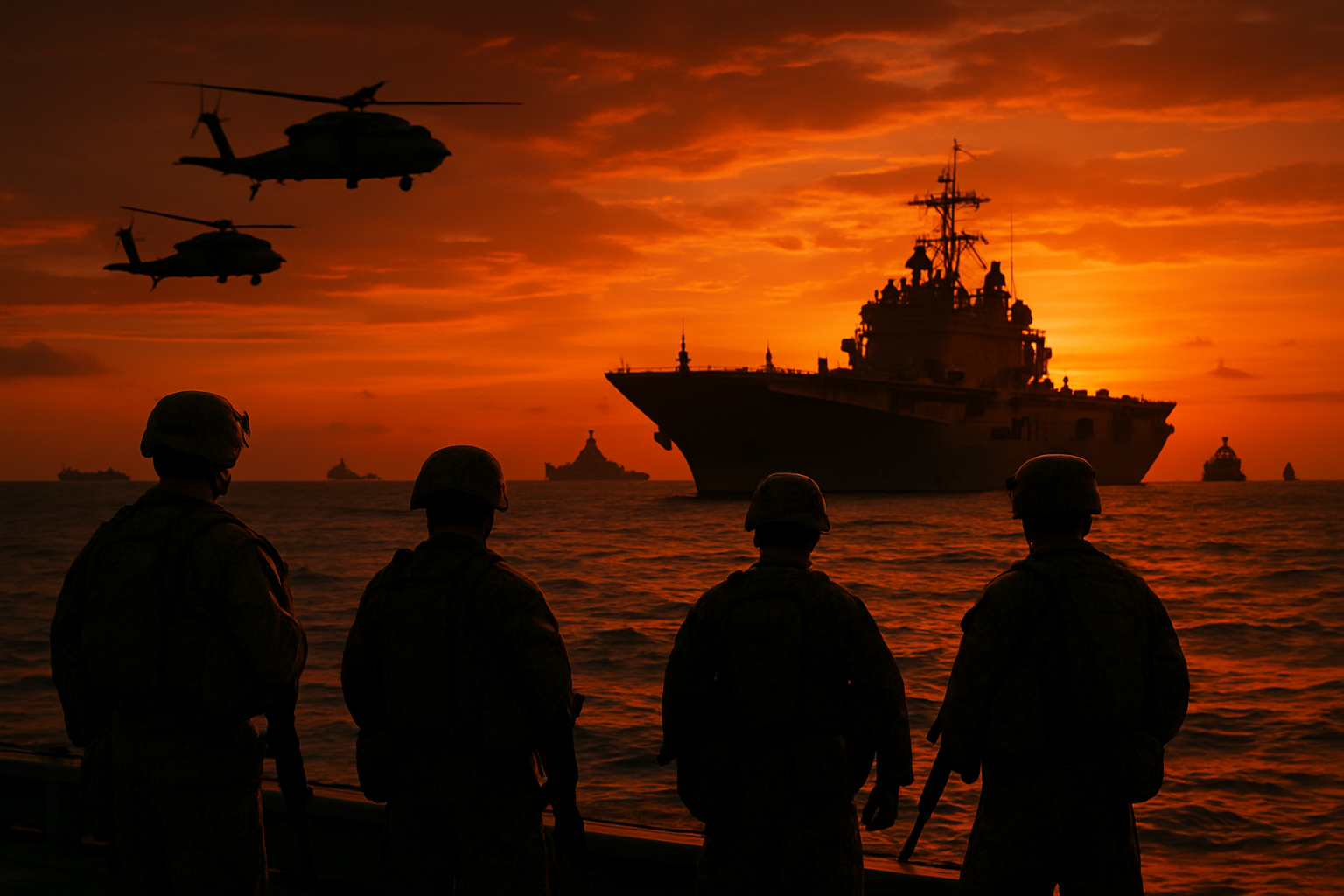
The United States is deploying thousands of Marines and amphibious assault ships to the Middle East as President Trump weighs ground operations against Iran, marking the most dangerous international crisis since the Cold War ended, according to multiple sources familiar with Pentagon planning.
The massive military buildup comes as the Iran crisis enters its third week, with Trump demanding Iran's "unconditional surrender" while considering unprecedented naval coalitions to secure the Strait of Hormuz, which carries 40% of global oil transit. Swedish reports indicate Trump is actively preparing for ground operations, with thousands of new Marine Corps soldiers heading toward Iran.
Operation Epic Fury Escalates to Historic Scale
The Pentagon's "Operation Epic Fury" has already cost $11.3 billion in its first week alone, making it one of the most expensive military operations in recent history. The campaign, which began March 1 with the confirmed death of Iranian Supreme Leader Ali Khamenei, now involves dual-carrier deployments of the USS Gerald Ford and USS Abraham Lincoln – representing approximately one-third of the entire US Navy fleet.
Sources indicate the Pentagon is preparing operations through September 2026, far beyond the initial 4-6 week timeline suggested by the White House. First US casualties have been confirmed: 3 service members killed and 150 wounded, with 8 in critical condition.
"The political stakes for the US president have risen in recent days as the war's costs – on the ground and in Washington – add up."
— New Zealand Defence Analysis
Global Crisis Reaches COVID-Scale Disruption
The conflict has triggered the worst global aviation crisis since COVID-19, with over 18,000 flights cancelled worldwide. Eight Middle Eastern countries have simultaneously closed their airspace, creating an "aviation black hole" that has severed critical Asia-Europe flight corridors.
Dubai International Airport, the world's busiest with 86 million annual passengers, remains completely shut down from missile damage. Major carriers including Emirates, Air France-KLM, and Wizz Air have suspended operations indefinitely, affecting hundreds of thousands of passengers globally.
Oil prices have surged past $100 per barrel for the first time since 2014, with warnings they could reach $200 as Iran has effectively closed the Strait of Hormuz through naval mining operations. The country has deployed an estimated 2,000-6,000 mines across the critical waterway, stranding over 150 oil tankers worth billions in cargo.
Energy Crisis Threatens Global Economy
The International Energy Agency has announced its largest strategic petroleum reserve release in its 50-year history – 400 million barrels from 32 countries – in an unprecedented intervention to stabilize markets. Natural gas prices have exploded 24% in Europe and 78% in the United States, while Qatar has halted LNG production representing 20% of global exports.
Major shipping companies Maersk and MSC have suspended all Persian Gulf operations, exposing the dangerous over-dependence of global supply chains on this single strategic chokepoint.
Revolutionary Guards Consolidate Power
Following Ali Khamenei's death on March 1, Iran has undergone its first hereditary succession in the Islamic Republic's 47-year history. Mojtaba Khamenei, the former leader's son, has been appointed as the new Supreme Leader, marking a fundamental shift from clerical to military governance.
CIA assessments suggest the Revolutionary Guards now hold unprecedented control over the Iranian state apparatus. Defense Secretary Pete Hegseth claims the new leader is "wounded and likely disfigured" from ongoing US-Israeli strikes, though this remains unconfirmed.
Iran's response has been systematic and devastating. Under "Operation True Promise 4," the Islamic Revolutionary Guard Corps has declared "no red lines remain," launching coordinated attacks across the region that have caused civilian casualties in multiple countries.
European Territory Attacked for First Time Since WWII
In a historic escalation, Iranian drones struck RAF Akrotiri in Cyprus – the first attack on European territory since World War II. This unprecedented breach of European security has prompted the largest naval coalition in the Eastern Mediterranean since 1974, with HMS Dragon leading Spanish, Italian, French, Dutch, and Greek vessels in an emergency response.
The European Union activated its ESTIA evacuation plan for the first time in the bloc's history, demonstrating how the Middle East conflict has expanded far beyond regional boundaries.
Nuclear Diplomacy Collapses Despite Breakthrough
The current military escalation represents a complete breakdown of nuclear diplomacy that had shown unprecedented promise just weeks earlier. In February, Geneva talks achieved what Iranian Foreign Minister Abbas Araghchi called "broad agreement on guiding principles" – the most significant progress since the JCPOA collapsed in 2018.
However, fundamental scope disagreements proved insurmountable. Iran maintained that ballistic missiles and regional proxies were "red lines" that could not be included in nuclear-only talks, while US Secretary of State Marco Rubio insisted on comprehensive agreements covering missiles, armed groups, and human rights.
Iran continues uranium enrichment at 60% purity – approaching the 90% weapons-grade threshold – with over 400 kilograms of material sufficient for multiple weapons if weaponized. The collapse occurred amid a broader nuclear governance crisis, as the New START treaty between the US and Russia expired in February, marking the first time in over 50 years without nuclear constraints between the superpowers.
Congressional Opposition Mounting
Bipartisan lawmakers are demanding comprehensive answers about strategy, costs, and the potential deployment of ground troops. Senator Richard Blumenthal has expressed being "more concerned than ever" about boots on the ground, while the conflict faces historically low public support at just 25% approval among Americans.
The Pentagon has quietly prepared operations extending through September, far beyond Trump's initial timeline, raising questions about the administration's exit strategy and long-term objectives in the region.
"Mi fido più di Putin... ma declina l'offerta russa: Teheran in cambio di Kiev."
— Italian Media on Trump's Regional Strategy
Regional Coalition Under Severe Strain
An unprecedented coalition of Saudi Arabia, UAE, Qatar, and Egypt that had supported diplomatic solutions is now severely strained as Iranian retaliation has directly targeted their territories. Egyptian President Abdel Fattah el-Sisi condemned attacks on "sisterly countries" while warning of "comprehensive chaos" spreading across the region.
The UAE has reported one civilian killed in Abu Dhabi, Kuwait has suffered 32 injuries from airport strikes, and Qatar intercepted 65 missiles and 12 drones, resulting in 8 wounded despite successful Patriot missile defenses. Saudi Arabia has intercepted 21 drones and 7 missiles targeting Riyadh and eastern regions.
Humanitarian Crisis and War Crimes Allegations
The Iran Red Crescent reports over 787 civilian casualties from US-Israeli strikes, including a horrific Pentagon-confirmed attack on a Minab elementary school that killed 165-185 students using "outdated targeting data." The strike has prompted calls for Geneva Conventions investigations and demands from 46 US Senate Democrats for a swift inquiry, which Trump has denied knowledge of.
International evacuations have reached the largest scale since the Arab Spring of 2011, with Australia reporting 115,000 citizens trapped and Germany evacuating 30,000 tourists from the region.
Template-Setting Crisis for 21st Century
UN Secretary-General António Guterres has called the crisis the "greatest test of multilateral cooperation and crisis management in the modern era." The rapid transition from diplomatic breakthrough to military confrontation demonstrates the fragility of crisis management in the multipolar era.
The stakes include regional war prevention, global energy security, nuclear governance credibility, and the enforcement of international law and post-WWII order principles – all being tested simultaneously in what experts describe as the most consequential international crisis since the Cold War ended.
Success in containing the conflict could provide a framework for nuclear crisis resolution in the 21st century. Failure may accelerate military solutions over diplomatic ones for decades, encouraging nuclear proliferation globally and undermining diplomatic credibility worldwide.
As Marine deployments continue and ground operations loom, the coming days will be critical in determining whether this crisis represents a turning point toward a more militarized approach to international disputes or whether diplomatic solutions can still prevail in an increasingly dangerous world.