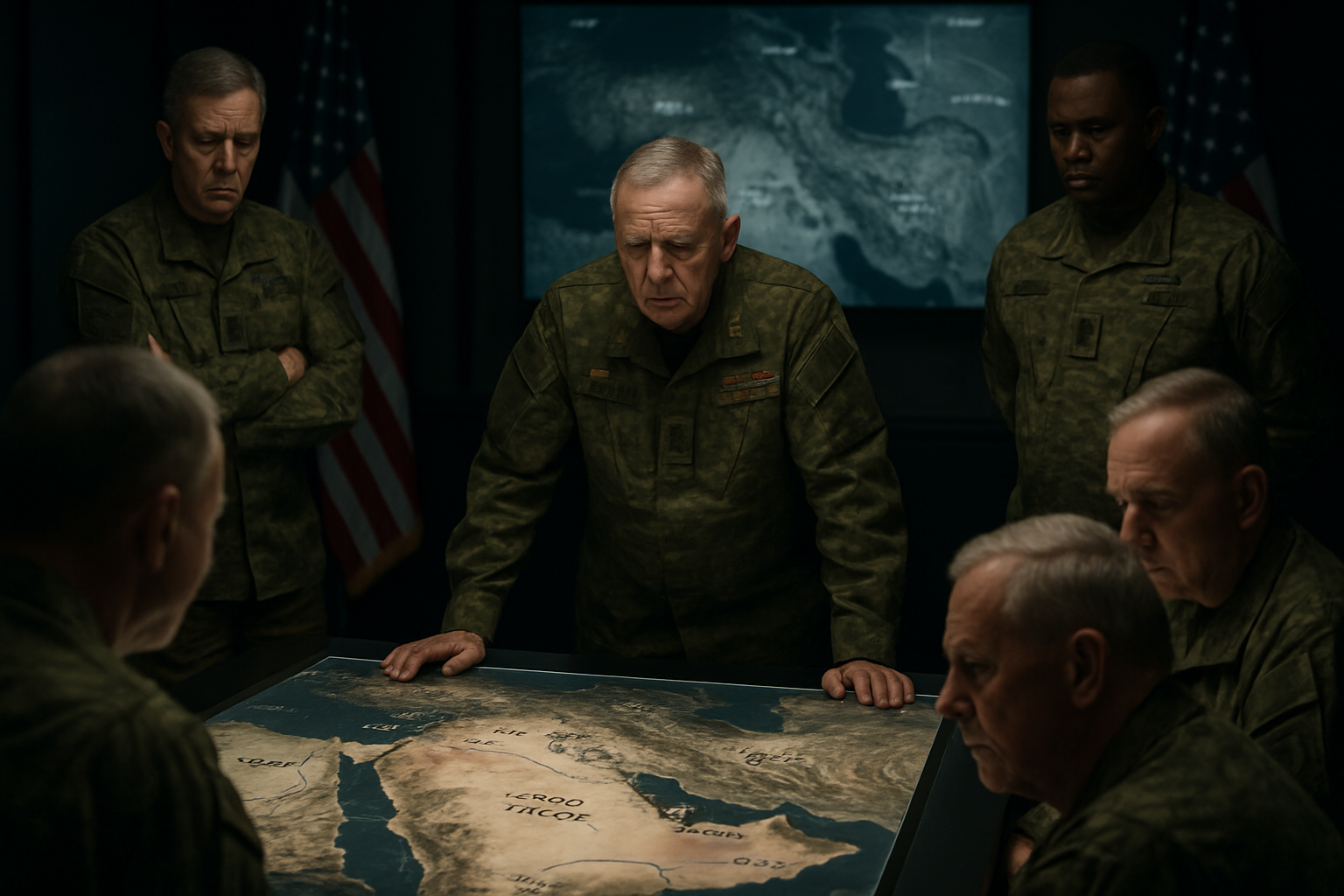
The United States military confirmed its first casualties in the ongoing Iran crisis, with three American service members killed and five seriously wounded during Operation Epic Fury, marking a deadly new chapter in the largest coordinated US-Israeli military campaign against Iran since 2003.
US Central Command announced the fatalities at 9:30 AM EST on March 1, 2026, stating that "three U.S. service members have been killed and another five have been seriously wounded" during combat operations that have plunged the Middle East into its most dangerous conflict in decades.
"Several others sustained minor shrapnel injuries and concussions – and are in the process of being returned to duty. Major combat operations continue and our response effort is ongoing," CENTCOM said in a statement, declining to provide specific details about how the casualties occurred.
Operation Epic Fury: Unprecedented Scale
The casualties occurred during the second day of Operation Epic Fury, the largest US-Israeli coordinated military campaign against Iran since the 2003 Iraq invasion. The operation has deployed an unprecedented dual-carrier strike force – the USS Gerald R. Ford and USS Abraham Lincoln – representing approximately one-third of the active US Navy fleet positioned 800 kilometers from Iran's coast.
Pentagon sources confirmed that confirmed Iranian leadership casualties include Defense Minister Aziz Nasirzadeh, Islamic Revolutionary Guard Corps (IRGC) Chief Mohammad Pakpour, and senior aide Ali Shamkhani, along with more than 40 high-ranking Iranian officials.
The operation followed the complete breakdown of nuclear negotiations despite recent diplomatic breakthroughs in Geneva that had achieved what Iranian Foreign Minister Abbas Araghchi described as "broad agreement on guiding principles" – the most significant progress since the Joint Comprehensive Plan of Action (JCPOA) collapsed in 2018.
"This represents the first American casualties in what has become the most significant Middle East military engagement in over two decades."
— Senior Pentagon Official
Iranian Supreme Leader Status Disputed
Multiple Israeli sources have claimed that Iran's Supreme Leader Ayatollah Ali Khamenei was killed during the strikes, though Iranian Foreign Minister Abbas Araghchi has categorically denied these reports, calling them "psychological warfare" and stating that Khamenei is "still alive as far as I know."
What has been confirmed is the deaths of several members of Khamenei's immediate family during the compound strikes, including his daughter, son-in-law, and granddaughter, according to Fars News Agency and sources close to the Supreme Leader's office.
President Trump announced Khamenei's death hours before any Iranian confirmation via Truth Social, calling the Iranian leader "one of the most evil people in History" and describing the situation as the "single greatest chance for Iranian people to take back their Country."
Massive Iranian Retaliation Campaign
Iran responded to the US-Israeli strikes with what it calls "Operation True Promise 4," launching coordinated missile and drone attacks across the Gulf region. The IRGC declared that "no red lines remain" and that all US and Israeli assets in the region are now "legitimate targets."
The Iranian retaliation has caused casualties across multiple countries:
- UAE: One civilian killed in Abu Dhabi from missile debris
- Kuwait: International Airport struck by drones, causing employee injuries
- Qatar: Successfully intercepted 65 missiles and 12 drones using Patriot systems, with 8 people injured by fragments
- Bahrain: US Fifth Fleet headquarters targeted
- Israel: Residential strike in Beit Shemesh killed 9 civilians and wounded 28 others
Dubai International Airport, the world's busiest, has been completely shut down after sustaining missile damage, affecting hundreds of thousands of passengers globally.
Nuclear Diplomacy Collapse
The military escalation represents the complete breakdown of intensive nuclear negotiations that had shown unprecedented promise. Despite achieving what Araghchi called "broad agreement on guiding principles" during Geneva talks mediated by Switzerland and Oman, fundamental disagreements over scope proved insurmountable.
Iran maintained that ballistic missiles and regional proxy forces were "red lines" that should be excluded from nuclear-only talks, while US Secretary of State Marco Rubio insisted on a comprehensive agreement that would include missiles, armed groups, and human rights issues.
Dr. Yusri Abu Shadi, a former IAEA inspector, confirmed that Iran has been enriching uranium to 60% purity with over 400 kilograms of material, making nuclear weapons capability "easily achievable" if Iran chooses to weaponize its program.
Global Aviation Crisis
The conflict has triggered an unprecedented global aviation crisis, with Iran, Iraq, Israel, UAE, Qatar, Syria, Kuwait, and Bahrain simultaneously closing their airspace to civilian traffic. Over 18,000 flights have been cancelled worldwide, representing the most extensive aviation disruption since the COVID-19 pandemic.
Major airlines including Emirates, Air France-KLM, Wizz Air, and Bulgaria Air have suspended all Middle East operations, stranding hundreds of thousands of passengers globally and severely disrupting the critical Europe-Asia transit hub.
Regional Coalition Under Strain
The crisis has severely strained an unprecedented regional coalition that had emerged to support diplomatic solutions. Saudi Arabia, UAE, Qatar, and Egypt had formed an extraordinary consensus backing the nuclear negotiation process, but this unity is now being tested as Iranian retaliation has directly targeted coalition member territories.
Egyptian President Abdel Fattah el-Sisi condemned attacks on "sisterly Arab countries" and warned of "comprehensive chaos," while multiple countries have ordered embassy evacuations and issued urgent travel warnings for the region.
Energy Security Implications
Oil prices have surged as the conflict threatens the Strait of Hormuz, through which 40% of the world's oil transits. Iran has warned that shipping through the strategic chokepoint will "not be allowed," creating immediate concerns about global energy security.
Natural gas prices have jumped 24% in Europe and 78% in the United States, with analysts warning that a broader regional war could disrupt worldwide supply chains far beyond the Middle East.
Nuclear Governance Crisis Context
The Iran crisis is unfolding against the backdrop of a broader nuclear governance breakdown. The New START Treaty between the US and Russia expired on February 5, marking the first time in over 50 years that the two nuclear superpowers have operated without arms control constraints. Combined with China's nuclear expansion, UN Secretary-General António Guterres has warned that nuclear risks are at their "highest in decades."
This makes the Iran situation a critical test case for 21st-century nuclear crisis resolution, with implications extending far beyond the current conflict.
International Response
The UN Security Council has convened an emergency session at the request of France, China, Russia, Colombia, and Bahrain. Secretary-General Guterres declared the military actions a "serious threat to international peace and security," warning they could "trigger a chain of events no one can control in the world's most unstable region."
Russia has condemned what Foreign Minister Sergey Lavrov called "reckless actions by Washington and West Jerusalem" as direct violations of international law, while China described the operations as a "serious violation of Iran's sovereignty and security."
Historical Significance and Stakes
March 1, 2026, represents what many analysts are calling the most dangerous moment since the end of the Cold War. The rapid transition from diplomatic breakthrough to military escalation demonstrates the fragility of modern crisis management in the multipolar era.
The stakes extend far beyond the immediate conflict: regional war prevention, global energy security, nuclear governance credibility, and international law enforcement mechanisms are all being tested simultaneously.
Success in containing the escalation could provide a template for diplomatic solutions to future nuclear crises. Failure may accelerate the preference for military solutions in international disputes, potentially reshaping Middle Eastern geopolitics for decades and encouraging nuclear proliferation elsewhere while undermining diplomatic credibility worldwide.
As Major General Sarah Chen, a former Pentagon strategist, observed: "These first American casualties mark not just a tactical development, but a strategic inflection point that will influence how the international community approaches nuclear crises for years to come."
The coming hours and days will prove decisive in determining whether this represents the beginning of a broader Middle Eastern war with global implications, or whether diplomatic channels can still prevent further escalation in what has become the most serious international crisis of the modern era.