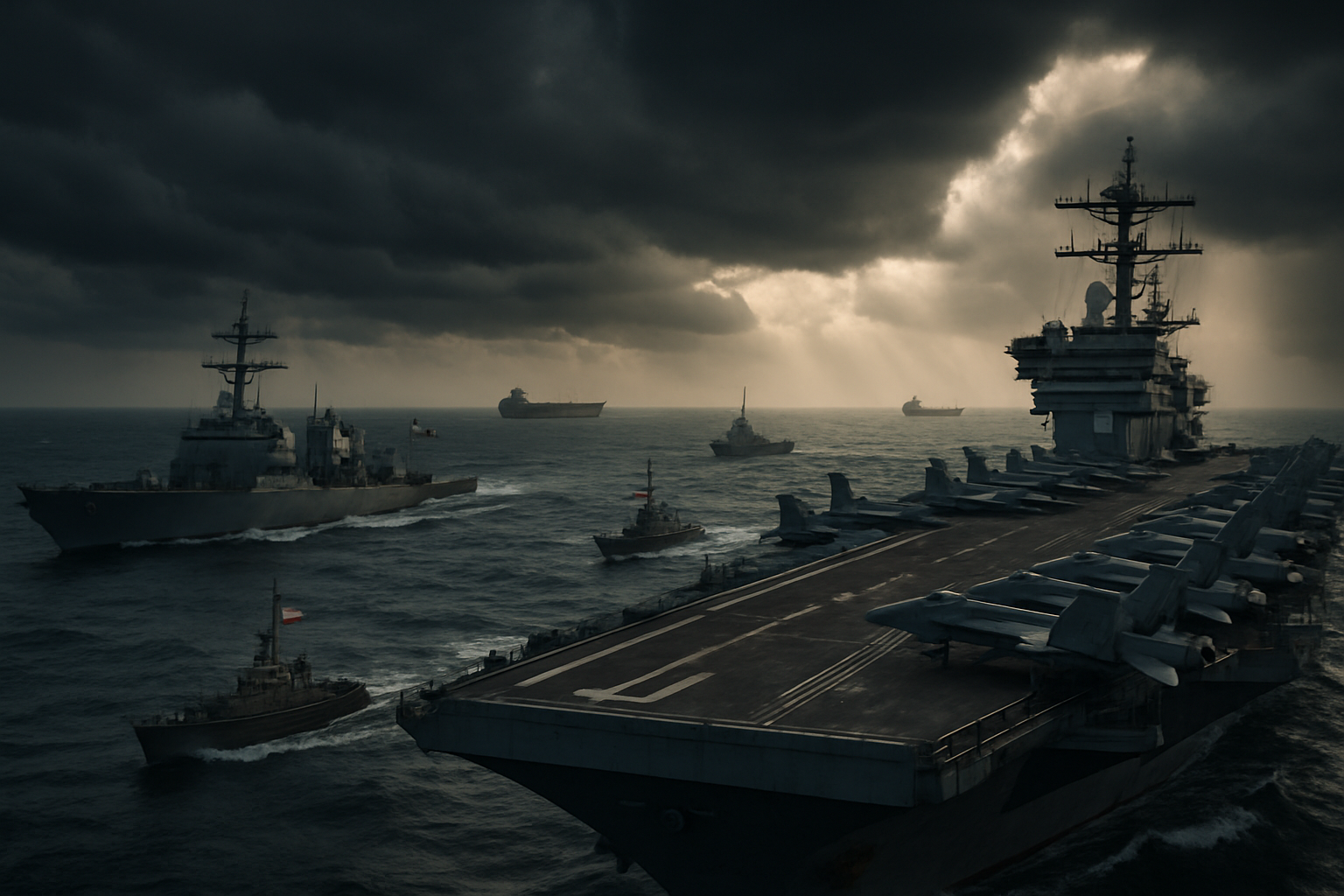
American military personnel in the Middle East are facing severe supply shortages and deteriorating conditions after nearly seven weeks of Operation Epic Fury, the largest US military engagement since the 2003 Iraq invasion, as Defense Secretary Pete Hegseth maintains that naval blockade operations against Iran will continue "as long as it takes."
Exclusive photographs obtained by USA Today reveal shocking conditions aboard US nuclear aircraft carriers and military installations, showing American soldiers struggling with basic necessities including food, toiletries, and clean clothing. Families have attempted to send care packages containing American snacks, recreational activities, toothpaste, and clean clothes, but these have failed to reach troops due to the ongoing blockade operations.
Blockade Operations Continue Despite International Pressure
Speaking at a Pentagon briefing Thursday, Hegseth delivered a stark ultimatum to Iran: "If Iran chooses poorly, then they will have a blockade and bombs dropping on infrastructure, power and energy." The Defense Secretary confirmed that US forces began blockading Iranian ports at 1400 GMT Monday following the collapse of Pakistan-mediated peace talks after 21 hours of marathon negotiations.
General Dan Caine, the top US military officer, stated that the blockade "applies to all ships, regardless of nationality, heading into or from Iranian ports," warning that "if you do not comply with this blockade, we will use force." He noted that "so far, 13 ships have made the wise choice of turning around."
The naval blockade, generally considered an act of war under international law, has effectively closed the Strait of Hormuz, a critical waterway through which 40% of global oil transit passes. Iran's Revolutionary Guard has responded by declaring "complete control" of the strait and threatening a "deadly whirlpool" for any vessels challenging Iranian sovereignty.
Troops Face Critical Supply Shortages
Norwegian media reports indicate that American soldiers in the Middle East have not received mail for over a month, highlighting the broader logistical challenges facing US forces. The supply shortages come as Operation Epic Fury has cost an estimated $27 billion in its first month alone, running at approximately $1 billion daily.
"The human cost of this conflict extends beyond battle casualties to the basic welfare of our service members who are operating under extremely challenging conditions."
— Military families advocacy source
The Pentagon has deployed dual-carrier battle groups USS Gerald Ford and USS Abraham Lincoln, representing approximately one-third of the US Navy's active fleet, along with thousands of Marines from the 82nd Airborne Division. Current US troop levels in the region are estimated at over 17,000 personnel, the largest Middle Eastern deployment since the Iraq invasion.
Economic and Diplomatic Consequences
The blockade has triggered a global economic crisis, with oil prices surging past $100 per barrel and threatening to reach $200. The International Energy Agency has released a record 400 million barrels from strategic reserves—the largest intervention in the agency's 50-year history. Over 150 tankers remain stranded in the Persian Gulf with billions of dollars in cargo.
Major international allies have resisted US calls for naval support. UK Prime Minister Keir Starmer declared Britain "will not be dragged into Iran war," while France and Germany have distanced themselves from Trump's military approach. Spain has gone further, closing its airspace to US military aircraft involved in Iran operations.
Congressional Opposition Mounts
Domestic political pressure continues to build against the extended military campaign. Only 25% of Americans support the Iran operations, representing historically low approval for military action. Senator Richard Blumenthal expressed being "more concerned than ever" about potential ground troop deployment, while lawmakers demand comprehensive briefings on strategy, costs, and exit plans.
The Pentagon has prepared operations extending through September 2026, far beyond the initial 4-6 week timeline projected by the Trump administration. This prolonged engagement has raised questions about the military's capacity to sustain such extensive operations while maintaining global commitments.
Iranian Response and Regional Impact
Iran has categorically rejected all diplomatic overtures, with Foreign Minister Abbas Araghchi stating that Iran "will never abandon enrichment even if war is imposed." The country's new Supreme Leader, Mojtaba Khamenei—the first hereditary succession in the Islamic Republic's 47-year history—has consolidated Revolutionary Guard control over governance during the crisis.
Regional allies including Saudi Arabia, UAE, Qatar, and Egypt have seen their consensus supporting diplomatic solutions severely strained. Iranian retaliation under "Operation True Promise 4" has targeted coalition partners directly, with casualties reported in Abu Dhabi, Kuwait, and Qatar.
Humanitarian and Strategic Implications
The Iranian Red Crescent reports over 787 civilian casualties from US-Israeli strikes, including controversial targeting of educational facilities that has prompted Geneva Conventions investigations. International evacuations have reached Arab Spring 2011 levels, with Australia reporting 115,000 nationals trapped and Germany evacuating 30,000 citizens.
The crisis occurs amid broader nuclear governance breakdown, with the New START treaty having expired in February 2026—the first time in over 50 years without US-Russia nuclear constraints. Iran continues 60% uranium enrichment with over 400kg of weapons-grade material, sufficient for multiple weapons.
Looking Ahead
UN Secretary-General António Guterres has called the situation the "greatest test of multilateral cooperation and crisis management in the modern era." The conflict represents a template-setting moment for 21st-century international relations, determining whether diplomatic solutions remain viable for nuclear crises or military approaches become the preferred method.
As the blockade enters its third day with no clear resolution in sight, the welfare of American service members remains a growing concern for military families and policymakers. The combination of supply shortages, extended deployment timelines, and uncertain strategic objectives continues to challenge the sustainability of current operations.
The situation demands immediate attention to both the humanitarian needs of deployed personnel and the broader strategic questions about America's long-term military commitments in an increasingly complex global security environment.