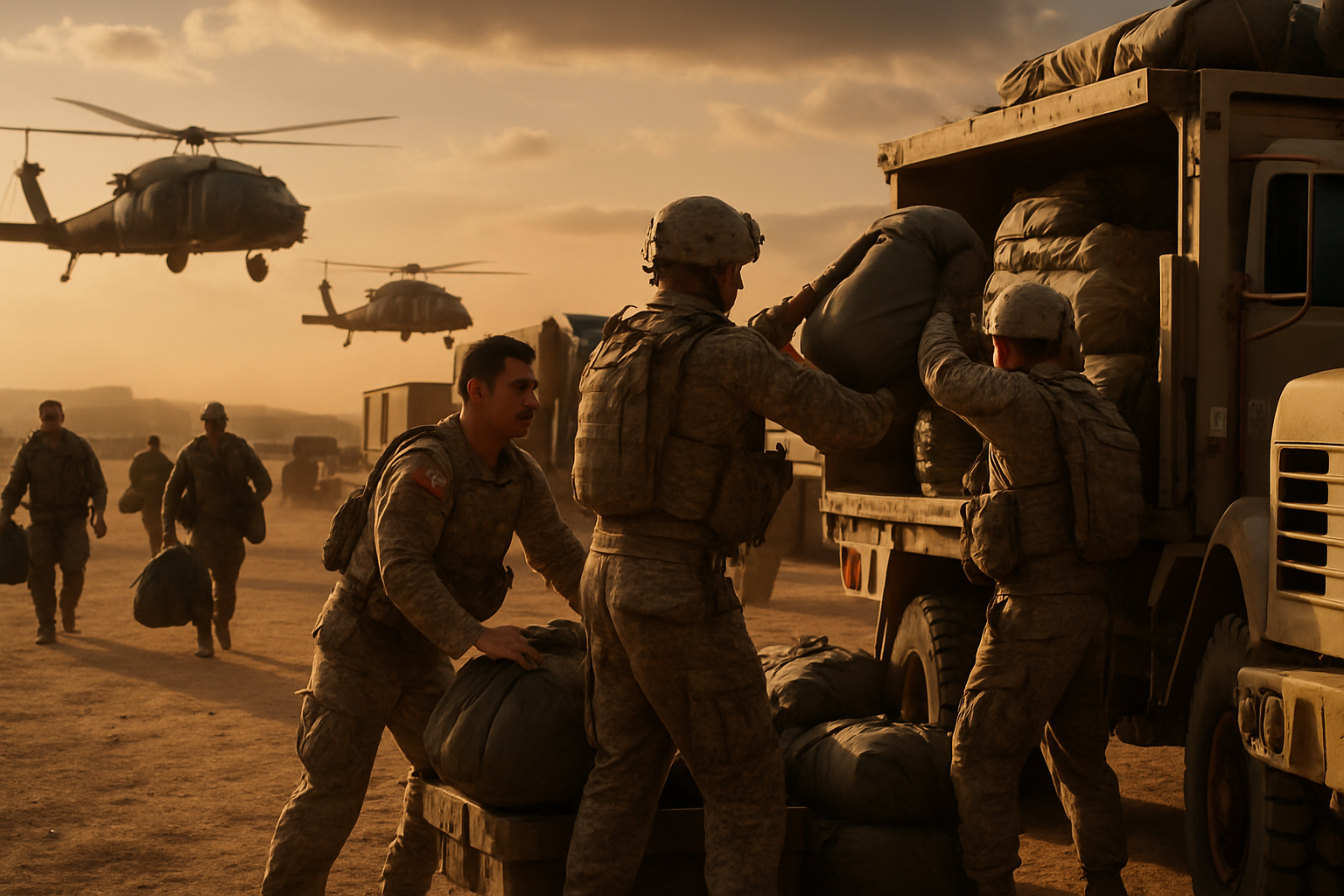
The United States has announced plans to withdraw all 1,000 American troops from Syria within two months, as the Syrian government assumes primary responsibility for counter-terrorism operations in the region, according to multiple international reports citing U.S. officials.
The decision represents a significant shift in U.S. Middle East strategy, coming amid broader regional diplomatic initiatives and ongoing nuclear negotiations with Iran. U.S. officials confirmed to multiple news outlets that troops are expected to withdraw from remaining positions within a two-month timeframe, ending more than a decade of American military presence in the war-torn country.
Strategic Context and Timing
The withdrawal announcement comes during a period of intense diplomatic activity across the Middle East. The United States is currently engaged in high-stakes nuclear negotiations with Iran through Switzerland-Oman mediation, while maintaining unprecedented dual-carrier naval presence in the region with the USS Gerald R. Ford and USS Abraham Lincoln positioned approximately 800 kilometers from Iran's coast.
Finnish sources report that "the United States' large-scale presence is no longer necessary, as the Syrian government is taking primary responsibility for combating the terrorist threat." This assessment reflects a broader recalibration of U.S. counter-terrorism priorities in Syria, where American forces have been stationed since 2014 to combat ISIS and support Kurdish-led Syrian Democratic Forces.
Italian media outlets, citing Wall Street Journal reports, emphasized that "the decision is not related to military deployment for Iran," indicating the Syrian withdrawal operates independently from the current military buildup targeting Iranian nuclear facilities and regional activities.
Regional Security Implications
The timing of the withdrawal coincides with broader regional security developments that have reshaped Middle Eastern dynamics. Iran continues uranium enrichment at 60% purity—significantly above the 3.67% limit established in the 2015 Joint Comprehensive Plan of Action (JCPOA)—approaching the 90% threshold required for weapons-grade material.
U.S. forces in Syria have served multiple strategic functions beyond counter-terrorism operations, including deterring Iranian expansion through the "Shia Crescent" connecting Iran, Iraq, Syria, and Lebanon. The withdrawal could potentially strengthen Iranian influence in Syria, where Tehran has maintained significant military and political support for the Assad government throughout the civil war.
Regional coalition partners, including Saudi Arabia, UAE, Qatar, and Egypt, have been backing current diplomatic processes to prevent military confrontation with Iran. This unprecedented Middle Eastern consensus may have influenced calculations regarding the necessity of maintaining Syrian bases as potential staging areas for operations against Iranian targets.
Military and Operational Considerations
U.S. troops in Syria have operated from several key locations, including the al-Tanf garrison near the Jordanian border and bases in northeastern Syria's Hasakah and Deir ez-Zor provinces. These installations have served as platforms for counter-ISIS operations and coordination with Syrian Democratic Forces, while also monitoring Iranian military activities and arms transfers to Hezbollah in Lebanon.
The withdrawal follows recent military incidents in the region, including the February shoot-down of an Iranian Shahed-139 drone by a U.S. F-35C fighter jet near the USS Abraham Lincoln, and Iranian Revolutionary Guard Corps harassment of U.S. tankers in the Strait of Hormuz. These tensions have raised oil prices by over $1 per barrel, affecting global energy markets dependent on Persian Gulf transit routes that handle 40% of worldwide oil shipments.
Recent reports indicate mobile Patriot missile systems have been deployed at al-Udeid Air Base in Qatar, demonstrating continued U.S. defensive preparations against Iranian missile threats despite the Syrian withdrawal.
Historical Context and Previous Withdrawal Attempts
This announcement represents the latest in a series of U.S. withdrawal considerations from Syria spanning multiple administrations. The complexity of Syrian operations reflects competing objectives including counter-terrorism, Iranian containment, Turkish relations, and Kurdish protection that have complicated previous exit strategies.
The current withdrawal occurs against the backdrop of broader Trump administration diplomatic initiatives, including the Board of Peace Council meeting scheduled for February 19, 2026, featuring 27 member nations with over $1 billion in Gaza reconstruction commitments. This "business approach" to conflict resolution represents a departure from traditional UN frameworks, potentially signaling broader strategic reorientation.
The Syrian withdrawal also coincides with ongoing Ukraine-Russia peace negotiations in Geneva, scheduled for February 17-18, 2026, with a June 2026 comprehensive peace deadline established by the Trump administration. These parallel diplomatic tracks suggest an administration prioritizing negotiated settlements over prolonged military deployments.
International Law and Regional Stability
The U.S. military presence in Syria has operated without explicit Syrian government consent or United Nations authorization, relying on Article 51 self-defense justifications related to counter-terrorism operations against ISIS. The withdrawal could reduce tensions with Damascus while potentially complicating coordination with European allies maintaining their own Syrian commitments.
Syria's civil war, which began in 2011, has resulted in over 500,000 deaths and displaced more than half the country's pre-war population of 22 million. While major combat operations have largely concluded, ongoing security challenges include ISIS remnants, Turkish-Kurdish conflicts, and Iranian military entrenchment.
The Assad government's assumption of counter-terrorism responsibilities raises questions about capacity and international coordination. Syrian military capabilities have been significantly degraded by over a decade of warfare, though Russian and Iranian support has helped stabilize government-controlled areas comprising approximately two-thirds of Syrian territory.
Implications for Kurdish Allies
The withdrawal poses particular challenges for Kurdish-led Syrian Democratic Forces (SDF), who have served as primary U.S. ground partners against ISIS. Kurdish forces control significant territory in northeastern Syria, including critical oil fields and agricultural areas that provide substantial revenue for autonomous administration.
Turkish military operations against Kurdish positions have intensified whenever U.S. protective presence diminished, creating humanitarian concerns and operational complications. The timing of withdrawal may require diplomatic coordination with Ankara to prevent Turkish military operations that could destabilize counter-ISIS progress.
European nations maintaining small contingents in Syria, including France, Germany, and the United Kingdom, may face increased pressure to expand their roles or coordinate alternative security arrangements for Kurdish protection and continued counter-terrorism operations.
Energy and Economic Factors
Syrian energy resources, while limited compared to regional producers, have strategic significance for reconstruction and political control. U.S. forces have helped prevent Syrian government access to northeastern oil fields, generating revenue estimated at several hundred million dollars annually for Kurdish autonomous administration.
The withdrawal may enable Syrian government efforts to regain control over these resources, potentially strengthening Damascus economically while reducing Kurdish leverage in future political negotiations. This shift could affect broader regional energy dynamics as Syria seeks to rebuild production capacity and export infrastructure.
International sanctions on Syria, maintained by the United States and European Union, have complicated reconstruction efforts and energy sector development. The military withdrawal does not necessarily indicate sanctions relief, though it may reduce one source of tension in potential diplomatic engagement.
Looking Ahead
The two-month withdrawal timeline suggests careful logistical planning to avoid precipitous departure that could create security vacuums exploited by ISIS remnants or trigger broader regional instability. Coordination with international partners and regional stakeholders will prove crucial for maintaining counter-terrorism gains while managing Kurdish security concerns.
The broader Middle Eastern diplomatic context, including Iran nuclear negotiations and Israel-Palestine peace initiatives, may provide frameworks for managing Syrian transition. Regional coalition support for diplomatic processes could extend to Syrian stabilization efforts, though competing interests regarding Iranian influence remain significant obstacles.
This withdrawal represents a critical test of the administration's stated preference for negotiated solutions over prolonged military deployments. Success in managing the transition while maintaining counter-terrorism progress could provide a template for future strategic reorientations, while failure might necessitate renewed intervention or complicate broader regional diplomatic initiatives.
As U.S. forces prepare to depart Syria, the international community watches closely to see whether this strategic shift advances regional stability or creates new challenges requiring alternative approaches to Middle Eastern security architecture in the coming decades.