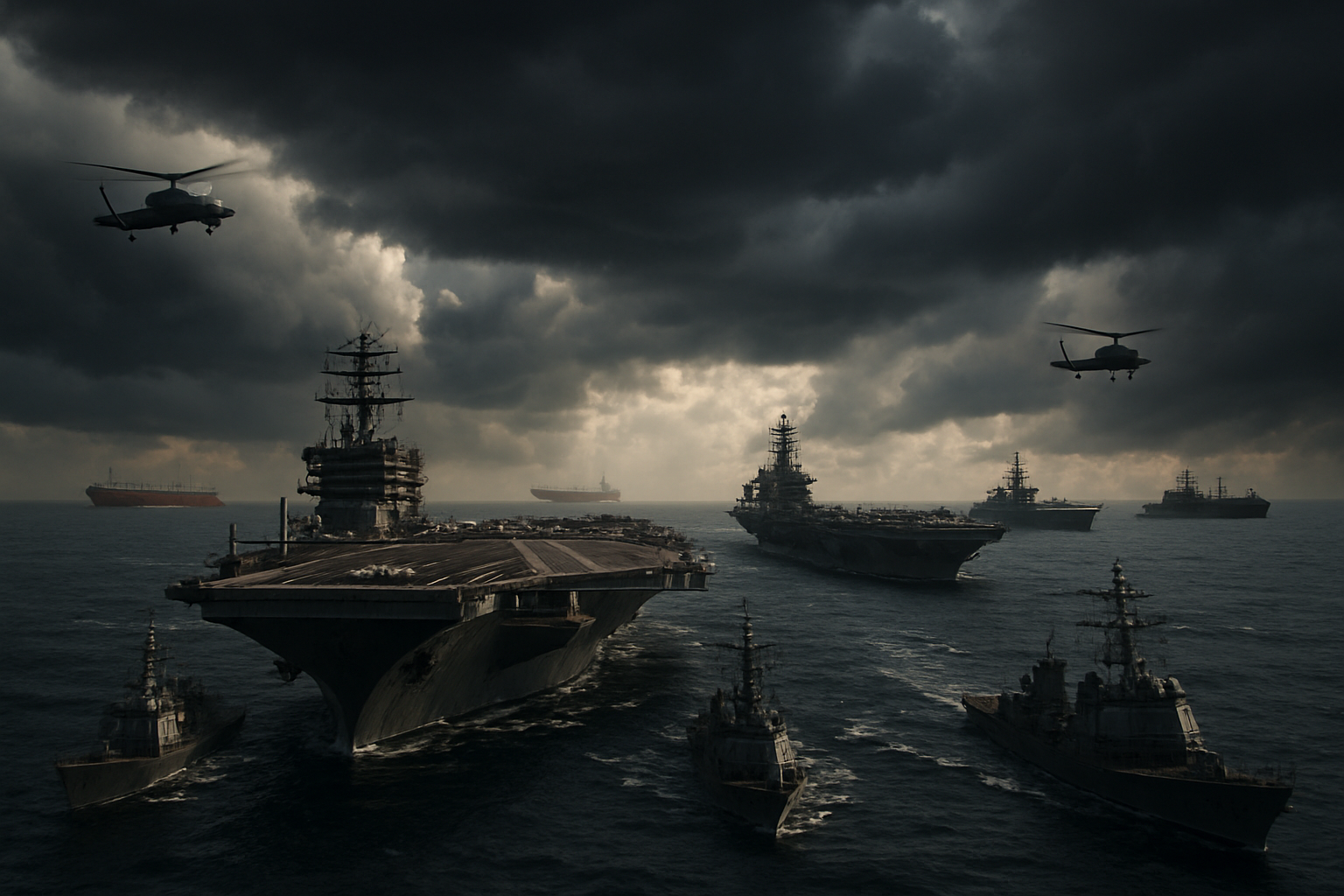
The United States announced a naval blockade of all Iranian ports and coastal areas effective Monday at 10 AM Eastern Time, after unprecedented peace talks mediated by Pakistan collapsed without agreement following 21 hours of marathon negotiations in Islamabad.
President Donald Trump declared that the U.S. Navy would begin blockading the Strait of Hormuz, warning that "any Iranian who fires at us, or at peaceful vessels, will be BLOWN TO HELL!" The announcement came after Vice President JD Vance announced the complete failure of the most direct US-Iran diplomatic engagement since the 1979 Islamic Revolution.
Historic Talks Collapse Over Nuclear Sticking Point
The failure of the Pakistan-mediated negotiations marks the end of what had been called the "Islamabad Accord" - a breakthrough framework that had achieved a temporary ceasefire just 88 minutes before Trump's previous "whole civilization" deadline on April 8. The talks, which ran from Saturday into early Sunday, were the highest-level discussions since Iran's 1979 revolution.
According to multiple sources, the primary sticking point was Iran's nuclear program. The United States demanded a commitment that Iran would not seek nuclear weapons development and would suspend its uranium enrichment activities. Iran, however, maintained its 60% uranium enrichment levels and refused to abandon what it has accumulated over 400 kilograms of weapons-grade material.
"Iran will never abandon enrichment even if war is imposed on us."
— Abbas Araghchi, Iranian Foreign Minister
The talks were further complicated by what negotiators called the "Lebanon loophole." Israeli Prime Minister Netanyahu's exclusion of Lebanon from the ceasefire agreement led to Israeli strikes that killed 254 people in a single day during the negotiations. Iran threatened withdrawal from talks unless comprehensive enforcement was implemented across all fronts.
Naval Blockade Declared Act of War
The U.S. Central Command (CENTCOM) announced that the blockade would be "enforced impartially against vessels of all nations entering or departing Iranian ports and coastal areas, including all Iranian ports on the Arabian Gulf and Gulf of Oman." The statement emphasized that CENTCOM forces would not impede freedom of navigation for vessels transiting the Strait of Hormuz to non-Iranian ports.
Under international maritime law, a naval blockade is generally considered an act of war. The Strait of Hormuz handles approximately 40% of global seaborne oil transit, making it one of the world's most critical energy chokepoints.
Iran's Revolutionary Guard responded defiantly, declaring "complete control" of the waterway and warning that enemies would be trapped in a "deadly whirlpool" if they challenged Iranian sovereignty. The IRGC stated that the strait would remain "open for safe passage of non-military vessels in accordance with specific regulations," but that military vessels would be considered a violation of the ceasefire.
Economic and Energy Implications
The blockade announcement has already triggered severe market reactions. Oil prices have surged above $100 per barrel, with Brent crude reaching $119.50 in recent peaks. The International Energy Agency has deployed its largest strategic petroleum reserve release in history - 400 million barrels from 32 countries.
Iran has deployed an estimated 2,000-6,000 naval mines throughout the strait, effectively closing the waterway. Over 150 oil and LNG tankers worth billions in cargo remain stranded in Persian Gulf waters, with major shipping companies Maersk and MSC suspending operations indefinitely.
The aviation industry continues to face unprecedented disruption, with over 18,000 flights cancelled worldwide - the most severe since the COVID-19 pandemic. Dubai International Airport, the world's busiest, remains closed due to missile damage.
Congressional Opposition Mounts
The escalation has faced significant resistance from Congress, with bipartisan lawmakers demanding answers about strategy, costs, and the potential deployment of ground troops. Senator Richard Blumenthal expressed that he was "more concerned than ever" about the prospect of boots on the ground.
Operation Epic Fury, the largest U.S. military operation since the 2003 Iraq invasion, has already cost $11.3 billion in its first week, with Pentagon officials projecting operations through September - far beyond the initial 4-6 week timeline. Public support for the conflict stands at just 25%, which analysts describe as "almost unprecedented" unpopularity for early-stage operations.
Iranian Leadership Transition
The crisis occurs amid a historic succession in Iran following the death of Supreme Leader Ali Khamenei on March 1. His son, Mojtaba Khamenei, has emerged as the favored successor, representing the first hereditary succession in the Islamic Republic's 47-year history. This transition from clerical to military governance has occurred under active warfare conditions.
President Trump has explicitly rejected the succession, claiming the right to personally choose Iran's next Supreme Leader - the most direct assertion of American control over Iranian affairs since 1979. Trump has dismissed Mojtaba Khamenei as a "lightweight" while demanding Iran's "unconditional surrender."
Regional Coalition Under Strain
The unprecedented coalition of Saudi Arabia, UAE, Qatar, and Egypt that had supported the diplomatic process is now severely strained. Iranian retaliation operations, designated "Operation True Promise 4," have targeted coalition member territories directly, resulting in casualties across the region.
The UAE reported one civilian killed in Abu Dhabi, Kuwait suffered 32 injuries from airport strikes, and Qatar sustained eight wounded despite successfully intercepting 65 missiles and 12 drones using Patriot defense systems. Egyptian President Abdel Fattah el-Sisi has condemned the attacks on "sisterly countries" and warned of "comprehensive chaos" spreading throughout the region.
European Territory Attacked
In an unprecedented escalation, Iranian drones struck RAF Akrotiri in Cyprus - marking the first attack on European territory since World War II. This expansion has prompted an extraordinary naval coalition response, with HMS Dragon leading British forces alongside Spanish frigates and vessels from Italy, France, the Netherlands, and Greece.
The European Union activated its ESTIA crisis mechanism for the first time in the bloc's history, coordinating the evacuation of Cyprus. However, European allies have largely rejected Trump's demands for broader support in the Gulf, with German Defense Minister Boris Pistorius asking, "What does Donald Trump expect a handful of European frigates to do that the powerful US Navy cannot?"
Nuclear Governance Crisis
The collapse of the Islamabad talks occurs against the backdrop of a broader nuclear governance crisis. The New START treaty between the U.S. and Russia expired in February 2026, marking the first time in over 50 years without nuclear constraints between the superpowers. Combined with China's nuclear expansion, UN Secretary-General António Guterres has warned that nuclear risks are at their "highest in decades."
Iran continues to maintain uranium enrichment at 60% purity - far above the 3.67% limit established in the original JCPOA agreement and approaching the 90% threshold needed for weapons-grade material. Intelligence assessments suggest Iran has accumulated sufficient enriched uranium for multiple nuclear weapons if it chooses to weaponize the material.
Global Humanitarian Impact
The conflict has generated a humanitarian crisis of significant proportions. Iran's Red Crescent has reported over 787 civilian casualties from U.S.-Israeli strikes. International evacuations are occurring on a scale not seen since the Arab Spring of 2011, with Australia reporting 115,000 citizens trapped in the region and Germany evacuating 30,000 nationals.
The Pentagon has confirmed responsibility for an elementary school strike that killed between 165-185 students, attributing the incident to "outdated targeting data." The strike has prompted calls for Geneva Conventions investigations into potential war crimes.
Looking Ahead
UN Secretary-General António Guterres has called this the "greatest test of multilateral cooperation in the modern era." The rapid transition from diplomatic breakthrough to military confrontation demonstrates what experts describe as "multipolar era crisis management fragility."
The stakes of containing or escalating this crisis extend far beyond the immediate regional conflict. Success in managing the situation could provide a framework for nuclear crisis resolution in the 21st century. Failure, however, may accelerate the preference for military solutions in international disputes, potentially encouraging nuclear proliferation globally and undermining diplomatic credibility worldwide.
The naval blockade represents a potential point of no return in what many analysts consider the most dangerous international crisis since the end of the Cold War. As the Monday deadline approaches, the world watches to see whether diplomatic solutions can still emerge or whether military confrontation will reshape international relations for decades to come.
The template being set in 2026 will likely influence how territorial disputes, nuclear proliferation prevention, and energy security challenges are addressed throughout the 21st century, with implications extending far beyond the current Middle Eastern crisis.