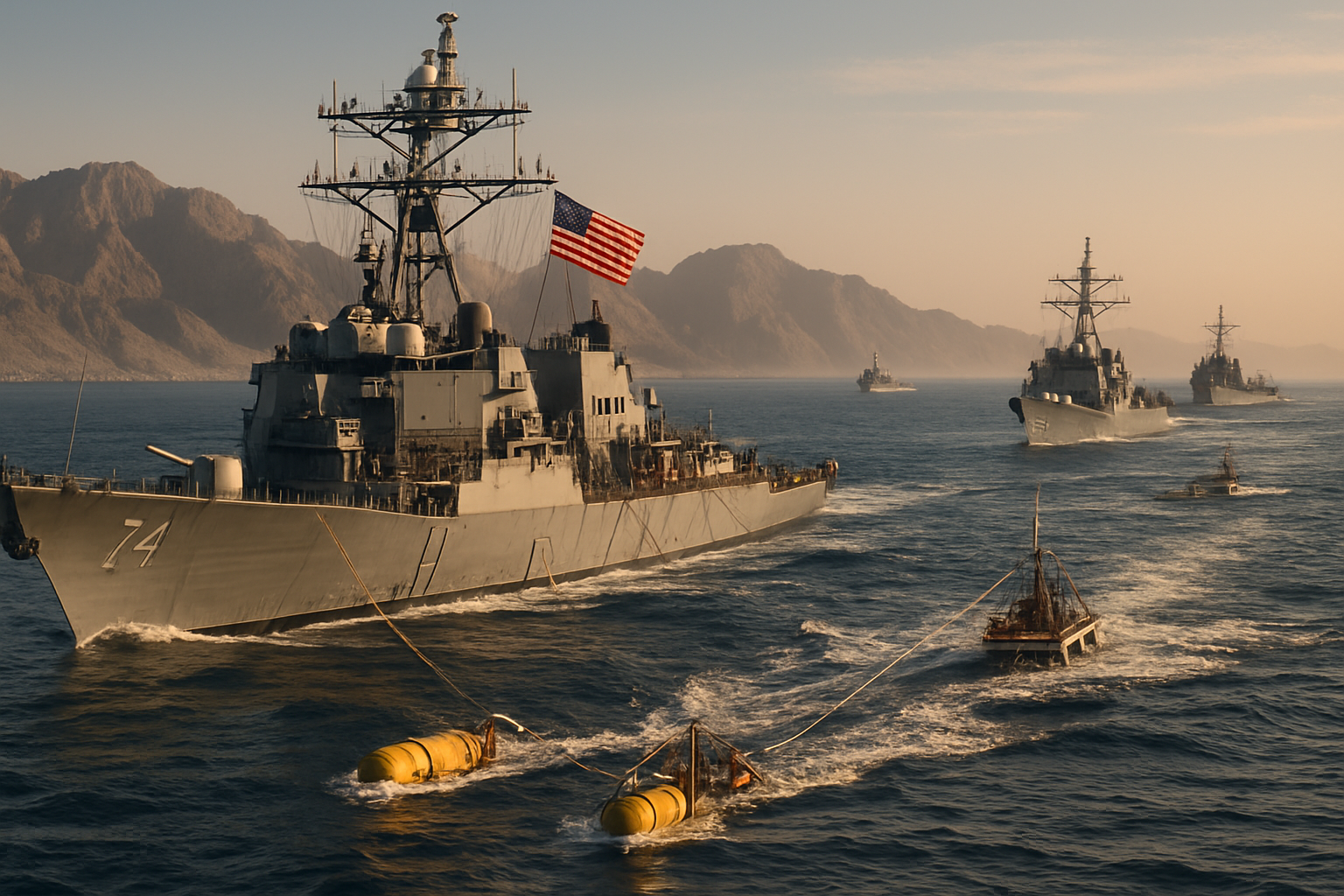
Two US Navy destroyers have entered the Strait of Hormuz to commence mine clearing operations in the strategic waterway, marking the first successful American naval transit since the Iran conflict began in February, according to US Central Command officials.
The USS Frank Peterson and USS Michael Murphy transited the Strait of Hormuz on Saturday as part of what CENTCOM described as a "broader mission to ensure the strait is fully clear of sea mines previously laid by Iran's Islamic Revolutionary Guards Corps." The operation represents a significant escalation in efforts to reopen the critical shipping route that handles approximately 40% of global oil transit.
Strategic Significance of the Mission
"Today, we began the process of establishing a new passage and we will share this safe pathway with the maritime industry soon to encourage the free flow of commerce," Admiral Brad Cooper, head of Central Command, said in a statement. The announcement comes as President Donald Trump had earlier declared on social media that US forces have started clearing the Strait of Hormuz of Iranian mines.
The operation follows weeks of escalating tensions after Iran deployed an estimated 2,000-6,000 naval mines throughout the waterway, effectively closing the critical chokepoint that serves as a lifeline for global energy markets. Oil prices have surged past $100 per barrel for the first time since 2022, with analysts warning of potential spikes toward $200 per barrel if the situation deteriorates further.
Iranian Denial and Contradictory Claims
Despite official US military confirmation, Iranian sources have disputed the American account of events. A spokesperson for Iran's armed forces contradicted US military claims, stating that "the initiative for the passage of any ship" through Iranian-controlled waters requires proper authorization. Iranian state media characterized the US announcements as "fake news" and maintained that no American warships had successfully transited the strategic waterway.
The conflicting narratives highlight the ongoing information war accompanying the physical confrontation. Iranian officials have consistently maintained that they retain control over the Strait of Hormuz, with the Revolutionary Guards declaring that "no red lines remain" in their systematic campaign against US and allied forces in the region.
"We're now starting to clear out the Strait of Hormuz. All of Iran's minelaying ships have been sunk and are lying at the bottom of the sea"
— President Donald Trump, Social Media Post
Historical Context and Ongoing Crisis
The current mine clearing operation represents the culmination of a crisis that began in late February 2026, when diplomatic negotiations between the US and Iran collapsed despite achieving what officials described as "broad agreement on guiding principles" - the most progress since the 2018 JCPOA breakdown. The fundamental disagreement centered on scope, with Iran seeking nuclear-only discussions while the US demanded comprehensive talks including ballistic missiles, regional proxies, and human rights issues.
The crisis escalated dramatically following the confirmed death of Supreme Leader Ali Khamenei on March 1, 2026, leading to the first hereditary succession in Islamic Republic history as his son Mojtaba Khamenei assumed power. This transition coincided with Operation Epic Fury, the largest coordinated US-Israeli military campaign since the 2003 Iraq invasion.
Global Economic Impact
The Strait of Hormuz closure has triggered the most severe global energy crisis since the 1970s oil shocks. The International Energy Agency has responded with its largest strategic petroleum reserve release in 50-year history - 400 million barrels from 32 countries, more than double the 2022 Ukraine crisis response. Major shipping companies including Maersk and MSC have suspended Persian Gulf operations, leaving over 150 oil and LNG tankers stranded with billions in cargo value.
The aviation industry has experienced unprecedented disruption, with over 18,000 flights cancelled worldwide - the most severe since COVID-19. Eight Middle Eastern countries maintain simultaneous airspace closures, effectively severing Europe-Asia air corridors. Dubai International Airport, the world's busiest with 86 million passengers annually, remains shuttered due to missile damage.
Military Operations and Casualties
Operation Epic Fury has cost an estimated $11.3 billion in its first week alone, with Pentagon operations now extending through September 2026, far beyond the initial 4-6 week timeline. The campaign has resulted in the first US combat casualties since 2003, with 3 service members confirmed killed and 150 wounded, including 8 in critical condition.
In a historic naval engagement, the USS Charlotte submarine sank the Iranian frigate IRIS Dena off Sri Lanka, killing over 80 crew members - marking the first enemy vessel sunk by a US submarine since World War II. The incident expanded the conflict beyond the Middle East into the Indian Ocean, demonstrating the global scope of the current crisis.
European Security Implications
The conflict took on new dimensions when Iranian drones struck RAF Akrotiri in Cyprus, marking the first attack on European territory since World War II. The unprecedented assault prompted an immediate naval coalition response, with HMS Dragon joining Spanish, Italian, French, Dutch, and Greek vessels in the Eastern Mediterranean. The European Union activated its ESTIA crisis mechanism for the first time in bloc history.
However, European allies have largely rejected US requests for naval coalition support in the Persian Gulf itself. German Defense Minister Boris Pistorius led resistance efforts, questioning "what a handful of European frigates could do that the powerful US Navy cannot." This represents the most comprehensive rejection of American military leadership since the 2003 Iraq War.
Regional Coalition Under Strain
The crisis has severely tested regional alliances, with an unprecedented Saudi-UAE-Qatar-Egypt consensus supporting diplomatic solutions now threatened by Iranian retaliation targeting member territories. The UAE reported 1 civilian killed in Abu Dhabi with Dubai operations shut down, Kuwait suffered 32 injured in airport strikes, and Qatar reported 8 wounded despite Patriots intercepting 65 missiles and 12 drones.
Egyptian President Abdel Fattah el-Sisi condemned attacks on "sisterly countries," warning of "comprehensive chaos" spreading throughout the region. The coalition fracturing represents a significant blow to Middle Eastern stability and decades-long security arrangements.
Nuclear Governance Crisis
The current crisis occurs amid a broader nuclear governance breakdown, with the New START treaty having expired in February 2026 - the first time in over 50 years without US-Russia nuclear constraints. Iran continues 60% uranium enrichment with over 400kg of weapons-grade material, sufficient for multiple nuclear weapons. UN Secretary-General António Guterres has described nuclear risks as at their "highest in decades."
Congressional Opposition and Domestic Politics
The conflict faces unprecedented domestic opposition, with only 25% American support representing "almost unprecedented" unpopularity for early-stage military operations. Senator Richard Blumenthal has expressed being "more concerned than ever" about potential ground troops deployment. Lawmakers are demanding comprehensive strategy answers, cost justifications, and exit plans as financial markets serve as the "ultimate constraint" on further escalation.
Looking Ahead
Pakistan has emerged as a potential mediator, with Foreign Minister Ishaq Dar confirming "indirect talks" between the US and Iran through a "message relay system." The US has reportedly shared a 15-point peace proposal that Iran is currently deliberating, with China expressing "full support" for Pakistan's mediation initiative.
UN Secretary-General Guterres has characterized the current situation as "the greatest test of multilateral cooperation in crisis management in the modern era." The rapid transition from diplomacy to military confrontation demonstrates what experts describe as "multipolar era crisis management fragility."
The stakes include regional war prevention, global energy security, nuclear governance credibility, and international law enforcement - with post-WWII order principles being tested simultaneously. Success in containing the crisis could provide a framework for 21st-century nuclear dispute resolution, while failure may accelerate military solutions for decades, encouraging proliferation and undermining diplomatic credibility worldwide.
As the mine clearing operations continue in the Strait of Hormuz, the world watches to see whether this historic naval mission can help restore stability to one of the globe's most critical shipping lanes, or whether it represents another escalation in what many consider the most dangerous international crisis since the Cold War.