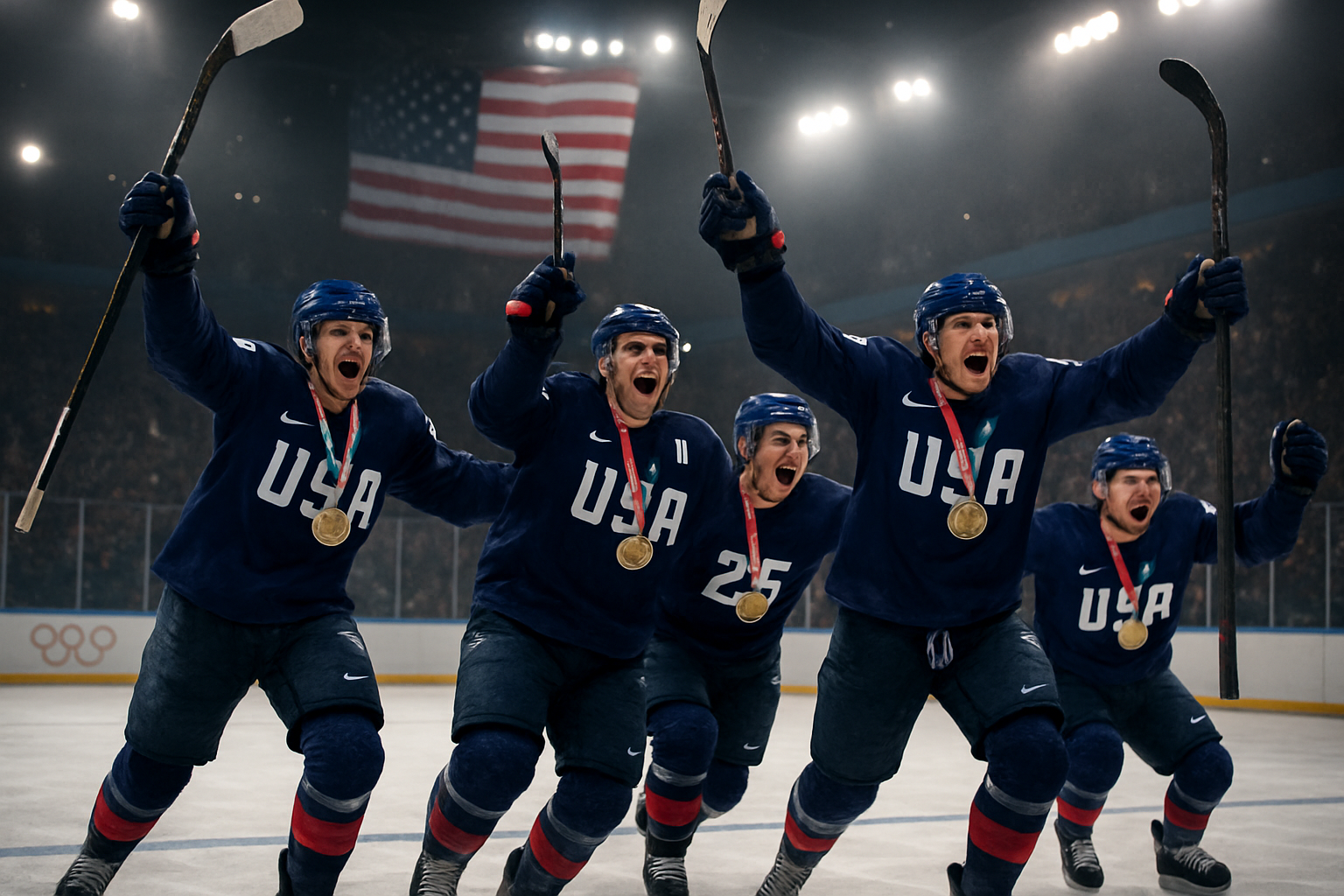
The United States men's hockey team ended a 46-year gold medal drought by defeating Canada 2-1 in overtime at the Milano-Cortina 2026 Winter Olympics, capturing their first Olympic hockey championship since the legendary "Miracle on Ice" victory in 1980.
Jack Hughes scored the game-winning goal in overtime to seal the dramatic victory at Milano's Santagiulia Ice Hockey Arena, sending the American team into wild celebration and completing one of the most anticipated Olympic hockey finals in recent memory.
A Battle for North American Hockey Supremacy
The final lived up to its billing as a classic showdown between hockey's two biggest rivals. According to multiple international sources covering the game, the United States took an early 1-0 lead in the first period, only to see Canada respond with an equalizer in the second period to tie the game 1-1.
The third period remained scoreless despite intense pressure from both teams, sending the gold medal game to overtime in a 3-on-3 format that has become the standard for international hockey.
"This is a historic moment for the entire American hockey program. To beat Canada for Olympic gold after 46 years is something special."
— US Team Official, quoted in international reports
Connor Hellebuyck's Stellar Performance
American goaltender Connor Hellebuyck was instrumental in the victory, making crucial saves throughout the game to keep the United States in contention. According to NPR's coverage, Hellebuyck's "brilliant performance" was key to saving the Americans' chances against a powerful Canadian offensive attack.
The game featured the return of NHL players to Olympic competition for the first time since 2014, adding star power and intensity to an already heated rivalry between the neighboring nations.
Breaking the 46-Year Drought
The victory marked exactly 46 years since the United States last captured Olympic hockey gold, when an amateur American team shocked the world by defeating the heavily favored Soviet Union in the "Miracle on Ice" game at Lake Placid 1980, before going on to win gold.
Swedish media outlets noted the historical significance, with DN.se reporting that this was "amerikanernas första OS-guld sedan 'Miracle on Ice' 1980" (the Americans' first Olympic gold since the 'Miracle on Ice' in 1980).
Multiple European sources, including coverage from Lithuania, Latvia, and Switzerland, emphasized the dramatic nature of the final and its place in Olympic hockey history.
Hughes Delivers in Overtime
Jack Hughes emerged as the hero for Team USA, scoring what Slovak media described as the "zlatý gól" (golden goal) that decided the championship. The young forward's clutch performance in the biggest moment demonstrated the depth of American hockey talent.
The overtime format, played 3-on-3, created the kind of open-ice hockey that favors skilled players like Hughes, and the American team capitalized on their opportunity when it mattered most.
Canada's Disappointment
For Canada, the silver medal represented a disappointing end to what had been a strong tournament. Swiss coverage noted how the loss "verschärfen die Krise der angeschlagenen Eishockeynation Kanada" (intensifies the crisis of the struggling hockey nation Canada), highlighting the pressure on Canadian hockey at the international level.
Canada had entered the tournament as defending champions and one of the favorites, making the loss particularly stinging for the hockey-mad nation that considers the sport central to its identity.
Finland Claims Bronze
In the bronze medal game, Finland defeated Slovakia 6-1 to claim third place, according to Russian media coverage. The decisive victory gave Finland their fifth Olympic hockey bronze medal, continuing their tradition of strong performances at major international tournaments.
The result demonstrated the continued strength of European hockey programs and the increasingly competitive nature of international hockey beyond the traditional North American powerhouses.
NHL's Return to Olympics
The tournament marked the first time since 2014 that NHL players were allowed to participate in the Olympics, after the league agreed to pause its regular season schedule. This return brought the world's best hockey players to the Olympic stage, elevating the level of play and global interest in the tournament.
The presence of NHL stars like Hughes and Hellebuyck for the United States, along with Canada's top players, created the kind of high-stakes, high-skill hockey that Olympic fans had been missing for over a decade.
Milano-Cortina 2026 Success
The hockey tournament took place as part of the Milano-Cortina 2026 Winter Olympics, which made history as the most geographically dispersed Winter Games ever, spanning over 400 kilometers across northern Italy. Despite logistical challenges, the hockey competition proceeded smoothly and delivered memorable moments.
The revolutionary dual-city hosting model proved successful in maintaining competitive excellence while demonstrating new possibilities for sustainable Olympic hosting.
Looking Forward
The victory represents a major milestone for USA Hockey and could inspire a new generation of American players. With the 2030 Winter Olympics on the horizon, the United States has established itself once again as a major force in international hockey.
For Canada, the defeat will prompt soul-searching about the state of their hockey program, though their silver medal performance showed they remain competitive at the highest level.
The thrilling final provided a fitting conclusion to what international observers called one of the most competitive Olympic hockey tournaments in recent memory, with the Americans' 46-year wait finally coming to an end in the most dramatic fashion possible.