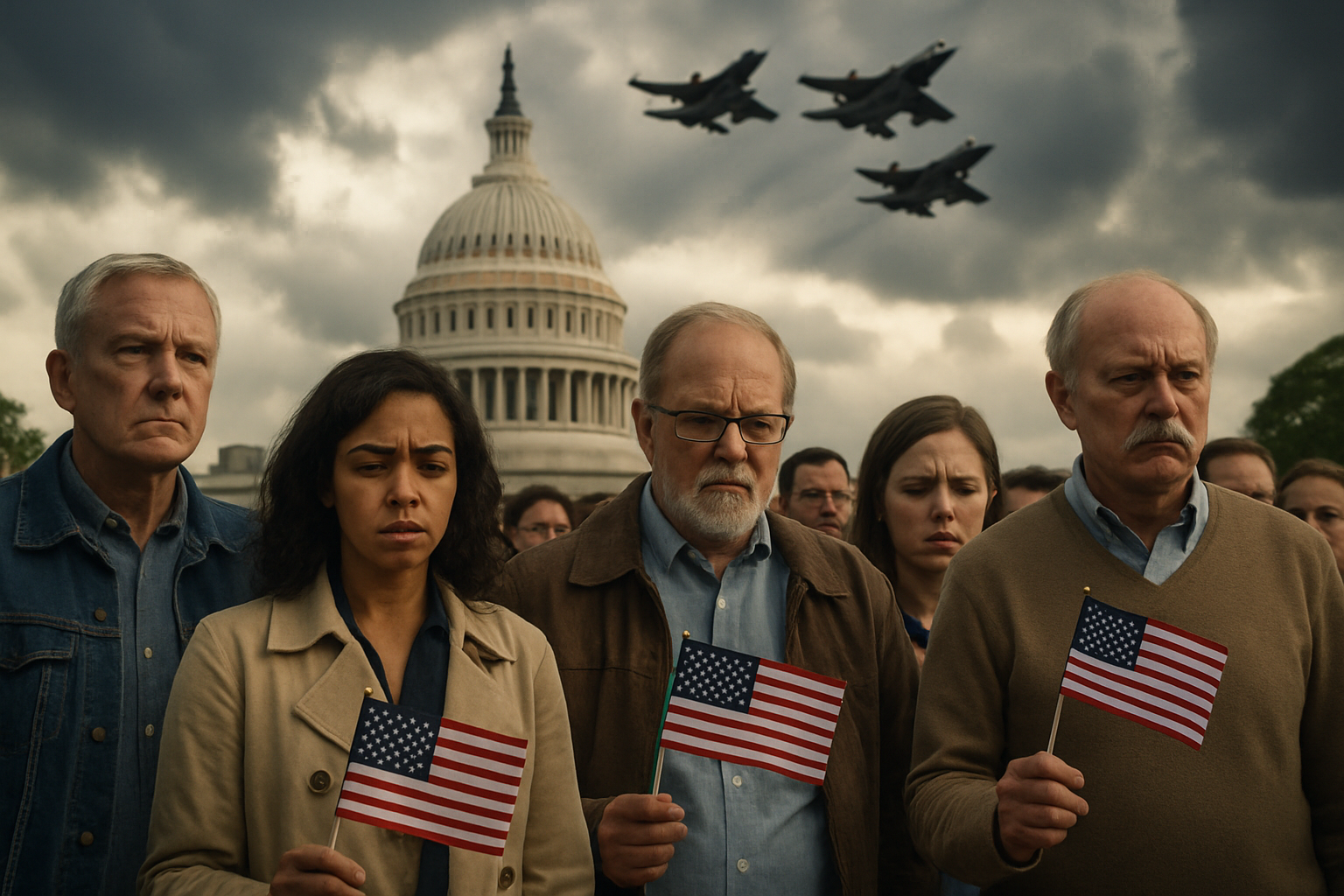
A new Reuters/Ipsos poll reveals deep American skepticism toward military action against Iran, with only 25% of respondents approving of recent U.S. strikes while 56% believe President Trump is too willing to use military force to advance American interests.
The polling data, concluded on Sunday, exposes a stark disconnect between the administration's aggressive military posture and public sentiment as the U.S. maintains an unprecedented dual-carrier deployment near Iranian waters—the largest Middle Eastern naval presence since the 2003 Iraq invasion.
Widespread Public Opposition to Military Escalation
According to the Reuters/Ipsos survey, 27% of Americans approved of the strikes that killed Iran's Supreme Leader Ali Khamenei, while 43% disapproved and 29% remained uncertain. Approximately nine in ten respondents reported awareness of the military operations, which began early Saturday as part of "Operation Epic Fury."
The poll's most striking finding concerns broader attitudes toward Trump's use of military force. An overwhelming 87% of Democrats believe the president is too willing to deploy military assets, joined by 23% of Republicans and 60% of independents—revealing significant bipartisan concern about the administration's approach.
This domestic resistance occurs against the backdrop of Trump's most extensive military buildup in the region, with the USS Gerald R. Ford joining the USS Abraham Lincoln to create a naval force representing approximately one-third of the active U.S. Navy fleet positioned 800 kilometers from Iran's coast.
Historical Context of American War Fatigue
The polling results reflect broader American war fatigue following decades of Middle Eastern interventions. Trump's military actions in recent months have extended beyond Iran to include strikes in Venezuela, Syria, and Nigeria, contributing to public concerns about overreach.
The president's explicit regime change rhetoric—calling Iranian government overthrow "the best thing that could happen"—represents a significant policy evolution from nuclear-focused negotiations to comprehensive political transformation objectives. This shift has occurred despite achieving what Iranian Foreign Minister Abbas Araghchi termed "broad agreement on guiding principles" in Geneva talks, the most significant diplomatic progress since the 2018 JCPOA collapse.
Diplomatic Breakdown Amid Military Pressure
The current crisis emerged from the complete breakdown of nuclear negotiations, despite unprecedented progress in Switzerland-Oman mediated talks. Iran maintained its exclusion of ballistic missiles and regional proxies as "red lines" from nuclear-only discussions, while U.S. Secretary of State Marco Rubio insisted on comprehensive agreements addressing missiles, armed groups, and human rights.
Iran continues enriching uranium at 60% purity—significantly above the 3.67% limit established in the original nuclear deal—approaching the 90% threshold required for weapons-grade material. Intelligence assessments suggest Iran possesses sufficient enriched uranium for multiple weapons if weaponized, creating urgent timeline pressures that contributed to the diplomatic collapse.
Regional Coalition Strained by American Actions
The military escalation has severely strained an unprecedented regional coalition of Saudi Arabia, UAE, Qatar, and Egypt that had backed diplomatic solutions. These Gulf states now face direct Iranian retaliation on their territories, with casualties reported in Abu Dhabi, Kuwait, Qatar, and Bahrain following Iran's "Operation True Promise 4" response.
"This polling demonstrates that the American people remain skeptical of military solutions to complex international problems, even as their government pursues the most aggressive Middle Eastern military posture in decades."
— Political analyst commenting on the Reuters/Ipsos findings
Egyptian President Abdel Fattah el-Sisi condemned Iranian attacks on "sisterly Arab countries," warning of "comprehensive chaos" as the regional consensus supporting diplomacy crumbled under the pressure of military escalation.
Nuclear Governance Crisis Context
The Iran crisis unfolds amid a broader nuclear governance crisis following the February 5 expiration of the New START treaty—marking the first time in over 50 years without U.S.-Russia nuclear constraints. Combined with China's nuclear expansion, UN Secretary-General António Guterres has warned that nuclear risks have reached their "highest levels in decades."
The collapse of what many considered the most promising U.S.-Iran diplomatic opening in years raises fundamental questions about the viability of diplomatic solutions for modern nuclear crises. The rapid transition from framework agreements to military confrontation demonstrates the fragility of crisis management mechanisms in the current multipolar era.
Energy Security and Global Implications
The military escalation threatens global energy security, with Iran warning that shipping through the Strait of Hormuz—which handles 40% of global oil transit—would "not be allowed" if hostilities continue. Oil prices have surged over 10% since the beginning of Operation Epic Fury, while natural gas prices have increased 24% in Europe and 78% in the United States.
The global aviation crisis has been equally severe, with Iran, Iraq, Israel, UAE, and Qatar simultaneously closing their airspace. Over 18,000 flights have been cancelled worldwide, affecting major carriers including Emirates, Air France-KLM, and Wizz Air, representing the most extensive regional disruption since COVID-19.
Domestic Political Ramifications
The polling data reveals the political risks facing the Trump administration as it pursues military solutions despite public skepticism. The 56% of Americans who view the president as too quick to use force include nearly a quarter of his own Republican base, suggesting potential electoral consequences for continued escalation.
The administration must now balance mounting domestic opposition with what it views as necessary military pressure to achieve strategic objectives in the Middle East. The disconnect between public opinion and policy implementation highlights the challenges of maintaining democratic legitimacy during sustained military operations.
International Law and Precedent Concerns
The crisis has prompted an emergency UN Security Council session, with Russia condemning what it termed "reckless actions by Washington and West Jerusalem" as violations of international law. The rapid escalation from diplomatic engagement to military strikes has created a template that may influence future approaches to nuclear crisis resolution globally.
Multiple countries have issued travel warnings and ordered embassy evacuations, with Sweden and Serbia directing immediate citizen evacuations from Iran citing "extremely uncertain" security conditions. The international response reflects concerns about the broader implications of abandoning diplomatic solutions for military confrontation.
Looking Ahead: Template-Setting Moment
The current crisis represents what analysts describe as a "template-setting moment" for 21st-century international relations. The success or failure of military approaches over diplomatic engagement will likely influence how future nuclear crises are addressed, potentially reshaping Middle Eastern geopolitics for decades.
As the Reuters/Ipsos poll demonstrates, American public opinion remains skeptical of military solutions despite the administration's confidence in the effectiveness of force. This disconnect between elite policy preferences and popular sentiment underscores the democratic tensions inherent in conducting sustained military operations without broad public support.
The coming phase will be decisive in determining whether the crisis can be contained to prevent broader regional war or whether it will accelerate military solutions that could destabilize global energy markets, encourage nuclear proliferation elsewhere, and undermine diplomatic credibility worldwide. The American public's reluctance to support military escalation may ultimately prove prophetic in influencing the trajectory of this historic Middle Eastern crisis.