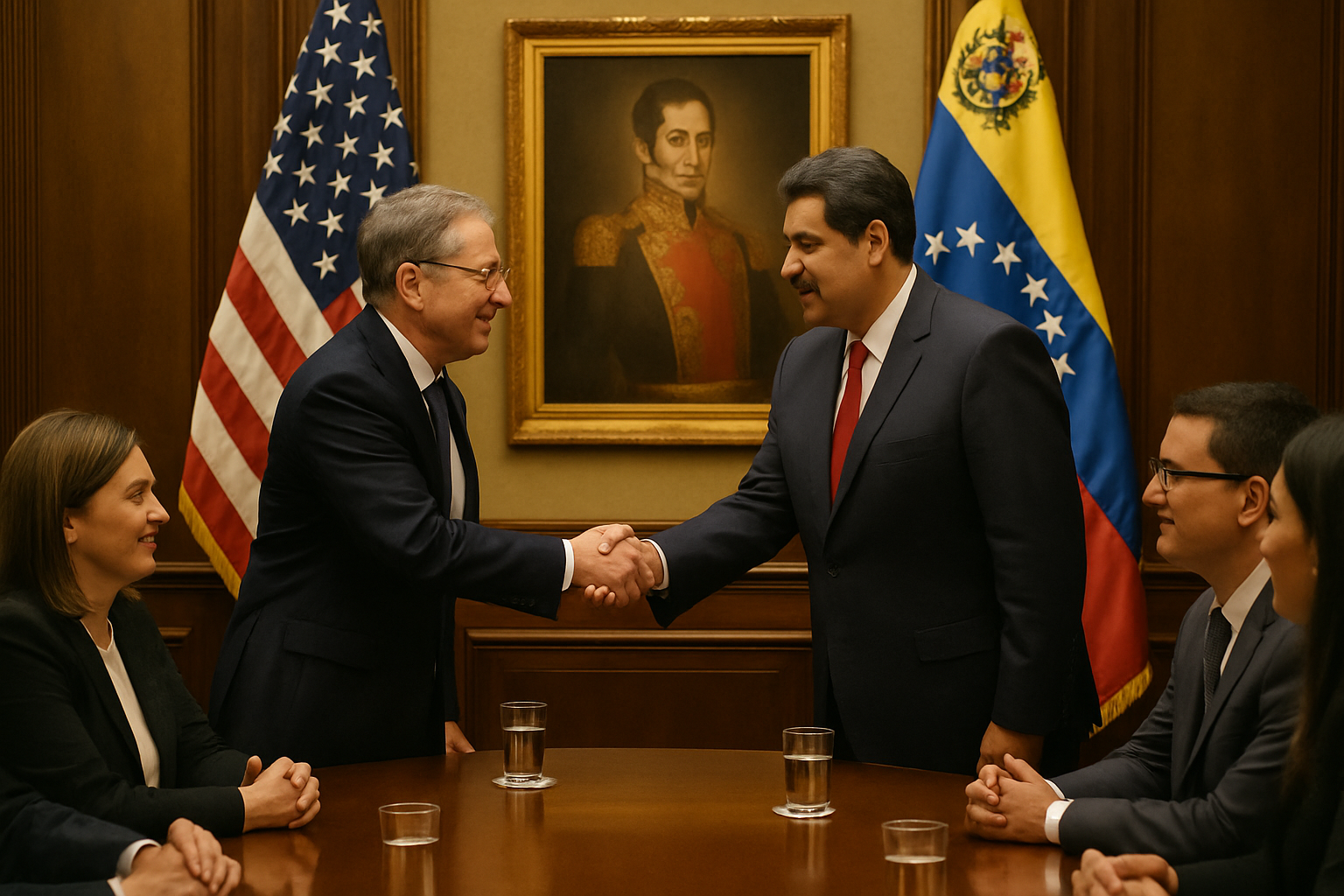
The United States has formally recognized Acting President Delcy Rodríguez as Venezuela's interim head of state, marking the culmination of one of the most dramatic diplomatic reversals in recent history, while parallel negotiations advance regarding the potential extradition of Colombian businessman Alex Saab.
The recognition comes just two months after U.S. special forces captured former President Nicolás Maduro in January 2026, ending nearly three decades of Chávez-Maduro rule. The announcement coincides with accelerating diplomatic engagement between Washington and Caracas, including high-level discussions about transferring Saab, currently detained at Venezuela's Helicoide prison, to U.S. custody.
Diplomatic Breakthrough After Decades of Hostility
According to sources familiar with the matter, the formal recognition represents the complete transformation from the Trump administration's previous "maximum pressure" campaign to what officials now describe as a strategic partnership. The shift has yielded immediate results: Venezuelan oil exports have surged 60% to 800,000 barrels daily since January, with the United States displacing China as Venezuela's top customer.
U.S. analyst Keith Mines, writing in a recent Just Security report, noted that Maduro's capture by U.S. Special Forces opened "a unique window" for democratic transition. However, Mines cautioned that the transfer of power to Vice President Rodríguez, whose primary focus appears to be opening Venezuela's oil sector to American companies, "risks closing the possibility of lasting democratic governance."
"The transition has opened the oil sector to U.S. companies in an unprecedented way, but genuine democratic reform requires more than economic cooperation."
— Keith Mines, Security Analyst
The Alex Saab Negotiations
Parallel to the diplomatic recognition, U.S. and Venezuelan authorities are reportedly making significant progress in negotiations regarding the potential extradition of Alex Saab, the Colombian businessman who served as a key financial operative for the Maduro regime. Sources close to the talks suggest the extradition could position Saab as a crucial witness in ongoing investigations into international financial networks.
Saab, who was previously held in U.S. custody from 2020 to 2023 before being released in a prisoner exchange, was re-arrested in February 2026 as part of a joint FBI-SEBIN operation. His potential cooperation with U.S. authorities could provide unprecedented insight into the complex financial mechanisms that sustained the Maduro government for over two decades.
The negotiations represent a significant shift in judicial cooperation between the two nations. Unlike during the Maduro era, when Venezuela consistently rejected U.S. extradition requests, the interim government has demonstrated willingness to collaborate with American justice officials on multiple fronts.
Regional and International Implications
The formal recognition of Rodríguez has generated mixed reactions across the region. Analysts note that President Trump has praised Rodríguez's work as "excellent," referring to Venezuela as America's "new friend and partner" in the hemisphere. This represents a complete reversal from the previous characterization of Venezuela as part of an "axis of authoritarianism."
The Dominican Republic has already reopened full diplomatic relations with Venezuela, while Brazil and European Union nations maintain cautious support for the transition. The recognition comes during Rodríguez's first major international engagement, including a planned meeting with Colombian President Gustavo Petro that observers describe as crucial for regional stability.
Former Spanish Prime Minister José Luis Rodríguez Zapatero, who has been mediating in Caracas since February, welcomed the U.S. recognition as a positive step toward comprehensive regional reconciliation. Cardinal Baltazar Porras has organized prayer vigils throughout Venezuela, adding moral authority to the diplomatic breakthrough.
Economic Transformation and Energy Partnership
The recognition coincides with sweeping economic changes in Venezuela. Energy Secretary Chris Wright's historic February visit to Caracas resulted in comprehensive cooperation agreements that effectively ended the 2019 oil embargo. Major companies including Chevron, BP, Shell, Eni, and Repsol have been authorized for expanded operations under Treasury Department permissions.
Interior Secretary Doug Burgum's recent visit to Venezuela focused on mining code reforms that will provide "unlimited opportunities for cooperation" for American companies seeking access to critical minerals. This addresses long-standing U.S. concerns about Chinese dominance in strategic materials essential for supply chain security.
"This partnership addresses both American energy security needs and Venezuelan economic recovery requirements in an unprecedented way."
— Chris Wright, U.S. Energy Secretary
Political Reconciliation Progress
The diplomatic breakthrough occurs against the backdrop of Venezuela's most comprehensive political reconciliation effort in recent Latin American history. Over 750 political prisoners have been released since January under Rodríguez's amnesty program, which covers political offenses from 1999-2026, spanning the entire Chávez-Maduro era.
However, human rights organizations note that approximately 600 political prisoners remain detained, and many releases have involved restrictive conditions rather than complete freedom. The case of Juan Pablo Guanipa, a close ally of Nobel Peace Prize laureate María Corina Machado, exemplifies these complexities—he was released but subsequently placed under house arrest with electronic monitoring.
Machado herself announced plans to return to Venezuela "within weeks" as a crucial test of the interim government's commitment to democratic principles. Her return would represent the most significant opposition reintegration since the transition began.
Congressional and Domestic Response
The recognition has generated predictable partisan responses in Washington. Republican lawmakers support the approach as an effective strategy to counter Chinese influence in Latin America, while Democrats have demanded greater transparency regarding Venezuelan oil sales and the rapid reversal of sanctions policy.
Representative María Elvira Salazar and Mario Díaz-Balart, reflecting the concerns of the Venezuelan diaspora in Florida, have expressed cautious optimism while emphasizing the need for sustained democratic progress rather than cosmetic reforms.
Congress previously passed legislation requiring oversight of Venezuelan oil deals by a 219-211 margin, reflecting bipartisan concerns about the administration's rapid policy reversal without adequate monitoring mechanisms.
Challenges and Sustainability Concerns
Despite the diplomatic progress, significant challenges remain for Venezuela's democratic transition. Oil production remains at only 700,000 barrels daily compared to historical peaks of 3 million barrels, requiring sustained international investment and technical assistance for meaningful recovery.
Hyperinflation, infrastructure decay, and power outages continue to affect millions of Venezuelans. The Central Bank recently released data showing 475% inflation in 2025—the world's highest rate—demonstrating the magnitude of economic challenges facing the interim government.
International observers emphasize that sustainable democratic transformation requires more than prisoner releases and economic cooperation. Institutional reforms affecting the electoral system, press freedom, and opposition rights protection will ultimately determine whether the current changes represent genuine democratization or tactical adjustments to maintain power.
Looking Forward: A Template for Regional Change?
The Venezuela case is being closely monitored throughout Latin America as a potential template for peaceful democratic transitions. The combination of military pressure, economic incentives, and selective diplomatic engagement represents what some analysts call "bilateral energy diplomacy"—a new approach to international crisis resolution in an era of great power competition.
President Trump has indicated his intention to visit Venezuela, which would make him the first U.S. president to do so since 1997. Such a visit would symbolically cap what many consider the most significant hemispheric realignment since the end of the Cold War.
The success or failure of Venezuela's transition will likely influence American approaches to similar challenges globally. As the international community continues to monitor developments, the coming months will prove decisive in determining whether this diplomatic transformation can produce lasting democratic change or represents merely a temporary arrangement between competing interests.
For now, the formal U.S. recognition of Delcy Rodríguez and the advancing Saab extradition talks signal that both nations are committed to moving beyond decades of hostility toward a more cooperative relationship—one that could reshape not just bilateral ties, but the broader dynamics of hemispheric politics for years to come.