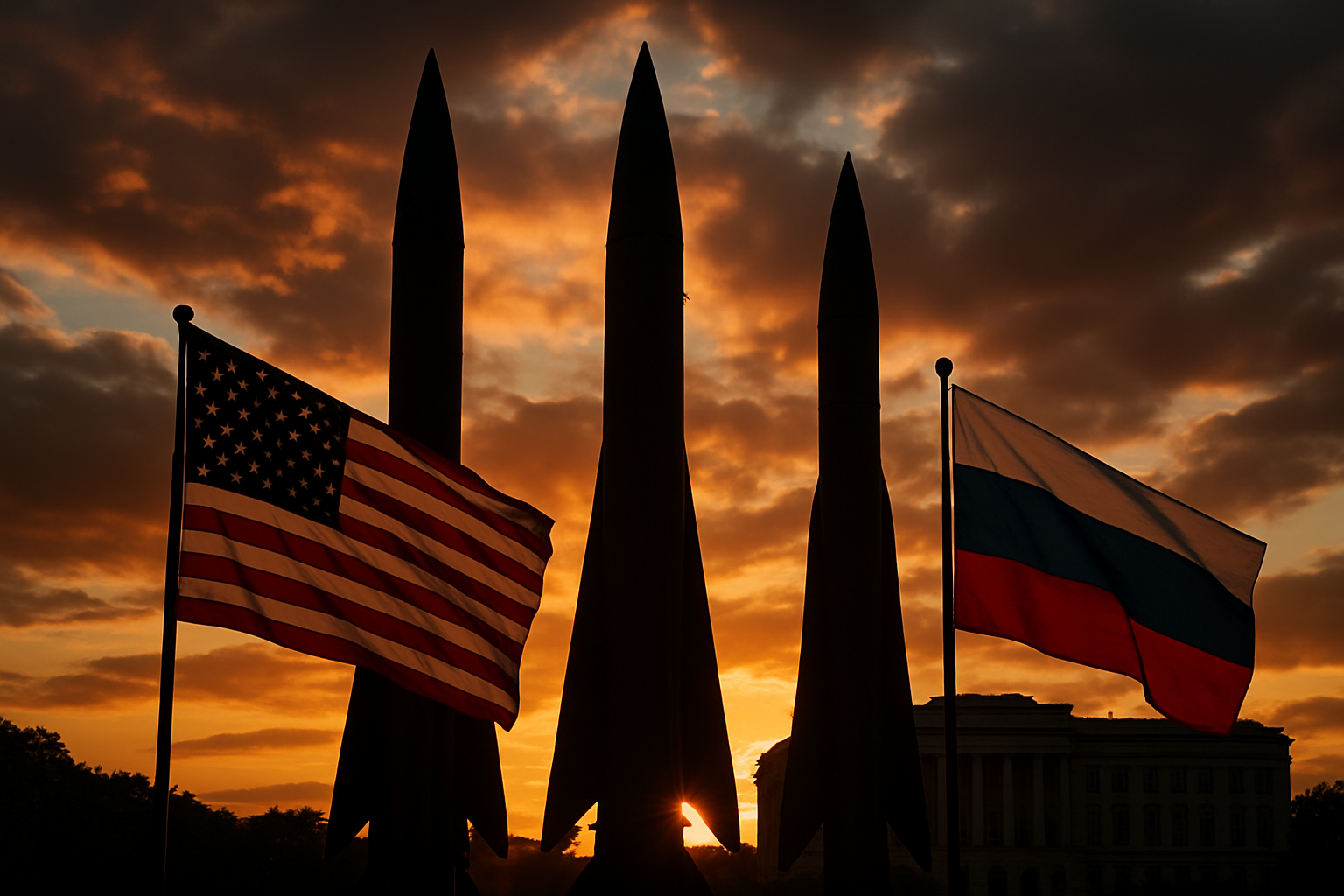
The New Strategic Arms Reduction Treaty (New START) between the United States and Russia officially expired at midnight GMT on Thursday, February 5, 2026, marking the first time in over five decades that no binding nuclear arms control agreement exists between the world's two largest nuclear powers.
The expiration of this landmark treaty, which limited both nations to 1,550 deployed strategic warheads each, has created an unprecedented nuclear policy vacuum that international leaders are calling a "grave moment" for global security. With the US and Russia controlling more than 80 percent of the world's nuclear weapons, the lapse removes critical verification mechanisms and formal limits that have helped prevent nuclear miscalculation since the Cold War.
International Alarm Over Nuclear Security Void
United Nations Secretary-General António Guterres characterized the treaty's expiration as a "grave turning point" for international peace and security, emphasizing that the risk of nuclear weapons use is now "higher than at any time in decades." Speaking from UN headquarters, Guterres reminded the international community that nuclear arms control "throughout the Cold War and beyond helped prevent catastrophe" by building stability and preventing "disastrous miscalculations."
The treaty's lapse comes at a particularly volatile time, coinciding with ongoing Ukraine-Russia-US trilateral peace talks in Abu Dhabi and heightened tensions across multiple global flashpoints. NATO Secretary-General Mark Rutte described the expiration as occurring at "the worst possible time," given the current state of international relations.
"The world now finds itself without nuclear constraints for the first time since the height of the Cold War. This is a critical moment that requires immediate diplomatic attention from all nuclear powers."
— António Guterres, UN Secretary-General
Diplomatic Breakdown and Failed Extension Attempts
The treaty's expiration follows months of unsuccessful diplomatic efforts to secure either an extension or a replacement agreement. Russia's Foreign Ministry confirmed on February 4 that "parties to the New START treaty are no longer bound by any obligations," revealing that the United States had not responded to President Vladimir Putin's proposal to extend the treaty's main provisions for an additional 12 months.
Originally signed in 2010 under Presidents Barack Obama and Dmitry Medvedev, the New START treaty was previously extended for five years in 2021 during the early days of the Biden administration. However, deteriorating US-Russia relations, particularly following Russia's invasion of Ukraine in 2022, created insurmountable obstacles to further cooperation.
The breakdown in negotiations appears to center on fundamental disagreements over the scope of future arms control. While Russia sought a narrow extension focused solely on strategic nuclear weapons, the United States has increasingly insisted that any future agreement must include China's rapidly expanding nuclear arsenal and address tactical nuclear weapons systems.
What the Treaty Previously Controlled
The now-expired New START treaty imposed comprehensive limitations on both nations' strategic nuclear capabilities. Each country was restricted to:
- 1,550 deployed strategic warheads
- 800 strategic delivery systems (deployed and non-deployed)
- 700 deployed strategic delivery vehicles
Beyond numerical limits, the treaty established crucial verification and transparency mechanisms, including biannual data exchanges on nuclear arsenals, regular on-site inspections, advance notification requirements for intercontinental ballistic missile launches, and telemetry sharing during missile tests.
These provisions created a framework of predictability and transparency that nuclear experts credit with maintaining strategic stability through various international crises over the past decade.
Religious and International Leaders Call for De-escalation
Pope Leo XIV issued a stark warning about the risks of a "new arms race," calling for immediate de-escalation and appealing for the preservation of arms control mechanisms. The Vatican's statement emphasized the need for "follow-up efforts to ensure stability" and urged both superpowers to prioritize global security over national competition.
European leaders have expressed particular concern given their geographic proximity to both Russia and potential nuclear flashpoints. German officials have characterized the expiration as creating "unacceptable risks" for European security, while French President Emmanuel Macron called for emergency consultations among NATO allies.
Technical and Strategic Implications
With formal limits removed, both the United States and Russia are now technically free to expand their nuclear arsenals without bilateral constraints. Military analysts warn this could trigger a cascade of nuclear proliferation as other nations reassess their security needs in an environment without superpower arms control.
The loss of verification mechanisms is considered equally concerning by nuclear experts. Without mandatory inspections and data exchanges, each nation's understanding of the other's nuclear capabilities will become increasingly speculative, potentially leading to worst-case scenario planning and overestimation of threats.
Current estimates suggest Russia possesses approximately 4,380 nuclear warheads (1,710 deployed), while the United States maintains roughly 3,708 warheads (1,670 deployed). Without treaty constraints, these numbers could grow significantly as both nations pursue modernization programs already underway.
China Factor Complicates Future Agreements
President Donald Trump has argued that any future arms control framework must include China, citing Beijing's rapidly expanding nuclear arsenal as a reason for declining to extend the bilateral US-Russia agreement. Intelligence assessments suggest China's nuclear forces have grown from approximately 350 warheads in 2020 to over 500 currently, with projections indicating continued expansion.
However, China has consistently resisted participation in trilateral arms control discussions, arguing that its nuclear arsenal remains significantly smaller than those of the United States and Russia. Chinese officials have indicated they would only consider arms control participation after the two superpowers reduce their arsenals to levels closer to China's current capabilities.
Timing Amid Multiple Global Crises
The treaty's expiration occurs against a backdrop of unprecedented global tensions. Ongoing conflicts in Ukraine, escalating US-Iran tensions, and broader geopolitical competition have created the most dangerous international security environment in decades.
The timing is particularly sensitive given current diplomatic efforts, including the Ukraine-Russia-US peace talks in Abu Dhabi and upcoming Iran-US nuclear negotiations scheduled for February 7 in Oman. Nuclear experts worry that the absence of US-Russia arms control could complicate other nonproliferation efforts and signal to additional countries that nuclear competition is acceptable.
Expert Warnings of Arms Race
The International Campaign to Abolish Nuclear Weapons (ICAN) criticized what it termed "US silence" on the treaty's expiration, stating it makes "every crisis more dangerous." Nuclear policy experts from research institutions worldwide have echoed these concerns, warning that the lapse creates incentives for both quantitative and qualitative nuclear competition.
Arms control advocates point to the historical importance of bilateral agreements in preventing miscalculation during previous crises, including the Cuban Missile Crisis, various Middle East conflicts, and tensions during the collapse of the Soviet Union. Without such frameworks, they argue, even minor incidents could escalate unpredictably.
Economic and Strategic Costs
The potential for renewed nuclear competition carries enormous economic implications. Both the United States and Russia are already investing heavily in nuclear modernization programs, with combined spending expected to exceed $100 billion annually. Without arms control limits, these expenditures could increase dramatically as each nation seeks to maintain strategic advantages.
For Russia, increased nuclear spending comes amid economic pressures from international sanctions and military expenditures related to the Ukraine conflict. For the United States, expanded nuclear programs would compete with other defense priorities and social spending in an already strained federal budget.
Regional Security Implications
The treaty's expiration has particular implications for regional security arrangements. NATO allies are reassessing their defense postures, while Russia's neighbors are evaluating their security guarantees. Some analysts worry that the absence of US-Russia arms control could encourage regional powers to develop their own nuclear capabilities as insurance against an increasingly unpredictable security environment.
Middle Eastern nations, already concerned about Iran's nuclear program, may view the US-Russia arms race as justification for their own nuclear hedging strategies. Similarly, Asian nations facing China's military modernization could interpret the superpower competition as validation for enhanced defense capabilities.
Future Diplomatic Prospects
Despite the treaty's expiration, diplomatic channels remain open for future negotiations. Russian officials have indicated willingness to negotiate a replacement agreement under appropriate conditions, while US officials have suggested that broader multilateral frameworks might be more appropriate for contemporary challenges.
However, significant obstacles remain. The ongoing Ukraine conflict has severely damaged US-Russia relations, while broader geopolitical competition makes comprehensive arms control agreements increasingly difficult to achieve. Additionally, domestic political pressures in both countries may limit leaders' willingness to make the compromises necessary for effective arms control.
Verification and Trust Challenges
Even if diplomatic progress occurs, rebuilding the verification and transparency mechanisms that took decades to develop will prove challenging. The New START treaty built upon institutional relationships and technical protocols established over multiple previous agreements, creating a foundation of trust that has now been severely damaged.
Nuclear experts emphasize that effective arms control requires not just political agreement but also technical cooperation, shared monitoring systems, and consistent implementation over extended periods. Reconstructing such arrangements from scratch would likely take years even under the best circumstances.
Global Nuclear Governance Crisis
The treaty's expiration represents more than just a bilateral US-Russia issue; it signals a broader crisis in global nuclear governance. The Nuclear Non-Proliferation Treaty (NPT), which commits nuclear weapon states to pursue disarmament, appears increasingly hollow when the two largest nuclear powers abandon arms control entirely.
This development could undermine broader nonproliferation efforts, as non-nuclear weapon states question the credibility of disarmament commitments from nuclear powers. The upcoming NPT Review Conference will likely face intense scrutiny regarding the effectiveness of the global nuclear order.
As the world enters this new era without US-Russia nuclear arms control, the international community faces the urgent challenge of preventing nuclear competition from spiraling into an unrestricted arms race that could define global security for decades to come.