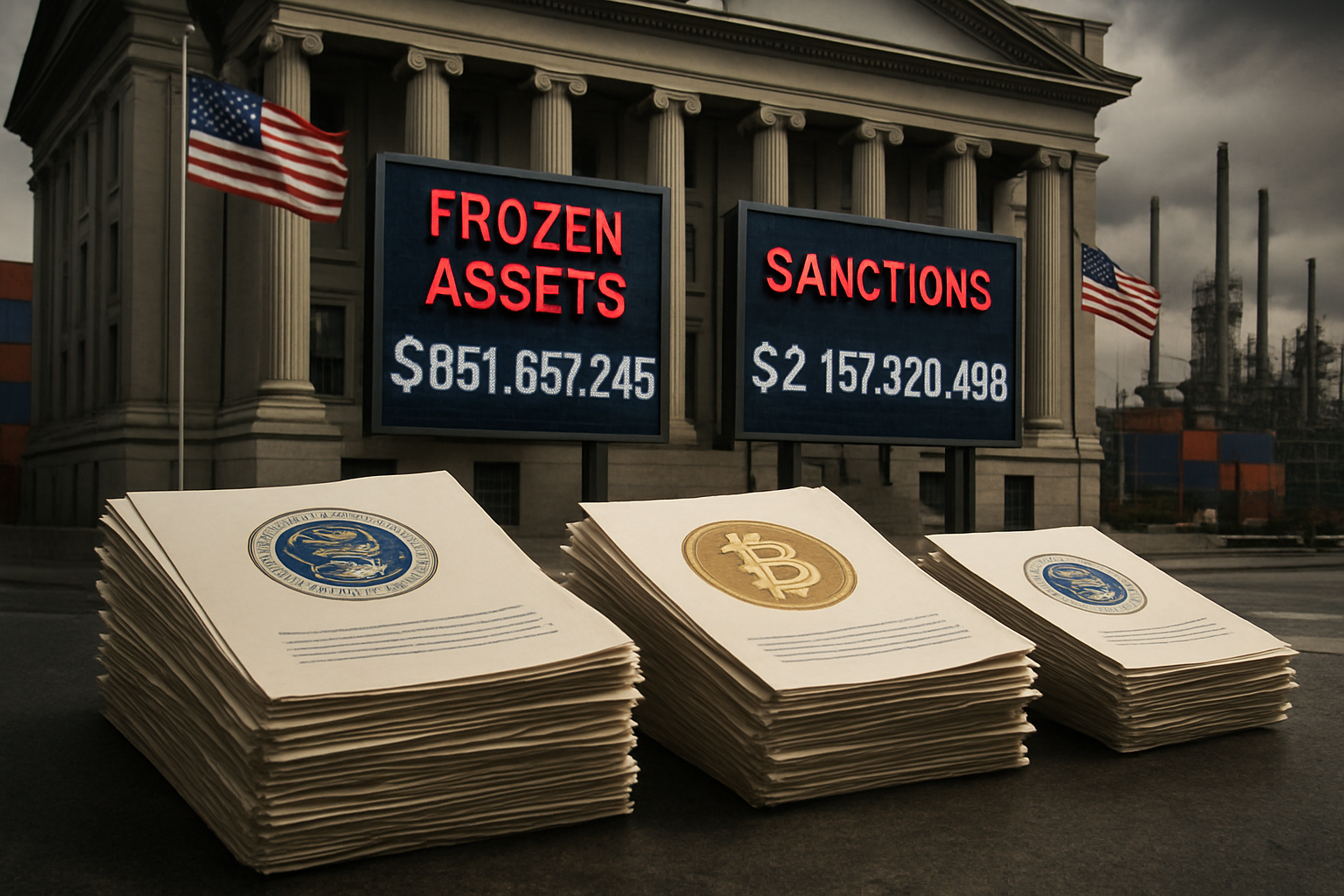
The United States escalated its economic pressure campaign against Iran and China on Friday, imposing sanctions on a major Chinese oil refinery and approximately 40 shipping companies while simultaneously freezing $344 million worth of cryptocurrency assets linked to Iran's financial networks.
The coordinated sanctions package, announced by the Trump administration, represents a significant intensification of the "maximum pressure" strategy that has characterized U.S.-Iran relations throughout the ongoing nuclear crisis. Treasury Secretary Scott Bessent confirmed the cryptocurrency seizure, describing it as part of Washington's broader effort to cut off Iran's access to international financial systems.
Chinese Oil Infrastructure Targeted
The sanctions against Chinese entities mark a dramatic expansion of secondary sanctions targeting companies and countries that conduct business with Iran. A major China-based oil refinery was specifically designated, along with roughly 40 shipping companies and tankers involved in transporting Iranian oil, according to sources familiar with the South China Morning Post reporting.
This move fulfills the Trump administration's longstanding threat to impose secondary sanctions on entities that facilitate Iran's oil exports, which remain Tehran's primary source of revenue despite existing restrictions. The action comes at a particularly sensitive time, as Pakistan-mediated ceasefire talks have shown fragile progress in recent weeks.
Cryptocurrency Asset Freeze
In a parallel enforcement action, U.S. authorities froze $344 million in cryptocurrency assets allegedly connected to Iranian financial networks. The seizure represents one of the largest crypto-related sanctions enforcement actions to date and demonstrates Washington's growing sophistication in tracking digital currency transactions used to circumvent traditional banking restrictions.
The cryptocurrency freeze is particularly significant given Iran's recent implementation of a controversial payment system requiring $1 per barrel in digital currency for oil tankers transiting the Strait of Hormuz. This system has been criticized by international maritime authorities as a violation of free navigation principles under the UN Convention on the Law of the Sea.
Historical Context and Escalation
These sanctions come against the backdrop of the most dangerous U.S.-Iran crisis since the Cold War, which reached its peak in early April 2026 when Trump issued his infamous "whole civilization will die tonight" ultimatum. Pakistan's historic mediation through Prime Minister Shehbaz Sharif and Field Marshal Asim Munir ultimately prevented catastrophic military conflict, achieving a ceasefire just 88 minutes before Trump's deadline.
"We maintain all options to ensure Iran cannot access the international financial system to fund its destabilizing activities."
— Treasury Secretary Scott Bessent
The current sanctions build upon a complex web of restrictions that have evolved since the collapse of the Joint Comprehensive Plan of Action (JCPOA) in 2018. Iran currently maintains uranium enrichment at 60% purity - significantly above the 3.67% limit established under the original nuclear deal and approaching the 90% threshold considered weapons-grade.
Regional Impact and Coalition Dynamics
The sanctions announcement threatens to complicate the delicate regional coalition that has supported diplomatic efforts to resolve the nuclear crisis. Saudi Arabia, the UAE, Qatar, and Egypt have maintained unprecedented consensus in backing negotiated solutions, but the targeting of Chinese commercial interests could strain these arrangements.
China has provided "full support" for Pakistan's mediation efforts, and German officials have noted "positive signs" in recent diplomatic engagement. However, the expansion of sanctions to Chinese entities risks undermining the multilateral cooperation that proved essential during April's crisis resolution.
Economic and Energy Market Implications
The Strait of Hormuz, through which approximately 40% of global oil transit flows, remains a critical chokepoint for international energy markets. While the April ceasefire achieved dramatic oil price stabilization - crashing from $119.50 to below $100 per barrel - the shipping lane continues to operate under Iranian coordination and the controversial cryptocurrency payment system.
The new sanctions could further complicate maritime commerce in the Persian Gulf, where over 150 tankers worth billions in cargo have faced disruptions. Major shipping companies Maersk and MSC have been gradually resuming operations, but vessel owners remain reluctant to commit fully given ongoing uncertainties.
Nuclear Diplomacy Stalemate
The sanctions escalation occurs as nuclear diplomacy remains deadlocked over fundamental scope disagreements. Iran maintains that ballistic missiles and regional proxy activities are "red lines" excluded from nuclear-only talks, while the United States insists on comprehensive agreements addressing missiles, armed groups, and human rights issues.
Iranian Foreign Minister Abbas Araghchi has repeatedly declared that Tehran will "never abandon enrichment even if war is imposed," while expressing willingness to engage in "reassuring agreements" on nuclear activities specifically. This structural disagreement has prevented breakthrough attempts since the JCPOA collapse in 2018.
Congressional and International Reactions
The sanctions received mixed reactions from Congress, where support for military operations against Iran fell to a historic low of 25% during April's crisis. Senator Richard Blumenthal noted concerns about escalation, while Republican hawks have pressed for stronger economic pressure as an alternative to military action.
International allies have expressed varying degrees of support. The United Kingdom's Prime Minister Keir Starmer has stated that Britain "won't be dragged into an Iran war," while France and Germany continue to emphasize diplomatic approaches. Only Israel's Benjamin Netanyahu has offered full support for expanded pressure measures.
Looking Forward
The expanded sanctions represent a test of whether economic pressure can achieve diplomatic objectives that direct military threats could not. The April crisis demonstrated that financial markets can serve as an "ultimate constraint" on prolonged confrontation, as seen when oil price volatility forced reconsideration of military options.
UN Secretary-General António Guterres has described the ongoing situation as the "greatest test of multilateral cooperation in the modern era." The success or failure of this sanctions approach may establish precedents for 21st-century conflict resolution, determining whether diplomatic innovation or military solutions become the preferred approach to international disputes.
With the New START treaty having expired in February 2026 - marking the first time in over 50 years without US-Russia nuclear constraints - the stakes extend far beyond bilateral U.S.-Iran relations. The outcome could influence global nuclear governance mechanisms, territorial sovereignty enforcement, and international law credibility for decades to come.