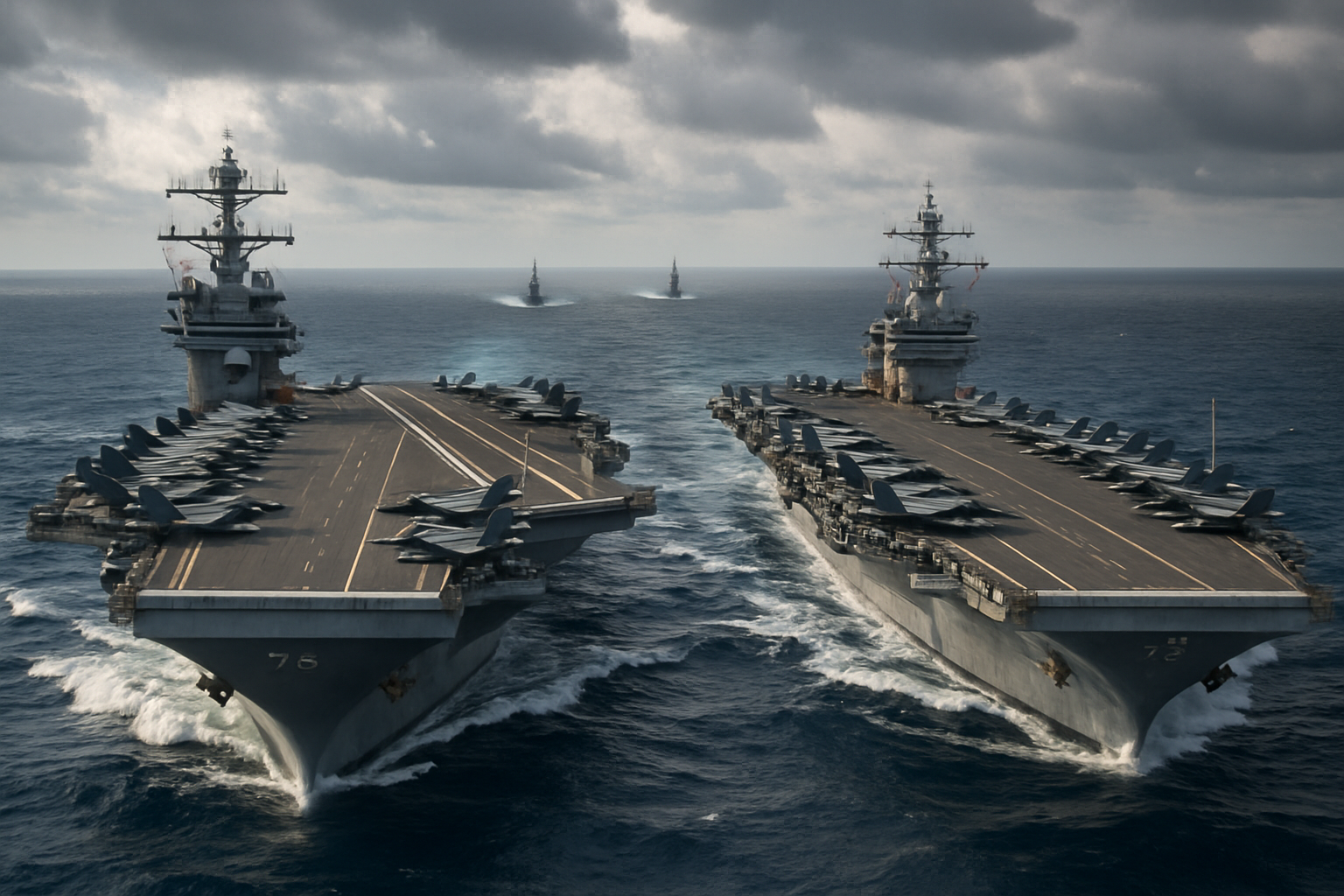
The United States is deploying its largest aircraft carrier, the USS Gerald R. Ford, to the Middle East to join the USS Abraham Lincoln already stationed in the Arabian Sea, according to multiple U.S. officials, marking the most significant American naval buildup in the region in recent years as tensions with Iran escalate despite ongoing nuclear negotiations.
The deployment order, first reported by The New York Times and confirmed by international sources, comes as President Trump's administration pursues a dual-track strategy of military pressure combined with diplomatic engagement. The Ford, currently operating in the Caribbean Sea, will sail to join the Abraham Lincoln and its accompanying guided-missile destroyers already positioned approximately 800 kilometers from Iran's coast.
Unprecedented Naval Power Projection
The Ford's deployment will create the largest U.S. naval presence in the Middle East in years, with two carrier strike groups providing unprecedented military capabilities in the Persian Gulf region. The USS Gerald R. Ford, commissioned in 2017, is the world's most advanced aircraft carrier, featuring cutting-edge technology and enhanced combat capabilities compared to previous generations.
The Abraham Lincoln carrier strike group has been stationed in the Arabian Sea since January 2026, originally deployed in response to Iran's violent crackdown on domestic protests that resulted in over 42,000 arrests and thousands of deaths. The addition of the Ford represents a significant escalation in military deterrence as diplomatic efforts continue through Omani mediation.
Captain Tim Hawkins, spokesperson for U.S. Central Command, confirmed the strategic positioning but declined to comment on specific operational details. The dual-carrier deployment provides multiple strike capabilities, enhanced defensive coverage for regional allies, and sustained 24/7 readiness in one of the world's most volatile regions.
Military Incidents Amid Diplomatic Engagement
The deployment decision follows a series of escalating military incidents that occurred even as nuclear negotiations proceeded in Oman. Most significantly, an F-35C fighter jet from the USS Abraham Lincoln shot down an Iranian Shahed-139 drone that aggressively approached the carrier in international waters of the Arabian Sea.
The drone incident, confirmed by CENTCOM, involved no U.S. casualties but demonstrated the persistent military tensions operating alongside diplomatic engagement. The same day, Iranian Revolutionary Guard Corps (IRGC) vessels harassed a U.S.-flagged tanker in the Strait of Hormuz, affecting maritime traffic through the waterway that handles 40% of global oil transit.
"We have to make a deal, otherwise bad things could happen to Iran."
— President Donald Trump, February 2026
Oil prices rose more than $1 per barrel following news of both the military incidents and the second carrier deployment, reflecting market concerns about potential supply disruptions in the energy-critical Persian Gulf region.
Nuclear Negotiations Face Fundamental Obstacles
The carrier deployment comes as U.S.-Iran nuclear talks, mediated by Oman, have achieved a framework for continued dialogue but remain deadlocked over fundamental scope disagreements. Iranian Foreign Minister Abbas Araghchi described the February 7 negotiations as having a "positive atmosphere" while maintaining that ballistic missiles and regional proxy activities remain "red lines" excluded from nuclear-only discussions.
Iran continues enriching uranium at 60% purity, significantly above the 3.67% limit established in the 2015 Joint Comprehensive Plan of Action (JCPOA) and approaching the 90% threshold considered weapons-grade. Intelligence reports suggest Iran possesses sufficient enriched uranium for multiple nuclear weapons if weaponized, though Tehran continues to deny seeking nuclear weapons capabilities.
U.S. Secretary of State Marco Rubio has insisted that any comprehensive agreement must address not only nuclear issues but also Iran's ballistic missile program, support for regional armed groups, and human rights violations. This broader scope demand conflicts directly with Iran's compartmentalized approach to negotiations.
Regional Coalition Supporting Diplomatic Process
Despite military tensions, an unprecedented regional coalition has emerged supporting the diplomatic process. Saudi Arabia, the United Arab Emirates, Qatar, and Egypt have all endorsed continued negotiations, representing remarkable Middle Eastern consensus for preventing military confrontation through diplomatic means.
Oman's role as neutral mediator has proved essential, leveraging the sultanate's historical experience from the 2015 JCPOA negotiations and its unique position maintaining diplomatic relations with both Washington and Tehran. The structured dialogue enabled by Omani mediation represents the most significant U.S.-Iran diplomatic engagement since the JCPOA's collapse in 2018.
Regional investment in diplomatic success reflects concerns about the economic and security implications of potential military confrontation. The Persian Gulf's role in global energy markets makes regional stability crucial for international economic security, with any conflict potentially disrupting supply chains far beyond the Middle East.
Israeli Coordination and Security Concerns
The naval deployment coincides with intensified coordination between President Trump and Israeli Prime Minister Benjamin Netanyahu, who met at the White House for their seventh encounter since Trump's return to office. Netanyahu has emphasized that any Iran agreement must include "limiting ballistic missiles and ending support for the Iranian axis" as essential Israeli security requirements.
Israeli officials view nuclear-only agreements as insufficient for addressing existential security threats from Iran's integrated missile and proxy network, including Hezbollah, Hamas, and the Houthis. The coordination reflects Israel's concerns about incomplete agreements that might provide sanctions relief without addressing the full spectrum of Iranian regional activities.
"All negotiations must include limiting ballistic missiles, ending support for Iranian axis."
— Benjamin Netanyahu, Israeli Prime Minister
Domestic Pressures Driving Iranian Calculations
Iran faces severe domestic pressure from economic sanctions, widespread protests, and international isolation. The Islamic Republic has arrested over 42,000 protesters since 2022, with thousands killed during violent crackdowns. Economic sanctions have created regime survival pressure, making sanctions relief through diplomatic agreements potentially attractive.
However, Iranian officials have maintained defiant positions on core issues. Foreign Minister Araghchi declared Iran would "never abandon uranium enrichment even if war is imposed," suggesting limited flexibility on nuclear capabilities despite economic hardships. This stance reflects internal regime calculations prioritizing perceived strategic capabilities over immediate economic relief.
The Iranian government's commemoration of the 47th anniversary of the 1979 Islamic Revolution featured both acknowledgment of domestic failures and renewed defiance on nuclear issues, illustrating the complex pressures facing Tehran's leadership.
International Nuclear Governance Crisis
The Iran crisis unfolds against a broader breakdown in international nuclear governance. The New Strategic Arms Reduction Treaty (New START) between the United States and Russia expired February 5, marking the first time in over 50 years without nuclear arms control agreements between the superpowers. This creates additional urgency for preventing Iranian nuclear weapons development amid the broader erosion of non-proliferation frameworks.
UN Secretary-General António Guterres has warned that nuclear risks are "higher than at any time in decades," with the Iran situation representing a critical test of diplomatic solutions to nuclear proliferation challenges. The intersection of superpower arms control breakdown with regional nuclear crises creates unprecedented challenges for international security architecture.
Economic and Military Dual-Track Strategy
The Trump administration continues implementing a dual-track approach combining military deterrence with economic pressure and selective diplomatic engagement. The same day nuclear talks concluded, Trump signed executive orders threatening 25% tariffs on countries conducting business with Iran, demonstrating the maintenance of "maximum pressure" even during diplomatic engagement.
The approach reflects calculations about leveraging American military and economic superiority to achieve diplomatic objectives while avoiding direct military confrontation. However, the sustainability of this strategy depends on preventing escalation while maintaining pressure sufficient to encourage Iranian concessions on core issues.
Strategic Stakes and Regional Implications
The deployment of a second aircraft carrier represents more than tactical military positioning; it signals American commitment to regional allies while testing whether military deterrence can create space for diplomatic solutions. Success could provide a template for resolving nuclear proliferation challenges through integrated pressure and engagement.
Failure, however, could accelerate military solutions that would reshape Middle Eastern geopolitics for decades. A regional war involving Iran would likely draw in multiple actors, disrupt global energy markets, and potentially trigger wider conflicts involving Israel, Saudi Arabia, and other regional powers.
The coming weeks will prove decisive for determining whether innovative diplomatic solutions can bridge decade-old challenges or whether military confrontation becomes inevitable. The dual-carrier deployment provides both deterrence capability and potential strike options should diplomatic efforts ultimately fail.
Looking Ahead: Critical Diplomatic Window
Both sides have agreed to continue nuclear negotiations "early next week," though fundamental disagreements persist over scope, verification mechanisms, and sanctions relief timelines. The window for diplomatic success remains open but appears to be narrowing as military preparations intensify and domestic pressures mount on both sides.
The international community is closely monitoring developments, recognizing that the Iran crisis represents a critical test of 21st-century conflict resolution mechanisms. Success could prevent regional war and provide precedents for addressing nuclear proliferation challenges elsewhere. Failure could establish dangerous precedents for military solutions to complex diplomatic challenges.
With two aircraft carriers now positioned in Middle Eastern waters, the United States has demonstrated both its commitment to preventing Iranian nuclear weapons development and its readiness for military action if diplomatic efforts prove insufficient. The next phase of this crisis will determine whether military pressure can ultimately serve diplomatic objectives or whether it accelerates toward the confrontation all parties claim to want to avoid.