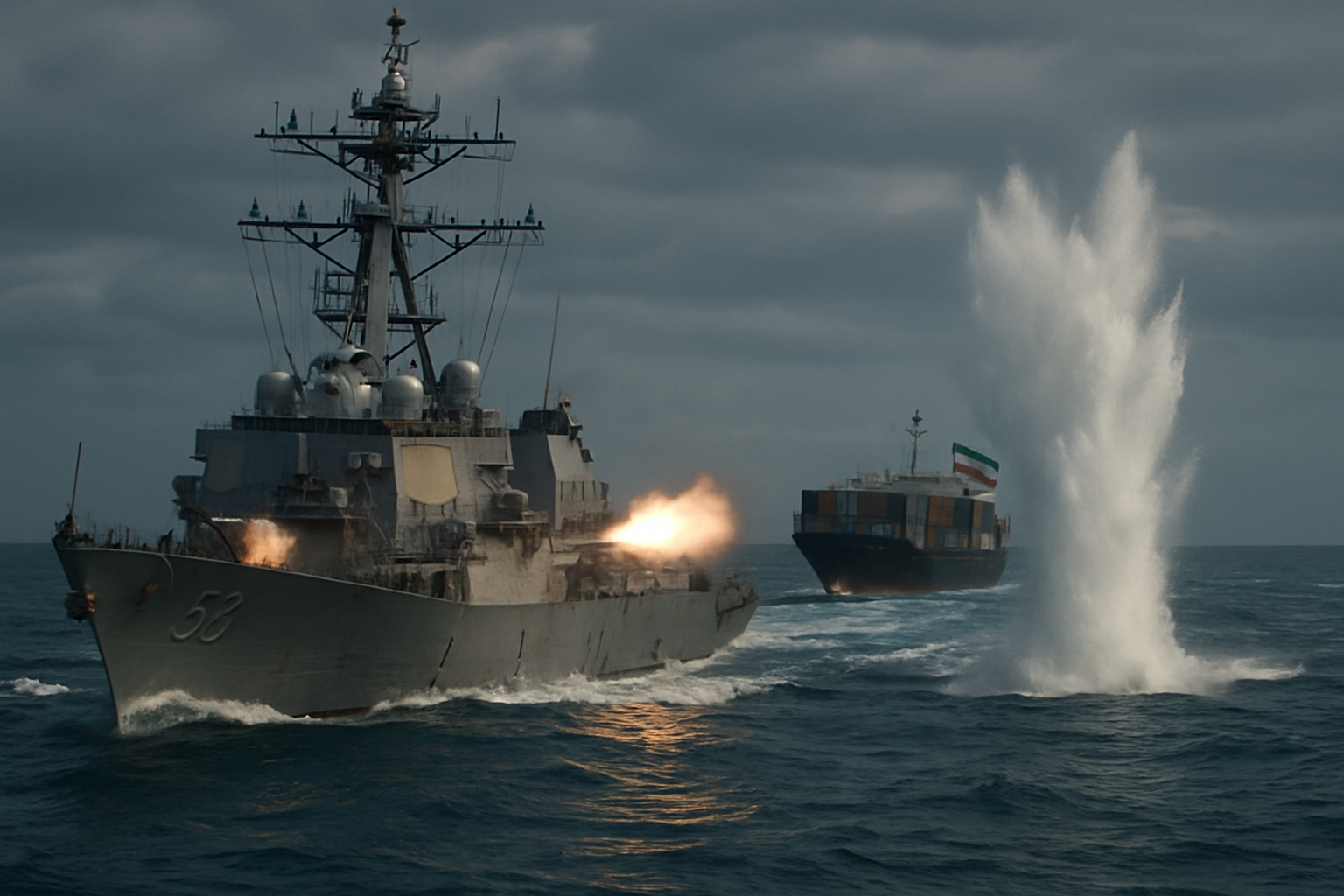
US naval forces have seized control of an Iranian cargo ship in the strategically vital Strait of Hormuz after opening fire on the vessel, triggering immediate Iranian threats of retaliation and sending global oil prices surging over 6% in one of the most serious maritime confrontations in the region this year.
President Donald Trump confirmed Sunday evening via Truth Social that US Navy destroyers fired on the Iranian-flagged cargo ship "Touska" in the Gulf of Oman, creating "a hole in the engine room" after the vessel allegedly ignored multiple orders to halt. The ship, which was under US Treasury sanctions, was subsequently boarded and taken under American military control.
"The Iranian ship ignored repeated calls to stop, so we blew a hole in their engine room," Trump posted, describing the operation as enforcement of the ongoing US naval blockade of Iranian ports that has been in place since earlier diplomatic efforts collapsed.
Iranian Response: Promises of Swift Retaliation
Iran's military leadership reacted with immediate condemnation and threats of retaliation. The Islamic Revolutionary Guard Corps (IRGC) declared the incident "armed piracy" and warned that Iranian forces would "respond soon and retaliate against this armed piratical act by the American military."
Iranian state media reported that the vessel was traveling from China to Iran when it was intercepted by US forces. Iran's supreme military command, Khatam al-Anbiya, stated that the ship was engaged in legitimate commercial activity when attacked, calling the seizure a violation of international maritime law.
"We warn that the armed forces of the Islamic Republic of Iran will soon respond and retaliate against this armed piracy by the American military."
— Khatam al-Anbiya spokesman, Iranian Supreme Military Command
Iranian President Masoud Pezeshkian, speaking with Pakistan's Prime Minister Shahbaz Sharif, characterized the US action as "intimidating and unjustified," according to Iranian state television reports. Tehran has consistently maintained that American naval operations in the Persian Gulf constitute violations of international law and regional sovereignty.
Oil Markets React with Sharp Price Increases
Global energy markets responded immediately to news of the confrontation, with oil prices experiencing their largest single-day jump in months. Brent crude surged to over $95 per barrel, representing a more than 6% increase from previous levels around $90, while West Texas Intermediate (WTI) crude saw similar gains.
The dramatic price movement reflects deep market concerns about potential disruptions to shipping through the Strait of Hormuz, the narrow waterway through which approximately 40% of the world's seaborne oil transit passes. Any escalation in US-Iran tensions in this critical chokepoint has historically triggered significant energy market volatility.
Energy analysts noted that the incident comes amid already elevated geopolitical tensions in the region, with shipping companies having previously suspended operations in Persian Gulf waters during earlier phases of the US-Iran confrontation.
Strategic Context: Ongoing Naval Blockade
The ship seizure represents the latest escalation in what has become an extended standoff between Washington and Tehran over Iran's nuclear program and regional activities. The US has maintained a naval blockade of Iranian ports since diplomatic talks collapsed in Pakistan earlier this year, despite strong opposition from European allies and congressional critics.
The confrontation occurs against the backdrop of failed peace negotiations mediated by Pakistan, where 21 hours of intensive talks between US Vice President JD Vance and Iranian representatives ultimately broke down over fundamental disagreements regarding Iran's nuclear enrichment program. Iran continues to enrich uranium to 60% purity, approaching weapons-grade levels, while maintaining over 400 kilograms of enriched material.
NATO allies have largely rejected US requests for naval support in the Gulf, with UK Prime Minister Keir Starmer declaring Britain "will not be dragged into an Iran war," while France and Germany have emphasized diplomatic approaches over military confrontation.
Congressional Opposition and Domestic Pressure
The latest escalation faces significant domestic political opposition, with congressional support for military operations against Iran at historically low levels of approximately 25%. Senator Richard Blumenthal has expressed growing concerns about potential ground troop deployments, while the costs of military operations have already reached $11.3 billion in their first week.
Financial markets have served as what analysts call the "ultimate constraint" on prolonged military confrontation, with previous phases of the crisis triggering dramatic stock market declines across Asian and European markets.
Regional Coalition Under Strain
The incident puts additional pressure on the unprecedented regional coalition of Saudi Arabia, UAE, Qatar, and Egypt that has largely supported diplomatic solutions to the crisis. Previous Iranian retaliation operations have caused casualties across Gulf state territories, with Egypt's President Abdel Fattah el-Sisi warning of "comprehensive chaos" affecting "sisterly countries."
The confrontation also raises questions about the sustainability of current shipping arrangements, as major logistics companies like Maersk and MSC have already suspended operations in Persian Gulf waters, leaving over 150 oil and LNG tankers stranded with cargo worth billions of dollars.
Nuclear Governance Crisis Context
The maritime confrontation unfolds within a broader nuclear governance crisis, as the New START treaty between the US and Russia expired in February 2026, marking the first time in over 50 years that the world's two largest nuclear powers operate without formal arms control constraints. Iran's advancing nuclear program, combined with this deteriorating global arms control framework, has led UN Secretary-General António Guterres to warn that nuclear risks are at their "highest level in decades."
Expert assessments suggest Iran possesses sufficient enriched uranium for multiple nuclear weapons if the decision were made to weaponize the material, creating urgent timeline pressures for any diplomatic resolution.
Template-Setting Implications
Security analysts view the current crisis as potentially template-setting for 21st-century international relations, determining whether diplomatic solutions can prevail over military confrontation in an increasingly multipolar world order. The stakes extend far beyond the bilateral US-Iran dispute, affecting global energy security, nuclear governance credibility, and international law enforcement mechanisms.
As Guterres noted, the situation represents the "greatest test of multilateral cooperation and crisis management in the modern era," with implications that could reshape international stability mechanisms for decades to come.
The immediate focus remains on whether the latest escalation will prompt renewed diplomatic efforts or lead to further military confrontation in one of the world's most strategically vital waterways. Oil markets and global supply chains continue to monitor developments closely, with the potential for significant economic disruption if tensions continue to escalate.