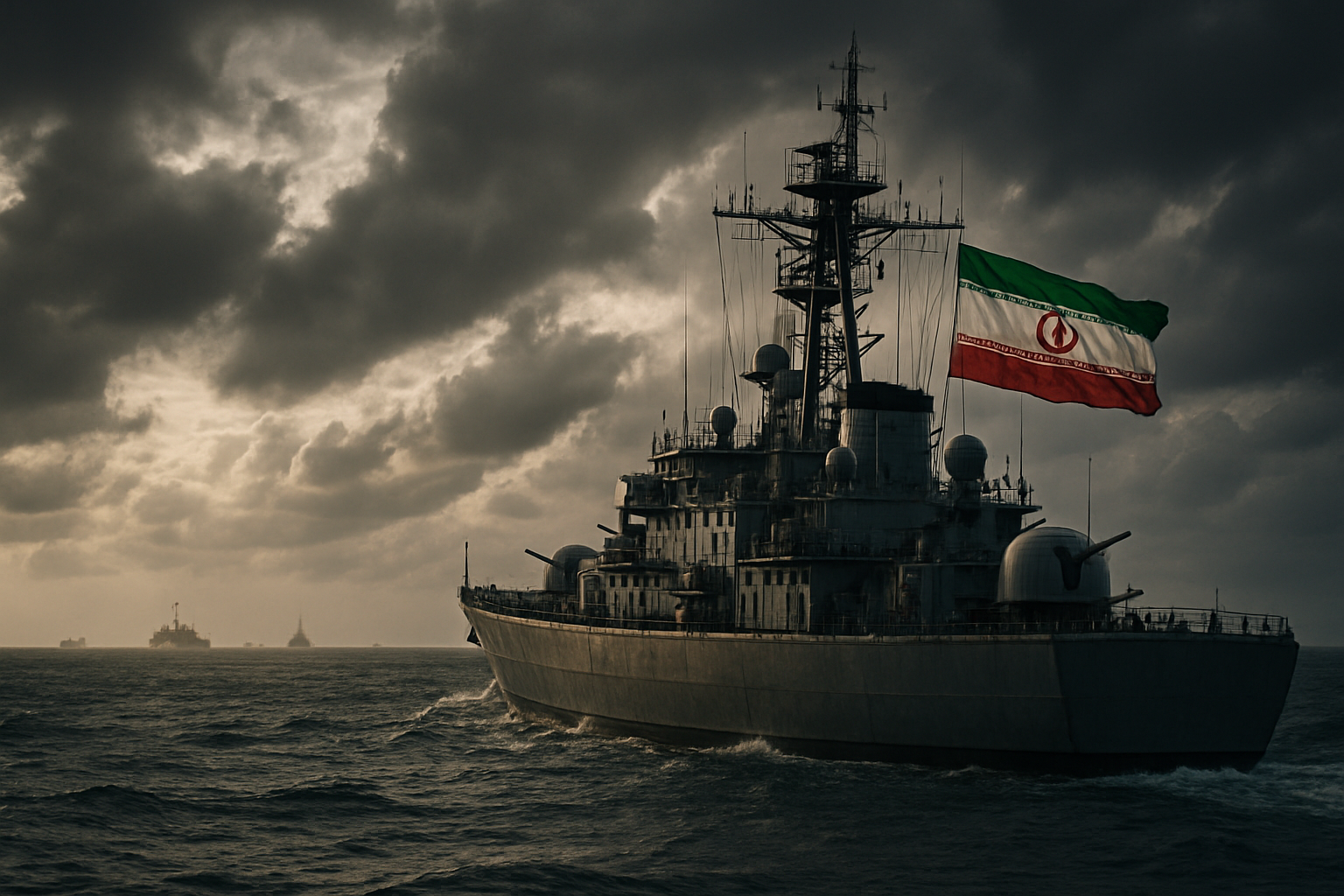
US Navy forces seized the Iranian-flagged cargo vessel Touska in the Gulf of Oman on Sunday following a tense standoff, marking the latest dangerous escalation in a crisis that has threatened global oil supplies and derailed diplomatic efforts to resolve mounting US-Iran tensions.
President Donald Trump confirmed via Truth Social that American forces had gained "full custody" of the container ship after its crew refused orders to halt. The USS Spruance opened fire on the vessel's engine room before Marines conducted a helicopter assault to board the ship, according to multiple sources familiar with the operation.
The seizure represents the most direct naval confrontation between US and Iranian forces in the ongoing crisis that began in March 2026, when Iran's Revolutionary Guard declared the Strait of Hormuz "unsafe for shipping" and deployed thousands of naval mines throughout the strategic waterway.
Maritime Confrontation Intensifies
The incident unfolded after the Touska, traveling from China to Iran's Bandar Abbas port, reportedly attempted to breach the US naval blockade of Iranian ports. Iran's Revolutionary Guard maintains "complete control" of the Strait of Hormuz and has threatened to create a "deadly whirlpool" for any vessels challenging Iranian sovereignty.
China's Foreign Ministry expressed serious concern over the seizure, with spokesman Guo Jiakun calling the situation in the strait "sensitive and complex" and urging all parties to exercise restraint. Beijing has called for de-escalation and respect for the recently announced ceasefire agreements.
According to Italian media reports, the Touska appears on US Treasury sanctions lists maintained by the Office of Foreign Assets Control, which administers American sanctions programs. The vessel's presence on these lists may provide legal justification for the seizure under international maritime law.
"Iran vowed to retaliate, throwing planned peace talks between the two countries into question."
— France 24 International News
Diplomatic Fallout and Peace Talks Collapse
The naval incident has effectively derailed Pakistani-mediated peace negotiations that were scheduled to resume in Islamabad. Iran's Foreign Ministry announced it has "no plans for further negotiations with the US," citing Washington's "excessive demands" and the continuation of the naval blockade.
The collapse represents a significant blow to unprecedented middle-power diplomacy efforts led by Pakistani Prime Minister Shehbaz Sharif and Field Marshal Asim Munir. Their previous "Islamabad Accord" had achieved a temporary ceasefire just 88 minutes before a Trump administration deadline in early April, temporarily crashing oil prices by 20% from $119.50 to $100 per barrel.
VP JD Vance had led 21-hour marathon negotiations that ultimately failed over nuclear program sticking points, with the US demanding Iran suspend its 60% uranium enrichment program and abandon its stockpile of 400+ kilograms of weapons-grade material. Iranian Foreign Minister Abbas Araghchi maintained Iran would "never abandon enrichment even if war is imposed."
Global Economic Impact
The seizure has triggered immediate market volatility, with Brent crude surging above $106 per barrel and WTI climbing to $104.29 - marking the second time in 2026 that oil prices have breached the $100 threshold. The Strait of Hormuz handles approximately 40% of global seaborne oil shipments, making any disruption a critical threat to energy security.
Major shipping companies Maersk and MSC continue to suspend operations in the Persian Gulf, with over 150 oil and LNG tankers worth billions in cargo stranded in the region. The International Energy Agency maintains its record 400 million barrel strategic reserve release - the largest in its 50-year history - to stabilize global markets.
Consumer impacts are being felt worldwide, with Bangladesh implementing fuel rationing for 170 million people, Pakistan maintaining wartime austerity measures, and European heating costs threatening to surge again after brief relief during the temporary ceasefire.
Regional Coalition Under Strain
The crisis has severely tested the unprecedented regional coalition of Saudi Arabia, UAE, Qatar, and Egypt, which has maintained unity despite Iranian retaliation attacks across their territories during Operation True Promise 4. The UAE suffered one civilian death in Abu Dhabi, Kuwait reported 32 injuries from airport strikes, and Qatar recorded 8 wounded despite Patriot missile system intercepts of 65 missiles and 12 drones.
Egyptian President Abdel Fattah el-Sisi's warnings about "comprehensive chaos" in "sisterly countries" have proven increasingly prophetic as diplomatic solutions remain elusive and military confrontations escalate.
International Opposition and Nuclear Concerns
NATO allies have largely distanced themselves from US military actions, with UK Prime Minister Keir Starmer declaring Britain "will not be dragged into an Iran war" and France and Germany emphasizing diplomatic approaches. Australia and Japan have declined to provide naval vessels, representing the most significant rejection of American military leadership since the 2003 Iraq War.
The crisis unfolds against the backdrop of the New START Treaty's expiration in February 2026 - the first time in over 50 years that the US and Russia operate without nuclear arms constraints. Iran's continued uranium enrichment at 60% purity, with sufficient material for multiple nuclear weapons if weaponized, adds urgency to the situation.
"The evolution of the international situation is becoming increasingly complex, and external risks are mounting."
— Zheng Shanjie, China's National Development and Reform Commission
Energy Security and Supply Chain Vulnerabilities
Chinese economic planners are reassessing the country's vulnerabilities amid the Strait of Hormuz disruptions, with the National Development and Reform Commission outlining strategies to safeguard economic security. The crisis has exposed the dangerous over-dependence on strategic chokepoints in global energy architecture.
Chinese investment analysts suggest the "Hormuz moment" could herald a decline in US dominance and accelerate the strategic retreat of Washington's influence in the region. The 21-mile strait represents a single point of failure for modern global logistics, with no realistic alternatives for the massive volume of energy and trade that flows through the waterway.
Congressional Opposition and Military Costs
Domestic opposition to military operations has reached historic levels, with only 25% of Americans supporting Operation Epic Fury according to recent polling. Senator Richard Blumenthal has expressed growing concerns about potential ground troop deployments, while the operation has already cost $11.3 billion in its first week alone.
Pentagon operations are projected to continue through September 2026, far exceeding initial 4-6 week timelines. The dual-carrier deployment in the Arabian Sea represents approximately one-third of the entire US Navy fleet, highlighting the massive military commitment required to maintain the blockade.
Template-Setting Crisis for 21st Century
UN Secretary-General António Guterres has called the situation "the greatest test of multilateral cooperation and crisis management in the modern era." The rapid transition from diplomacy to military confrontation demonstrates what experts describe as "multipolar era fragility" in crisis management mechanisms.
The stakes extend far beyond the bilateral US-Iran dispute, affecting global energy security architecture, nuclear governance credibility, and international law enforcement mechanisms for decades to come. Success in containing the crisis could provide a framework for 21st-century nuclear crisis resolution, while failure may accelerate military solutions and undermine diplomatic credibility worldwide.
Looking Forward
As the seizure of the Touska represents the latest escalation in what has become the most dangerous international crisis since the end of the Cold War, the international community faces critical questions about energy security paradigms, alliance structures, and conflict resolution mechanisms.
The collapse of Pakistani mediation efforts eliminates one of the few remaining diplomatic channels, raising the prospect of prolonged military confrontation with global implications extending decades beyond the current crisis. Whether innovative diplomatic solutions can still emerge to bridge fundamental disagreements over nuclear programs and regional conflicts remains an open question with civilizational implications.