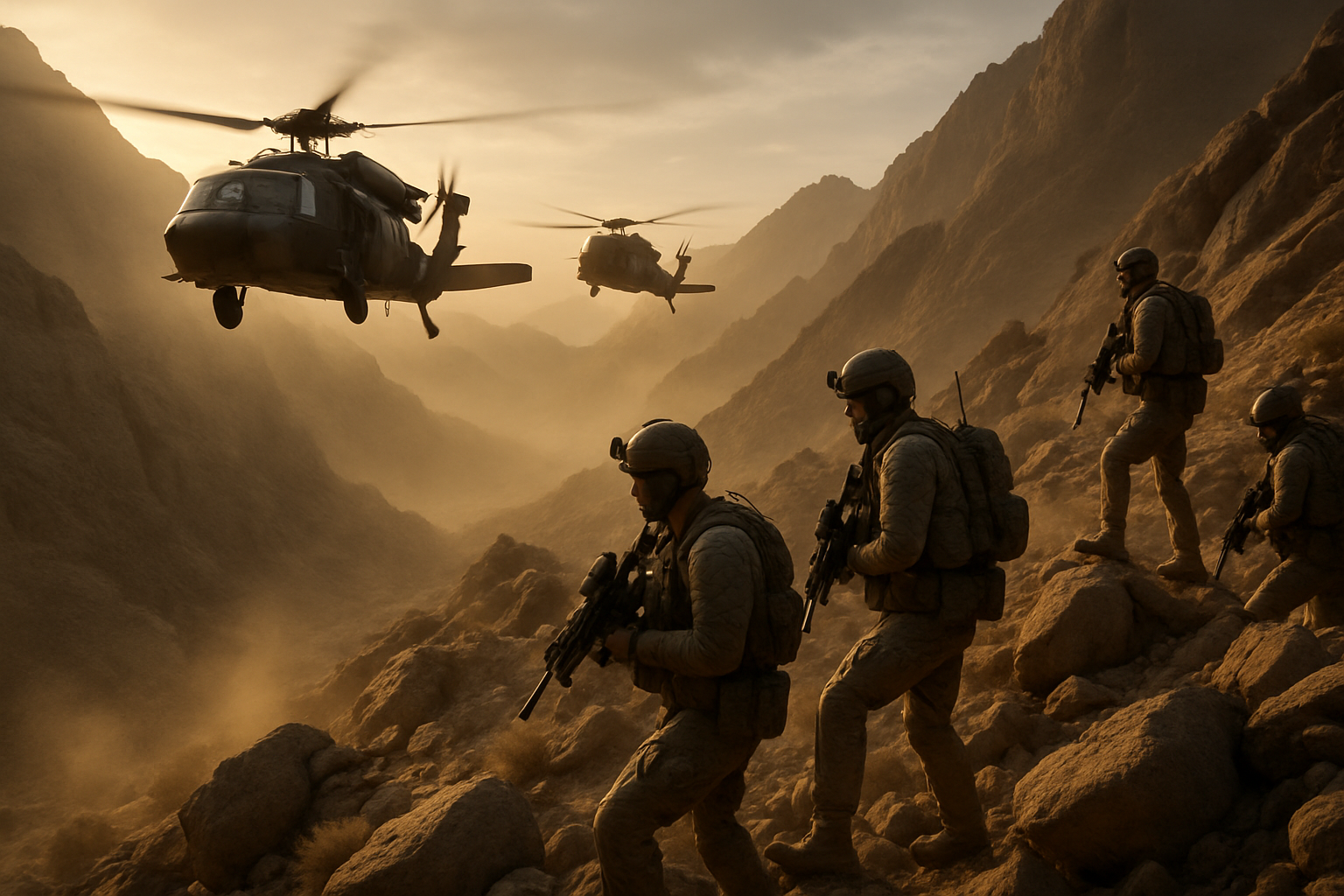
US special forces completed a dramatic rescue operation Sunday, successfully extracting an injured F-15E Strike Eagle weapons systems officer from deep inside Iranian territory after he spent more than 48 hours evading Revolutionary Guard forces in mountainous terrain.
President Donald Trump announced the successful rescue early Sunday morning, describing it as "one of the most daring Search and Rescue Operations in U.S. History." The operation marks a significant tactical victory for American forces amid the ongoing Operation Epic Fury, the largest US-Israeli coordinated military campaign since the 2003 Iraq invasion.
The Rescue Mission Unfolds
The dramatic extraction operation involved hundreds of military personnel and dozens of aircraft operating under hostile conditions. According to multiple international sources, the injured colonel—a weapons systems officer from an F-15E Strike Eagle shot down Friday—had been hiding in southwestern Iran's rugged mountain terrain while Iranian Revolutionary Guard forces conducted intensive search operations.
"The airman was injured but he will be just fine. Over the past several hours, the United States Military pulled off one of the most daring Search and Rescue Operations in U.S. History."
— President Donald Trump, Statement
Iranian forces had offered rewards of up to 57,000 euros for the pilot's capture and were conducting what they termed "comprehensive field operations" across the region. The rescue operation faced intense resistance, with multiple US aircraft coming under fire during the extraction. Iran claimed to have shot down two Black Hawk helicopters and a C-130 transport plane during the rescue mission, though these claims could not be independently verified.
High-Stakes Mountain Extraction
Swedish media reports revealed the most harrowing details of the rescue, describing it as "the most complex operation ever." The missing airman was discovered injured in a mountain crevice at an altitude of 2,200 meters above sea level in Iran's challenging terrain. The operation required specialized mountain rescue capabilities and precise coordination between multiple military units.
European intelligence assessments suggested that Iran had deliberately released footage of the F-15's ejection seat to disrupt US coordination efforts. Despite these psychological warfare tactics, American forces maintained operational security throughout the mission.
The rescue operation encountered significant complications when Iranian forces opened fire on US aircraft attempting the extraction. At least one Black Hawk helicopter was damaged during the mission, with crew members wounded, according to reports from multiple international outlets.
Context of the Broader Crisis
The successful rescue comes amid the most dangerous international crisis since the Cold War, with Operation Epic Fury having already cost $11.3 billion in its first week alone. The downing of the F-15E Strike Eagle on Friday marked the first confirmed US aircraft loss during the six-week conflict, representing a significant symbolic victory for Iranian forces against American air superiority.
The crisis stems from the complete breakdown of diplomatic efforts, despite Geneva talks achieving a "broad agreement on guiding principles"—the most progress since the 2018 JCPOA collapse. Iran's insistence on nuclear-only negotiations excluding ballistic missiles and regional proxies as "red lines" proved incompatible with US demands for a comprehensive agreement addressing missiles, armed groups, and human rights issues.
Regional and Global Implications
The successful rescue operation occurs against the backdrop of unprecedented global disruption. More than 18,000 flights have been cancelled worldwide—reaching COVID-scale aviation crisis levels—while oil prices have surged past $100 per barrel due to Iran's closure of the Strait of Hormuz, affecting 40% of global oil transit.
The conflict has seen Iranian "Operation True Promise 4" retaliation strike multiple regional targets, causing casualties across Gulf states including the UAE, Kuwait, and Qatar. Most significantly, Iranian forces struck RAF Akrotiri in Cyprus, marking the first attack on European territory since World War II.
Congressional Pressure Mounts
The rescue operation's success provides some relief to the Trump administration, which has faced mounting congressional pressure over the conflict. With only 25% American public support—described as "almost unprecedented" unpopularity for early-stage military operations—bipartisan lawmakers have been demanding comprehensive briefings on strategy, costs, and the potential for ground troop deployment.
"I am more concerned than ever about the prospect of American boots on the ground in this conflict."
— Senator Richard Blumenthal
Pentagon operations are now planned to continue through September, far exceeding the initial 4-6 week timeline originally envisioned by the administration. The extended timeline has raised questions about mission scope and ultimate objectives.
Nuclear Governance Crisis
The rescue operation takes place within a broader nuclear governance crisis following the expiration of the New START treaty in February 2026—the first time in over 50 years that the US and Russia have operated without nuclear constraints. Iran continues uranium enrichment at 60% purity with over 400 kilograms of weapons-grade material, approaching the threshold for multiple nuclear weapons capability.
UN Secretary-General António Guterres has described the situation as the "greatest test of multilateral cooperation in the modern era," highlighting the template-setting nature of this crisis for 21st-century conflict resolution.
The Human Cost
While celebrating the successful rescue, the operation underscores the human stakes of the escalating conflict. The Iranian Red Crescent reports over 787 civilian casualties from US-Israeli strikes, while the Pentagon has confirmed responsibility for attacks on civilian targets including an elementary school where 165-185 students were killed due to "outdated targeting data."
International evacuations have reached Arab Spring 2011 levels, with Australia reporting 115,000 nationals requiring extraction and Germany 30,000 stranded tourists. The EU has activated its ESTIA evacuation mechanism for the first time in the bloc's history.
Looking Forward
The successful rescue operation, while providing a tactical victory, does not resolve the underlying strategic challenges facing both sides. With peace negotiations suspended and no clear diplomatic pathway forward, the rescued airman's extraction represents both a human triumph and a symbol of the broader crisis management challenges facing the international community.
As President Trump declared "we have him!" the operation demonstrates American military capabilities in complex hostile environments while highlighting the human cost and global implications of the ongoing conflict. The rescue marks a rare moment of success in what continues to be the most dangerous international crisis since the end of the Cold War.