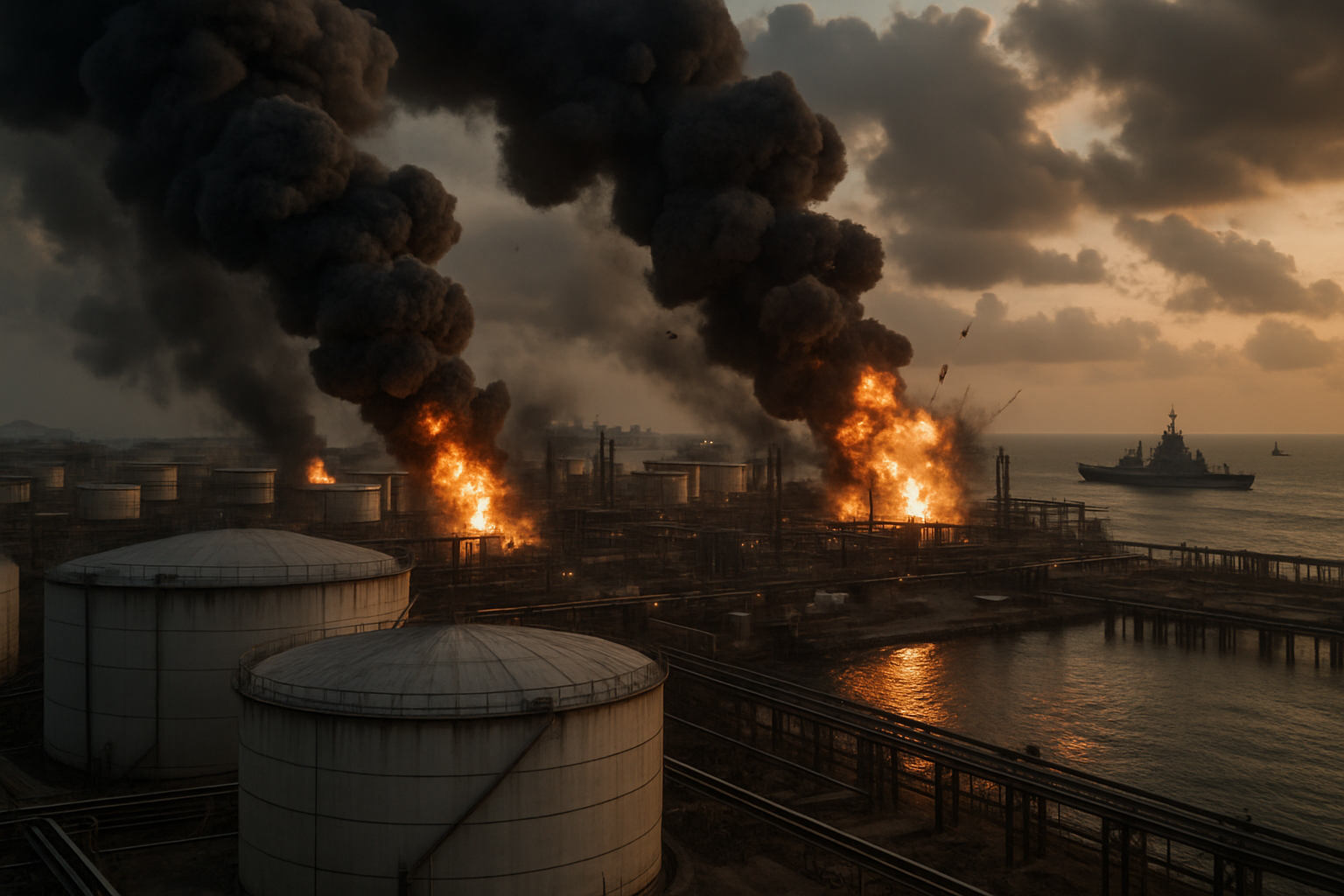
President Donald Trump announced that the United States has conducted "one of the most powerful bombing raids in the history of the Middle East" against Iran's Kharg Island oil export hub, marking a dramatic escalation in the ongoing conflict while deliberately sparing oil infrastructure in a calculated show of restraint.
The strategic strikes on Kharg Island represent the first US attack on Iran's most critical energy infrastructure, which handles 90% of the country's crude oil exports. Located approximately 300 miles northwest of the Strait of Hormuz, the island serves as Iran's primary economic lifeline and a cornerstone of global energy markets.
Unprecedented Military Operation
Trump confirmed via Truth Social that US Central Command "totally obliterated" military targets on the island while deliberately avoiding oil facilities. "Our weapons are the most powerful and advanced in the world, but out of consideration, I decided not to destroy the oil infrastructure on the island," Trump stated, warning that this decision could be immediately reconsidered if Iran continues to interfere with shipping in the Strait of Hormuz.
The operation represents the latest phase of "Operation Epic Fury," the largest coordinated US-Israeli military campaign since the 2003 Iraq invasion, utilizing an unprecedented dual-carrier deployment of the USS Gerald R. Ford and USS Abraham Lincoln—representing approximately one-third of the active US Navy fleet.
Strategic Implications and Energy Markets
The attack on Kharg Island carries profound implications for global energy security. The island's oil terminal processes approximately 1.6 million barrels per day, representing a critical chokepoint in the global petroleum supply chain. Oil prices have already surged past $100 per barrel, with analysts warning of potential increases toward $200 if the Strait of Hormuz remains compromised.
"Should Iran, or anyone else, do anything to interfere with the Free and Safe Passage of Ships through the Strait of Hormuz, I will immediately reconsider this decision."
— President Donald Trump, Truth Social
Iran has effectively closed the Strait of Hormuz through naval mining operations, stranding over 150 tankers worth billions in cargo. The waterway typically handles 40% of global seaborne oil transit, making its closure a critical threat to international energy security.
Regional Coalition Under Strain
The escalation has severely strained the previously unprecedented coalition of Saudi Arabia, UAE, Qatar, and Egypt that had backed diplomatic efforts. Iranian retaliation campaigns have directly targeted these coalition members, with casualties reported across multiple Gulf states.
Egyptian President Abdel Fattah el-Sisi condemned Iranian attacks on "sisterly Arab countries," warning of "comprehensive chaos" spreading across the region. This marks a significant departure from the remarkable Middle Eastern consensus that had previously supported diplomatic solutions.
Global Crisis Dimensions
The conflict has triggered the most extensive aviation crisis since COVID-19, with over 18,000 flights cancelled worldwide as eight Middle Eastern countries simultaneously closed their airspace. Dubai International Airport, the world's busiest with 86 million annual passengers, remains shuttered from missile damage.
Major carriers including Emirates, Air France-KLM, and Wizz Air have suspended operations indefinitely, affecting hundreds of thousands of passengers globally. The disruption has severed critical Asia-Europe flight corridors, demonstrating the conflict's far-reaching impact on global connectivity.
Nuclear Diplomacy Collapse
The military escalation followed the complete breakdown of nuclear negotiations despite achieving what Iranian Foreign Minister Abbas Araghchi called "broad agreement on guiding principles"—the most significant diplomatic progress since the 2018 JCPOA collapse.
The fundamental scope disagreement proved insurmountable: Iran insisted on nuclear-only talks excluding ballistic missiles and regional proxies as "red lines," while the US demanded comprehensive agreements addressing missiles, armed groups, and human rights issues. Iran continues uranium enrichment at 60% purity with over 400 kilograms of material approaching weapons-grade levels.
Humanitarian and Congressional Concerns
The Pentagon investigation confirmed US responsibility for an elementary school strike in Minab that killed between 165-185 students, attributed to "outdated targeting data." This incident has prompted 46 Democratic senators to demand a swift investigation, with Trump denying knowledge of the Pentagon findings.
Congressional scrutiny has intensified, with bipartisan lawmakers demanding answers on strategy, costs, and potential ground troop deployment. Senator Richard Blumenthal expressed being "more concerned than ever" about boots on the ground, as operation costs have reached $11.3 billion in the first week alone.
Iranian Leadership Succession
The conflict occurs during Iran's unprecedented constitutional succession crisis following Supreme Leader Ali Khamenei's death on March 1. Mojtaba Khamenei, his son, has emerged as the favored successor in what would be the first hereditary succession in the Islamic Republic's 47-year history.
CIA assessments suggest Revolutionary Guards members will likely consolidate control, indicating a fundamental shift from clerical to military governance. This transition is occurring under active warfare conditions, creating additional instability within Iranian decision-making structures.
International Response and Implications
UN Secretary-General António Guterres has called the crisis the "greatest test of multilateral cooperation in crisis management of the modern era." The conflict occurs against the backdrop of nuclear governance breakdown, with New START having expired in February 2026—the first time in over 50 years without US-Russia nuclear constraints.
An unprecedented European naval coalition, including HMS Dragon and Spanish frigates, has deployed to protect Cyprus following the first Iranian attack on European territory since World War II. This marks a fundamental expansion of the conflict's geographic scope.
Template-Setting Moment
The rapid transition from diplomatic breakthrough to military confrontation demonstrates the fragility of crisis management in the multipolar era. The outcome will establish precedents for international dispute resolution, nuclear proliferation responses, and energy security architecture for decades to come.
Success in containing the escalation could provide a framework for future nuclear crisis resolution, while failure may accelerate military solutions over diplomatic approaches, potentially encouraging proliferation globally and undermining diplomatic credibility worldwide.
As the conflict enters its second week, the stakes continue to escalate: regional war prevention, global energy security, nuclear governance credibility, and the enforcement of international law principles established after World War II are all being tested simultaneously in what represents the most consequential international crisis since the Cold War's end.