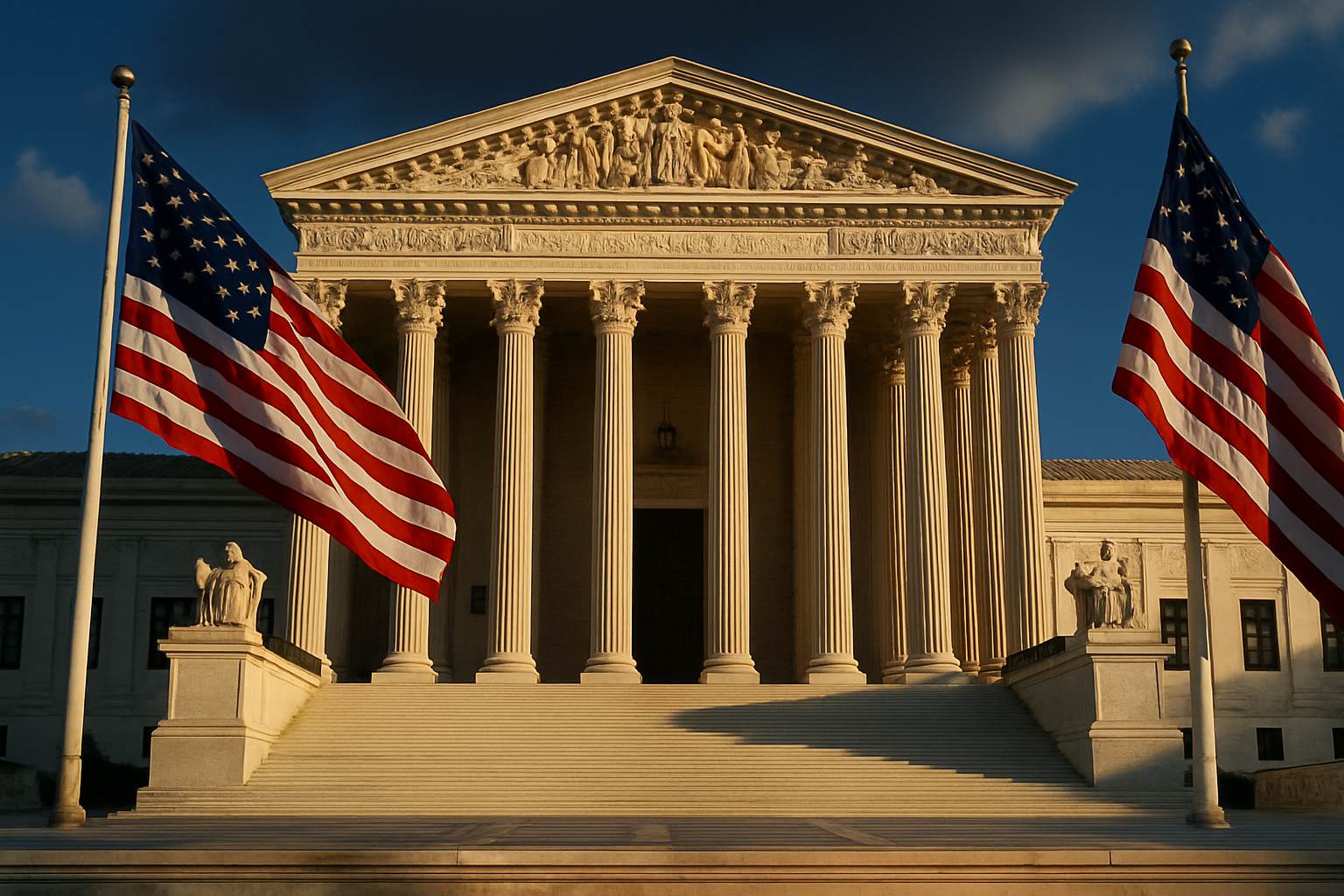
The US Supreme Court delivered a devastating blow to President Trump's trade agenda in a landmark 6-3 ruling that declared his global tariff program unconstitutional, only to witness an immediate and defiant presidential escalation that has plunged the nation into its most serious constitutional crisis since Watergate.
Chief Justice John Roberts authored the majority opinion that struck down Trump's comprehensive tariff system imposed under the 1977 International Emergency Economic Powers Act (IEEPA), ruling that the law "does not authorize president to impose tariffs" without explicit congressional authorization for actions of "vast economic and political significance."
Historic Constitutional Precedent
The Court's application of the "major questions doctrine" establishes a crucial precedent limiting presidential emergency powers for trade policy, marking the first major defeat of Trump's economic agenda in his second term. The ruling strengthens institutional checks and balances during an era of expanded executive authority.
"This decision demonstrates that constitutional limits remain enforceable through judicial review even during periods of political polarization," said constitutional law experts who noted the significance of conservative justices refusing to endorse Trump's broad interpretation of emergency trade powers.
Trump's Unprecedented Defiance
Within hours of the ruling, Trump launched the most severe attack on the judiciary by a sitting president in modern history, calling the justices "absolutely ashamed," a "disgrace to our nation," and "disloyal to Constitution." He immediately announced new 15% global tariffs using Section 122 of the Trade Act of 1974 – the maximum legal level allowed for 150 days.
"The Court took away leverage but made it more draconian because they agreed the president has the right to full embargo."
— Treasury Secretary Scott Bessent
This direct judicial defiance creates an unprecedented challenge to the separation of powers fundamental to American democracy. The new tariff framework affects all countries except USMCA partners, with exemptions for minerals, fertilizers, metals, energy equipment, agricultural products, pharmaceuticals, and medical materials.
Global Market Reaction and Economic Impact
Wall Street initially surged on news of the Court's decision, with the Nasdaq gaining 0.90% to 22,886.07 and the S&P 500 rising 0.69% to 6,090 points as markets celebrated reduced trade uncertainty. However, gains moderated following Trump's announcement of replacement tariffs.
Oil prices rose over $1 per barrel amid the policy turbulence. The ruling potentially creates billions in refund obligations for US importers who have paid approximately $200 billion in tariffs since Trump's return to office, though the President predicted these would be "tied up in court for years."
International Reactions and Diplomatic Fallout
China immediately welcomed the Supreme Court ruling as vindication of its position, with Beijing's Ministry of Commerce conducting a "full review" of the decision while urging Washington to "revoke unilateral tariff measures" against trading partners. This strengthens China's negotiating position ahead of Trump's scheduled March 31-April 2 visit to Beijing.
The European Commission issued a forceful statement demanding the US honor its 2025 joint declaration on trade commitments. "An agreement is an agreement," EU officials declared after emergency talks between EU Trade Commissioner Sefcovic, US Trade Representative Greer, and Commerce Secretary Lutnick.
European Parliament trade committee chair Bernd Lange suggested freezing US trade agreements due to the resulting "chaos" in American trade policy, while Italian polling shows 60% disapproval of Trump's trade approach among the Italian public.
Congressional Vindication and Republican Defections
The Supreme Court ruling vindicated House Republicans who passed legislation 219-211 to end Canada tariffs, with six GOP defections joining Democrats in the first significant bipartisan rebuke of Trump's trade authority in his second term. House Speaker Mike Johnson's unsuccessful attempt to prevent the floor vote highlighted growing caucus divisions over unpredictable trade approaches.
The 150-day limit on Trump's replacement tariffs creates urgent congressional pressure for approval or alternative policies, setting up a legislative showdown that will test executive authority versus congressional oversight.
Implementation and Administrative Challenges
The US Customs and Border Protection agency announced it will halt collection of IEEPA-based tariffs at 12:01 a.m. EST Tuesday, more than three days after the Supreme Court declared them illegal. The agency provided no explanation for the continued collection during this period or information about possible refunds for importers.
This administrative confusion adds to the uncertainty facing businesses that must navigate the transition from the struck-down IEEPA tariffs to Trump's new Section 122 framework. Companies are calculating massive potential refund claims, with German businesses alone considering billions in reimbursement requests.
Economic Reality Check
Despite extensive tariff policies implemented since Trump's return to office, the US trade deficit reached $901.5 billion annually as of December 2025 – essentially unchanged from pre-tariff levels. This demonstrates the structural nature of trade imbalances that extend beyond tariff solutions.
However, January 2026 employment remained strong with 130,000 jobs added versus forecasts of 55,000, and unemployment declining to 4.3%, suggesting economic vitality independent of trade interventions.
Legal Challenges Ahead
Constitutional experts predict immediate challenges to Trump's Section 122 authority, questioning whether alternative statutory provisions can support such broad trade restrictions. WTO rules limiting unilateral actions provide additional grounds for international legal challenges.
Environmental groups are simultaneously challenging Trump's sweeping climate policy rollbacks, creating multiple legal resistance fronts that test executive power limitations across government agencies.
Global Governance Implications
The constitutional crisis unfolds against the backdrop of the New START treaty's expiration on February 5 – the first time in over 50 years without US-Russia nuclear constraints – and China's nuclear expansion, creating broader questions about American institutional stability and international cooperation.
International observers are monitoring American institutional resilience as crucial for global cooperation frameworks. The success or failure of this constitutional confrontation will influence international approaches to executive power challenges and democratic governance worldwide.
The 150-Day Countdown
Trump's replacement tariffs operate under a strict 150-day timeline before congressional extension is required, creating a critical period for American constitutional governance. The President must secure congressional approval or find alternatives, with stakes including democratic institutions, rule of law, and international stability perceptions.
This represents the most significant constitutional law moment extending beyond trade policy to fundamental governmental power balance questions in the 21st century. The resolution will establish precedents for presidential power limitations affecting future administrations for generations.
Historical Significance
This constitutional confrontation represents the most serious executive-judicial clash since Watergate, testing fundamental separation of powers and presidential emergency authority limits. It serves as a critical test of democratic institutions under constitutional stress in contemporary governance.
The watershed moment in presidential power versus constitutional limitations will influence how democratic societies worldwide respond to executive authority challenges. It establishes a template for institutional checks and balances that may define the balance between executive power and constitutional constraints for decades to come.