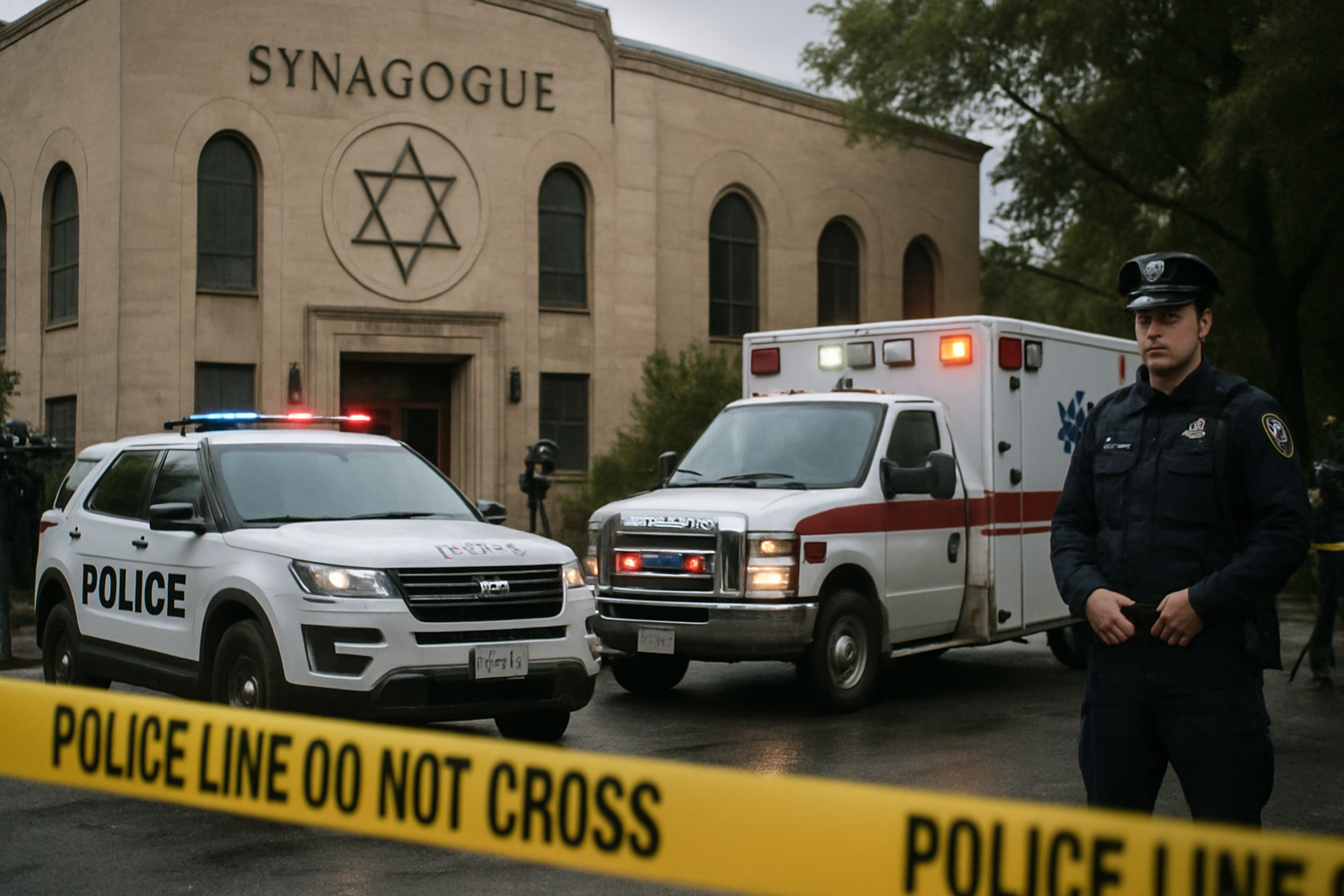
A wave of coordinated attacks against synagogues across the United States has intensified fears of domestic terrorism, with a devastating Michigan incident serving as the latest flashpoint in what authorities are calling an unprecedented surge in antisemitic violence.
The most serious incident unfolded at Temple Israel synagogue in West Bloomfield, Michigan, where a Lebanon-born U.S. citizen crashed his truck into the building and its adjoining preschool before being fatally shot by security personnel. The attack, which occurred during preschool hours with children present, represents the seventh synagogue targeted globally this month, according to international security assessments.
Multiple Attacks Across America
The Michigan synagogue attack was part of a coordinated day of violence that also saw an Islamic State supporter open fire in a Virginia university classroom, killing one person and injuring two others before being neutralized. These back-to-back incidents have added to mounting concerns about the possibility of attacks on U.S. soil amid escalating tensions following recent U.S. and Israeli airstrikes on Iran.
In a separate incident, arsonists set fire to a synagogue in Rotterdam, Netherlands, while Canadian Jewish communities report heightened fears following recent shooting incidents at synagogues there. The pattern suggests a coordinated international campaign targeting Jewish institutions.
"Every light is flashing. After shootings at synagogues, Canada's Jews fear what's next,"
— Canadian Jewish Community Leaders
The FBI has launched a federal terrorism investigation into the Michigan attack, treating it as an "act of targeted violence against the Jewish community." The investigation is being led by the Joint Terrorism Task Force, which is examining potential extremist connections, social media activity, and how the suspect acquired explosive materials found in his vehicle.
Security Response and Investigation Details
The quick response by well-trained synagogue security personnel likely prevented a much larger tragedy. CNN reports that a large quantity of explosives was discovered in the suspect's vehicle, indicating sophisticated premeditation and planning. The combination of vehicle ramming and explosive devices demonstrates advanced extremist tactics that required extensive preparation.
Temple Israel's rabbi praised the security team "who neutralized the terrorist and saved everybody," while also commending teachers for following active shooter procedures. The incident occurred around 12:30 PM on Thursday during preschool hours, with multiple children present in the building.
One security officer was struck by the vehicle and hospitalized, but no other serious injuries were reported among congregation members or staff. The Jewish Federation of Detroit implemented a precautionary lockdown of affiliated agencies, which was lifted hours later after authorities determined there was no ongoing threat.
International Context and Rising Antisemitism
The attacks occur against a backdrop of escalating global antisemitic incidents. Recent international violence includes the December 14, 2025 Bondi Beach Hanukkah festival massacre that killed 15 people, the February 21, 2026 Brisbane synagogue ramming attack, and Ireland's documented 143 antisemitic incidents between September 2025 and February 2026.
European intelligence agencies have identified sophisticated Iranian intelligence networks conducting surveillance of Jewish communities across the continent. British counter-terrorism forces recently arrested four men, including one Iranian national and three dual citizens, for conducting surveillance of Jewish institutions.
Israeli Prime Minister Benjamin Netanyahu thanked the synagogue security agents and praised the Trump administration's "firm position" on antisemitism, stating that "antisemitism doesn't know borders" - reflecting international concern about the coordinated nature of these attacks.
Law Enforcement Response and Enhanced Security
Michigan Governor Gretchen Whitmer strongly condemned the attack and emphasized the Jewish community's right to worship safely. Enhanced security measures have been implemented at Jewish institutions statewide, with intelligence-led patrols increased in areas with significant Jewish populations.
The NSW Police in Australia have established an armed response command with over 250 specialist officers following similar attacks in that country. Operation Shelter, an anti-hate crime unit, has been made permanent as part of the broader security response.
The investigation methodology demonstrates evolving law enforcement approaches to religious targeting. The combination of vehicle ramming and explosive devices shows sophisticated extremist tactics that mirror international terrorist playbooks, particularly those seen in recent European attacks.
Community Impact and Resilience
Despite the violence, Jewish communities have demonstrated remarkable resilience through interfaith support networks and determination to maintain religious activities with enhanced security protocols. The successful prevention of mass casualties at the Michigan synagogue, given the explosive materials involved, underscores the critical importance of professional security training at religious institutions.
The attacks highlight the ongoing vulnerability of religious institutions to vehicle-based attacks, despite existing security measures. However, the trained response of security personnel shows that preparation and professional protocols can effectively counter even sophisticated threats.
Mental health services have been provided to affected communities, and interfaith support has emerged as a key component of the response. Community leaders emphasize that these attacks will not deter religious observance or community gathering.
Implications for National Security
The Michigan attack methodology represents a concerning evolution in domestic terrorism tactics. The pre-positioned explosive materials suggest the attacker intended to cause mass casualties, while the vehicle ramming component enabled rapid entry past exterior security measures.
Federal investigators are examining the suspect's background, social media presence, and potential connections to extremist networks. Of particular concern is how the suspect acquired knowledge of explosive device construction and the materials necessary to build them.
The timing and coordination of multiple attacks suggests possible communication between perpetrators or inspiration from common sources. Authorities are investigating whether recent geopolitical events, particularly Middle East tensions, may have triggered this wave of violence.
"The security preparations credited with saving lives show that proper training and protocols can effectively counter sophisticated threats,"
— Temple Israel Rabbi
Broader Pattern of Religious Violence
The attacks fit within a disturbing international pattern of religious targeting that spans multiple continents. Recent incidents include systematic campaigns in Australia with childcare center firebombings and house torchings of prominent Jewish leaders, described as "deliberate tactics to divide" ordered by overseas actors.
European authorities have documented increasingly sophisticated attack planning, with Iranian intelligence operations targeting Jewish communities through surveillance networks. The coordination suggests state-level involvement in planning and financing these operations.
The global nature of the threat has prompted unprecedented international cooperation between law enforcement agencies. Intelligence sharing has increased significantly, with particular focus on tracking financial networks that might be supporting these coordinated attacks.
Looking Forward: Security and Community Response
As investigations continue, the Michigan synagogue attack serves as both a stark warning and a demonstration of effective community preparedness. The successful response by security personnel prevented what could have been a devastating mass casualty event.
The incident underscores the need for continued vigilance and professional security training at religious institutions. It also highlights the importance of community solidarity and interfaith cooperation in responding to religiously motivated violence.
Federal authorities emphasize that community reporting and intelligence gathering remain crucial for preventing similar attacks. The investigation into the Michigan incident continues, with additional arrests possible as investigators trace the suspect's network and methods.
The wave of antisemitic violence represents one of the most serious challenges to religious freedom and community safety in recent years. The response by law enforcement, security professionals, and interfaith communities will likely serve as a model for addressing similar threats in the future.