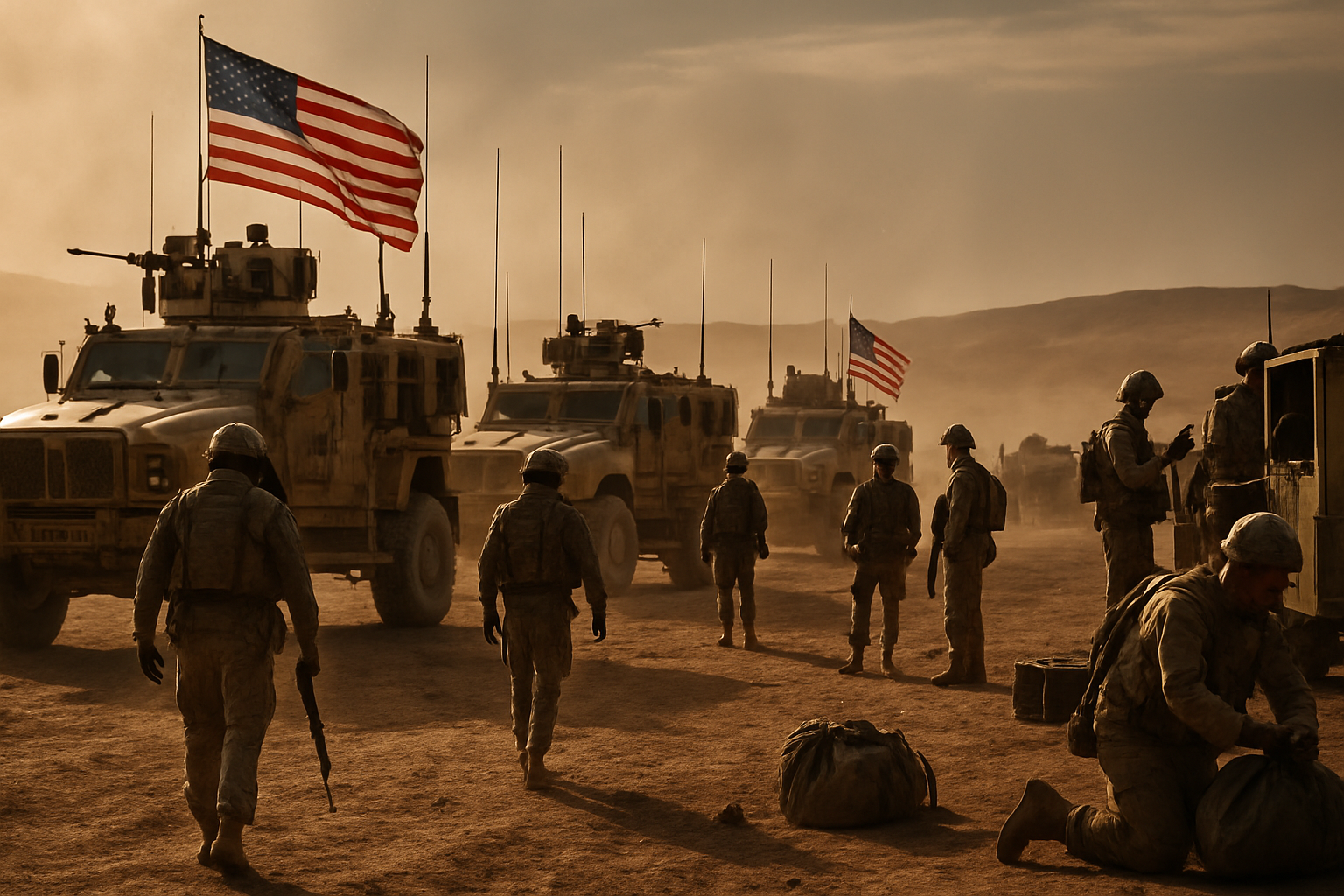
The United States has announced plans to withdraw all remaining troops from Syria over the next two months, with approximately 1,000 American service members set to leave the country by April 2026, according to multiple reports from major news outlets.
The decision comes amid significant shifts in Syria's internal political landscape, as forces loyal to Syria's transitional president, Ahmed al-Sharaa, have reportedly assumed control of several American military bases across the country. US officials confirmed that the Syrian government has agreed to take the lead in combating terrorism within its borders, making large-scale US military presence "no longer required."
Strategic Shift in Middle East Policy
The withdrawal marks a dramatic policy transformation that reflects the Trump administration's preference for conditions-based transitions and negotiated solutions over prolonged deployments. American forces have maintained a presence in Syria since 2015 as part of an anti-terrorism campaign to counter the influence of the Islamic State group (ISIS).
According to US media reports, Washington will pull the last 1,000 soldiers from the country after the new Syrian government has taken over areas previously controlled by the Kurdish-led Syrian Democratic Forces (SDF), which had served as America's primary ally in the fight against ISIS.
"The Syrian government has agreed to take the lead combatting terrorism within its borders and US military presence 'at scale' is no longer required."
— US Official, BBC
Complex Regional Dynamics
The timing of the withdrawal announcement coincides with mounting tensions between the United States and Iran in the region. President Trump has significantly ramped up military presence in the Middle East, deploying dual aircraft carriers and increasing pressure on Iran regarding its nuclear program. Officials note that the decision to remove troops from Syria is part of a broader strategic reorientation while maintaining readiness to respond to threats in the region.
The move comes as the US has also been building up its military capabilities near Iran, where officials have vowed to respond to any attack by laying siege to American military outposts in the region. The aircraft carrier USS Abraham Lincoln is already positioned near Iran, while the USS Gerald R. Ford has been ordered to join it, creating the largest US naval presence in the Middle East in years.
End of Anti-ISIS Operations
Since 2015, American troops in Syria have operated primarily from the al-Tanf garrison and northeastern Syria bases in Hasakah and Deir ez-Zor provinces, conducting counter-ISIS operations while monitoring Iranian activities and coordinating with the Kurdish-led Syrian Democratic Forces. These operations generated significant intelligence and operational success against terrorist networks.
The Syrian Democratic Forces, who controlled northeastern territory including oil fields generating hundreds of millions annually, served as the primary US ground partner throughout the campaign. Turkish military pressure against Kurdish positions has historically intensified when US protective presence diminishes, creating potential humanitarian and operational complications.
International Implications
The withdrawal represents the latest attempt at ending US involvement in Syria, spanning multiple administrations dealing with competing objectives including counter-terrorism, Iranian containment, Turkish relations, and Kurdish protection. The Assad government's assumption of counter-terrorism responsibilities comes despite questions about its degraded military capabilities, though it maintains Russian and Iranian support in stabilizing government-controlled areas covering approximately two-thirds of Syrian territory.
European allies and regional partners are closely monitoring the transition to ensure that progress made against ISIS remnants is not reversed. The two-month timeline allows for careful logistical planning to avoid a precipitous departure that could create security vacuums for terrorist groups.
Economic and Energy Considerations
The withdrawal may enable the Syrian government to regain control of northeastern oil fields, potentially strengthening Damascus economically while reducing Kurdish leverage in future negotiations. However, international sanctions against Syria are expected to remain in place separate from the military withdrawal decision.
US forces operated in Syria without Syrian government consent or UN authorization, using Article 51 self-defense justifications based on the fight against ISIS. The end of this presence removes a major point of contention in US-Syria relations while raising questions about future counter-terrorism cooperation.
Looking Forward
The decision represents a critical test of the Trump administration's preference for negotiated solutions over military deployments. Success in managing the transition while preserving counter-terrorism gains could provide a template for future strategic reorientations in other regions.
Officials emphasized that the US remains ready to respond to any threats in the region and that the withdrawal is occurring only because conditions on the ground have changed sufficiently to allow Syrian forces to assume primary responsibility for security. The transition is being carefully coordinated with international partners to maintain the gains achieved against ISIS while managing concerns about Kurdish security and regional stability.
As the two-month timeline progresses, the international community will be watching closely to see whether this withdrawal can serve as a model for responsible military disengagement or whether it creates new challenges in an already complex regional security environment.