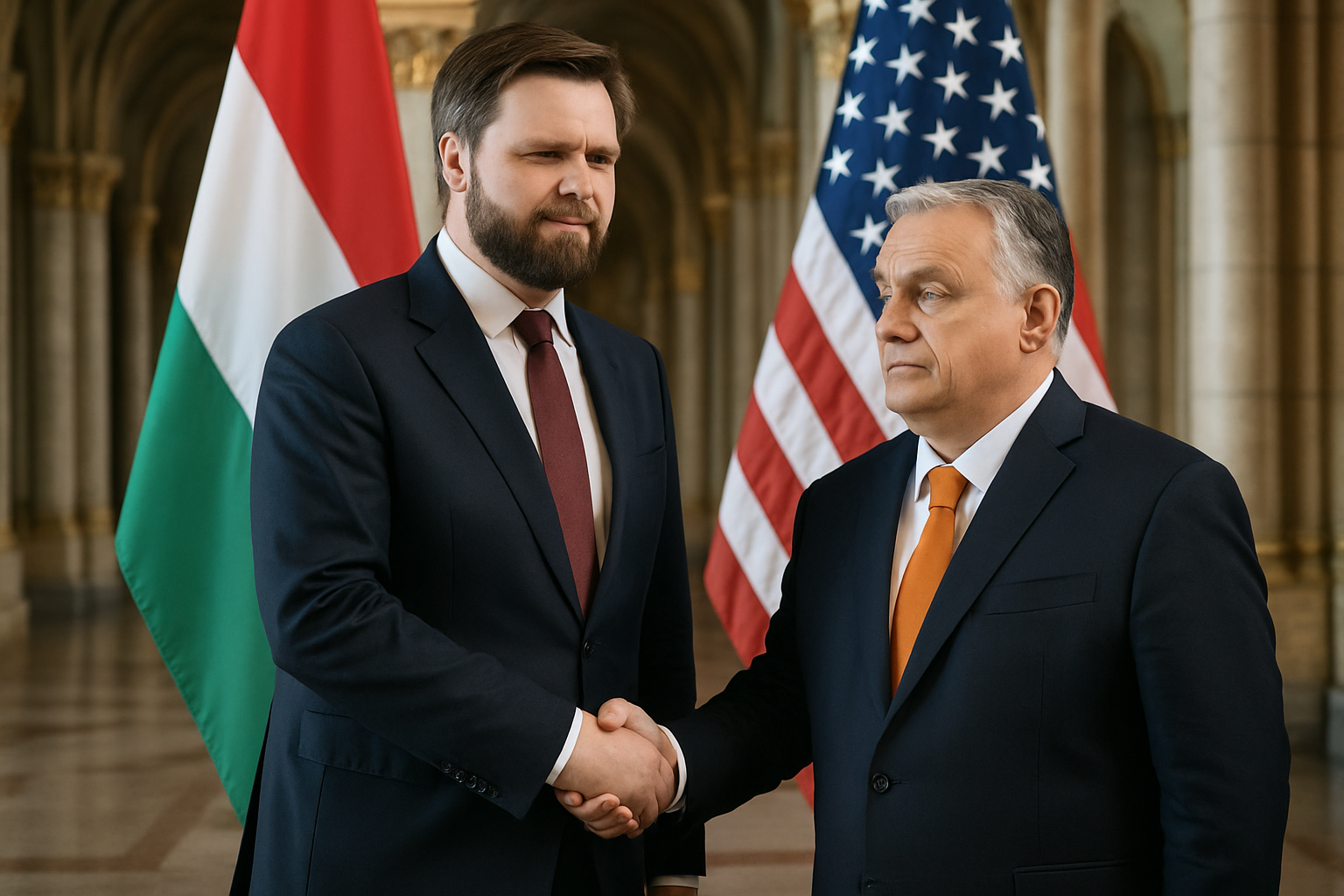
US Vice President J.D. Vance arrived in Budapest on Tuesday for a two-day diplomatic mission to support Hungarian Prime Minister Viktor Orbán just five days before the April 12, 2026 parliamentary elections, representing an unprecedented American intervention in a European Union member state's democratic process.
Vance and his wife Usha were greeted at Budapest airport by Hungarian Foreign Minister Péter Szijjártó, who declared the visit a sign of a "new golden age in U.S.-Hungary relations." The timing of the visit, coming during Orbán's most challenging electoral campaign since returning to power in 2010, has raised significant concerns about foreign interference in European democratic processes.
Electoral Context: Orbán Faces Unprecedented Challenge
For the first time in over a decade, Viktor Orbán's Fidesz party finds itself trailing in polls against opposition coalitions led by Péter Magyar's Tisza Party. This marks a historic shift in Hungarian politics, where Magyar, a former government insider, has successfully consolidated opposition forces behind a pro-European platform promising wealth taxes, euro adoption, and stronger EU and NATO ties.
The opposition's momentum reached its peak in March with the "Greatest National March" in Budapest, drawing an estimated 500,000 participants - the largest demonstration against Orbán's government since 2010. Magyar's campaign has resonated with voters frustrated by economic stagnation, corruption allegations, and what many see as democratic governance fatigue after sixteen years of Fidesz dominance.
"This visit clearly shows that there is a new golden age in U.S.-Hungary relations."
— Péter Szijjártó, Hungarian Foreign Minister
Dual Foreign Interference Allegations
Vance's visit occurs alongside documented Russian interference operations supporting Fidesz, as revealed by investigative journalist Szabolcs Panyi through VSquare reporting. This represents the first concrete evidence of Kremlin operatives actively participating in European electoral campaigns, creating an unprecedented situation of dual foreign intervention - American political backing combined with Russian operational support.
The Ukrainian Foreign Ministry has characterized recent pipeline sabotage discoveries near the Hungarian border as "most likely Russian operations under false flag as part of Moscow's large-scale interference in Hungary's elections." These allegations have added another layer of complexity to an already volatile electoral environment.
Energy Crisis and EU Relations at Breaking Point
The visit takes place against the backdrop of Hungary's ongoing blockade of the EU's historic €90 billion Ukraine aid package - the largest single-nation assistance in European history. This crisis stems from the Druzhba pipeline dispute, which has been offline since January 27, 2026, with Hungary claiming Ukraine deliberately halted Russian oil transit as "political blackmail."
Lithuanian Foreign Minister Kestutis Budrys has warned that the "EU cannot become Budapest's hostage," reflecting growing frustration across European capitals. The crisis has accelerated discussions about enhanced cooperation mechanisms that would allow 26 EU states to proceed without Hungarian participation - a fundamental departure from consensus decision-making that could reshape European integration.
Economic and Strategic Implications
During Vance's visit, Hungarian leaders are expected to discuss migration, global security, and economic cooperation. Bloomberg News reports that Hungarian oil company MOL is set to agree to purchase 500,000 tons of oil from the US for approximately $500 million, demonstrating the tangible benefits Hungary seeks from its alignment with the Trump administration.
The European Commission has already frozen €19 billion in funding to Hungary over rule of law concerns, while intelligence restrictions have been imposed following allegations that Foreign Minister Szijjártó leaked EU Council details to Russian Foreign Minister Sergei Lavrov during official meetings.
Unprecedented Diplomatic Intervention
The Trump administration's support for Orbán represents a rare instance of direct American intervention in EU member state elections. President Trump previously endorsed Orbán in February, calling him "a truly strong and powerful leader" and declaring "complete and unconditional support." Secretary of State Marco Rubio's recent visit to Budapest, where he declared Trump was "profoundly attached to your success," further reinforced this unprecedented diplomatic backing.
This approach marks a significant departure from traditional US diplomatic neutrality in European elections and has likely raised concerns in Brussels about external interference in democratic processes. The alliance serves both leaders' interests - Orbán gains international legitimacy amid EU tensions, while Trump maintains his populist coalition across Europe.
Regional Security Concerns
The visit comes amid heightened regional security tensions following the discovery of sophisticated explosive devices near the Balkan Stream/TurkStream pipeline infrastructure in Serbia, just one week before the Hungarian elections. While Hungarian authorities have suggested Ukrainian involvement without providing evidence, Kyiv has categorically denied any connection to the incident.
The pipeline carries 15.75 billion cubic meters of gas annually through the Turkey-Bulgaria-Serbia-Hungary route, making it critical for Central European energy security. Enhanced security protocols have been implemented along the entire pipeline route with increased military patrols and surveillance.
Democratic Governance Under Pressure
The April 12 election has been characterized by senior EU officials as a "template-setting moment for 21st-century democracy under foreign interference." With 89% of Europeans demanding greater EU unity according to recent Eurobarometer polling, the contrast with Hungary's increasingly confrontational stance has become stark.
Opposition leaders have dismissed recent security incidents as "election campaign tactical panic-making," suggesting Orbán is exploiting security fears for political gain. The tight electoral race means every development in the final week could prove decisive for Hungary's future direction.
Stakes for European Integration
The election outcome will have profound implications extending far beyond Hungary's borders. An opposition victory would remove Brussels' most persistent internal critic and restore Hungary to mainstream EU alignment on rule of law and foreign policy coordination. Conversely, Orbán's survival with foreign interference could embolden similar operations continent-wide and strain European institutions.
The success or failure of this election will influence EU decision-making capacity, NATO cohesion, and transatlantic relationships for years to come. It represents a critical test of whether democratic institutions can adapt to 21st-century challenges while preserving European values and collective action principles.
Looking Ahead
As Vance continues his diplomatic mission in Budapest, all eyes remain on April 12 - a date that could mark either a historic democratic transition in Hungarian politics or the consolidation of an increasingly authoritarian system backed by competing foreign powers. The stakes could not be higher for European democracy, institutional resilience, and the future of transatlantic relations.
The visit underscores how domestic European politics have become increasingly internationalized, with great power competition playing out in the electoral arena of EU member states. The outcome will provide crucial lessons for democratic governance under external pressure and foreign interference in the modern era.