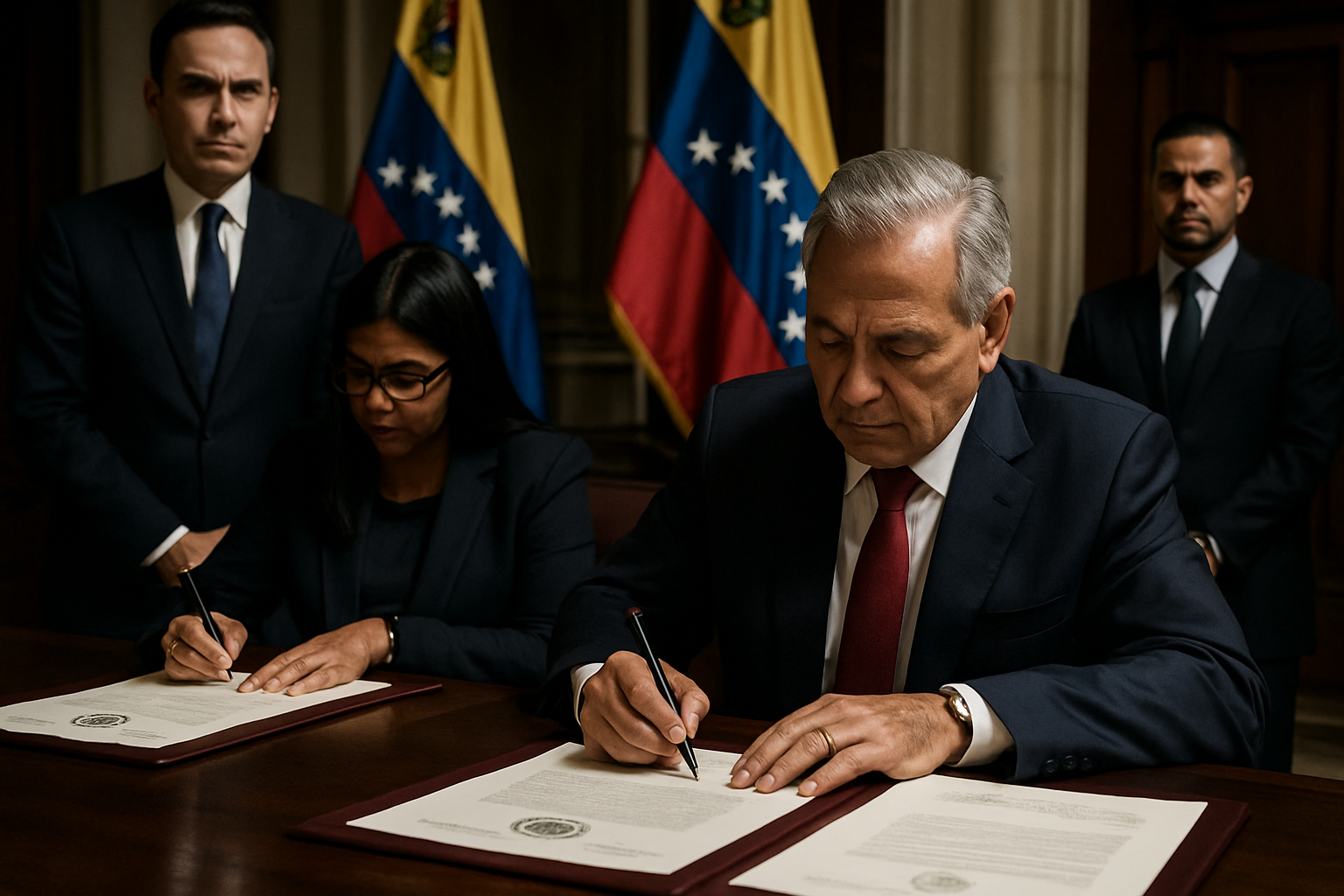
Venezuela's Acting President Delcy Rodríguez signed a historic amnesty law on Friday covering political offenses from 1999-2026, immediately triggering the release of 379 political prisoners in what represents the most comprehensive political reconciliation effort in recent Latin American history.
The 13-article legislation, which passed the National Assembly unanimously without a single dissenting vote, covers nearly three decades of political conflict spanning the entire Chávez-Maduro era. Venezuelan National Assembly deputy Jorge Areasa announced the prisoner releases during a television interview, marking a significant milestone in the country's post-Maduro democratic transition.
Immediate Implementation and Releases
The law's implementation was swift, with Venezuelan courts processing the 379 releases within hours of Rodríguez's signature. This brings the total number of political prisoners freed under the interim government to over 750 since January 2026, following Nicolás Maduro's removal from power.
Among those released was opposition leader Juan Pablo Guanipa, a close collaborator of Nobel Peace Prize laureate María Corina Machado. Speaking at a mass in Maracaibo following his release, Guanipa declared his commitment to fighting for democratic change through electoral processes.
"It is up to us to fight to create the conditions so that we can have a democratic solution to the crisis,"
— Juan Pablo Guanipa, Opposition Leader
Guanipa, who served as vice president of the National Assembly, was cheered by supporters who greeted him with messages of solidarity at the Basilica of Our Lady of the Rosary of Chiquinquirá.
Scope and Limitations of the Amnesty
The legislation covers political detentions carried out since 1999, but only encompasses 15 of the 27 years of the Chávez-Maduro period. Article 9 notably excludes those who "promoted attacks on national territory by foreign states or corporations," a provision that has drawn criticism from human rights organizations.
Portuguese sources confirm the law establishes amnesty for opposition figures, journalists, and activists who were detained on terrorism and treason charges during the previous regime. However, it maintains exclusions for constitutionally forbidden crimes, including hate crimes, though the scope of this category remains undefined.
Civil Society and International Reactions
The amnesty has generated mixed reactions from civil society organizations and international observers. Human rights group Cofavic emphasized that the releases represent "restitution of rights, not State favor," while opposition leader Andrés Velásquez questioned the necessity of amnesty legislation, arguing that the political prisoners "are innocent."
Italian NGOs and families of excluded prisoners have denounced what they characterize as a "fraudulent law," claiming that torture in prisons continues and that at least 400 detainees remain excluded from the amnesty's benefits. The organization Veppex Miami called the law "partial, selective and discriminatory."
International Support and Mediation
The amnesty process has benefited from sustained international mediation efforts. Former Spanish Prime Minister José Luis Rodríguez Zapatero has been mediating in Caracas since February, while Cardinal Baltazar Porras organized nationwide prayer vigils to support the reconciliation process.
Spain's Foreign Minister José Manuel Albares announced that Spain would request the European Union lift sanctions against Acting President Rodríguez following the law's approval, signaling growing international confidence in Venezuela's democratic transition.
Ongoing Challenges and Implementation
Despite the significant progress, substantial challenges remain. According to human rights organization Foro Penal, over 600 political prisoners remain detained despite the releases already undertaken. The implementation process has faced delays due to disagreements over Article 7, which requires prisoners to "present themselves to justice."
Families of political prisoners had maintained desperate vigils and hunger strikes at detention centers like Zona 7 in Caracas, with some protesters fainting due to the physical toll. The Committee for Liberation of Political Prisoners (CLIPP) warned that government indifference put protesters' lives at "grave risk."
Economic and Diplomatic Context
The amnesty law's implementation occurs amid Venezuela's broader democratic and economic transformation. Oil exports have surged 60% to 800,000 barrels daily, with the United States displacing China as Venezuela's top customer following comprehensive energy cooperation agreements.
The Dominican Republic has reopened commercial relations with Venezuela, while Brazil and the European Union have expressed cautious support for the democratic transition. This represents a dramatic shift from the international isolation experienced during the Maduro era.
Regional Significance
The Venezuelan amnesty law sets a potential template for political reconciliation efforts throughout Latin America. Covering 27 years of political conflict, it represents the most ambitious attempt at institutional reconciliation in recent regional history.
However, critics argue that the exclusions and selective implementation undermine its effectiveness as a genuine reconciliation tool. The success or failure of Venezuela's amnesty process will likely influence similar efforts in other post-authoritarian contexts across the region.
Looking Forward
The implementation of Venezuela's amnesty law marks a critical test of the country's commitment to democratic transformation. While the immediate release of 379 prisoners represents significant progress, the exclusion of hundreds of others and questions about long-term sustainability remain key challenges.
Acting President Rodríguez called for "maximum speed" in the law's implementation, stating that "one must know how to ask for forgiveness and one must also know how to receive forgiveness." The coming weeks will determine whether this historic legislation can deliver comprehensive reconciliation or will be remembered as a partial measure that fell short of its transformative potential.
International observers continue monitoring the situation closely, viewing Venezuela's amnesty process as both a test case for democratic transition in Latin America and a critical indicator of whether genuine political reconciliation can be achieved after decades of authoritarian rule.