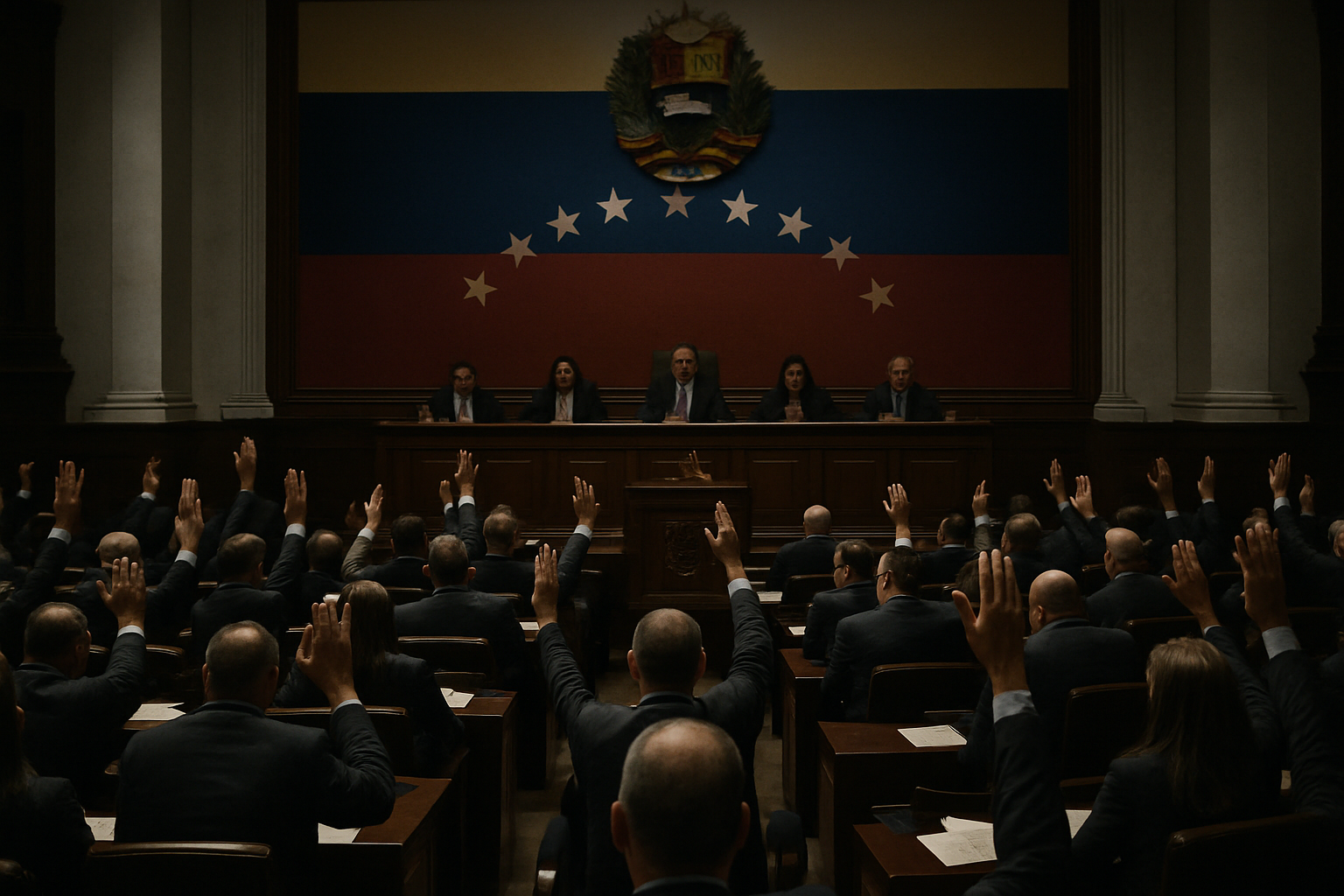
Venezuela's National Assembly unanimously passed a controversial amnesty law covering political offenses from 1999-2026, but critics argue the legislation contains significant exclusions that leave many political prisoners behind bars, including Argentine gendarme Nahuel Gallo whose case has become emblematic of the law's limitations.
The 13-article legislation, passed without a single dissenting vote in February 2026, was promoted by Acting President Delcy Rodríguez as part of Venezuela's post-Maduro democratic transition. However, human rights organizations and families of political prisoners have denounced what they describe as "restrictive" provisions that undermine the law's promise of comprehensive reconciliation.
Exclusions Generate Opposition Backlash
The amnesty law's Article 9 specifically excludes those who "promoted attacks on national territory by foreign states or corporations," a provision that human rights advocates argue is deliberately vague and could be used to maintain the imprisonment of high-profile opposition figures. Additionally, Article 7's requirement that prisoners "present themselves to justice" has created delays, with the Chavista party demanding crime acknowledgment while opposition groups reject what they view as criminalizing persecution victims.
The case of Argentine gendarme Nahuel Gallo has become particularly contentious. Despite international pressure from Argentina and repeated diplomatic interventions, Gallo remains excluded from the amnesty's scope. Organizations representing families of political prisoners warned that the law's "fine print" effectively negates the promised comprehensive liberation.
"This law constitutes a partial, selective and discriminatory measure, and is not a true act of justice and reparation for victims of authoritarianism."
— Organization of Venezuelans Persecuted in Political Exile (Veppex)
International and Domestic Reactions
The Venezuelan National Assembly has established a special commission to analyze cases of political prisoners excluded from the amnesty law, acknowledging the controversial nature of the exclusions. Former Spanish Prime Minister José Luis Rodríguez Zapatero, who has been mediating the democratic transition process, expressed cautious optimism about the law while recognizing its limitations.
Legal expert Alberto Arteaga Sánchez clarified the difference between amnesty and pardon, emphasizing that amnesty acts on facts rather than people. He noted that the legislation does not cover all possible scenarios, particularly cases involving common crimes with political motivations.
Venezuelan exiles in the United States, organized through Veppex, have been particularly vocal in their criticism. The Miami-based organization characterized the law as falling short of providing genuine justice for victims of what they describe as decades of authoritarian rule.
Implementation Challenges
According to Foro Penal, a human rights organization tracking political detentions, over 600 political prisoners remain detained despite the release of more than 400 individuals since January 2026 under Rodriguez's amnesty program. The organization has documented the gradual release process but emphasizes that significant work remains to achieve comprehensive liberation.
The implementation has faced procedural delays, particularly around Article 7's requirements. Opposition deputy Tomás Guanipa, whose brother Juan Pablo Guanipa was briefly released but then placed under house arrest with electronic monitoring, demanded "all guarantees and international standards" for prisoner reintegration.
Civil society groups have expressed mixed reactions. Cofavic, a prominent human rights organization, emphasized that releases represent "restitution of rights, not State favor," while opposition leader Andrés Velásquez questioned the necessity of amnesty altogether, arguing that political prisoners "are innocent."
Regional and Historical Context
The amnesty law represents the most comprehensive political prisoner release program in recent Latin American history, covering a 27-year period spanning the entire Chávez-Maduro era. The legislation comes as Venezuela undergoes its most significant democratic transition since 1999, with Acting President Rodríguez leading an interim government following Nicolás Maduro's removal in January 2026.
The scope of the law is unprecedented in the region, potentially affecting hundreds of opposition figures, journalists, and activists who were detained on terrorism and treason charges under the previous regime. However, the exclusions have raised questions about whether the measure represents genuine democratic reform or cosmetic changes designed to appease international pressure.
International observers, including representatives from Portugal and other European nations, have called for more detailed provisions and greater transparency in the implementation process. The lack of public consultation in drafting the law has been cited as violating international standards, despite general support for the reconciliation goals.
Broader Democratic Transition
The amnesty law debate occurs within the context of Venezuela's broader democratic transition, which has included unprecedented diplomatic engagement with the United States and significant economic reforms. Oil exports have surged 60% to 800,000 barrels daily since January, with the U.S. displacing China as Venezuela's top customer.
Cardinal Baltazar Porras has organized nationwide prayer vigils supporting the amnesty process, providing moral authority to reconciliation efforts. The Catholic Church's backing, combined with international mediation efforts, has added legitimacy to the transition process while highlighting the humanitarian stakes involved.
The Committee for Liberation of Political Prisoners (CLIPP) has maintained vigils and protests outside detention centers, with some family members conducting hunger strikes to pressure authorities for complete releases. These demonstrations underscore the human cost of legislative deadlock and the urgency felt by families who have waited years for their loved ones' freedom.
Looking Ahead
The success of Venezuela's amnesty law will ultimately be measured by its implementation and the extent to which it achieves genuine reconciliation versus political maneuvering. The creation of a parliamentary commission to review excluded cases suggests recognition that the current law may be insufficient to address the full scope of political persecution.
Human rights advocates emphasize that meaningful reconciliation requires not just prisoner releases but also guarantees against future persecution, monitoring mechanisms, and safe return conditions for political exiles. The international community continues to monitor the process as an indicator of Venezuela's commitment to democratic transformation.
As Venezuela navigates this critical juncture in its democratic transition, the amnesty law controversy illustrates the complex challenges of achieving justice and reconciliation after decades of political conflict. While the legislation represents a significant step forward, its exclusions and implementation challenges remind observers that the path to full democratic consolidation remains fraught with obstacles.