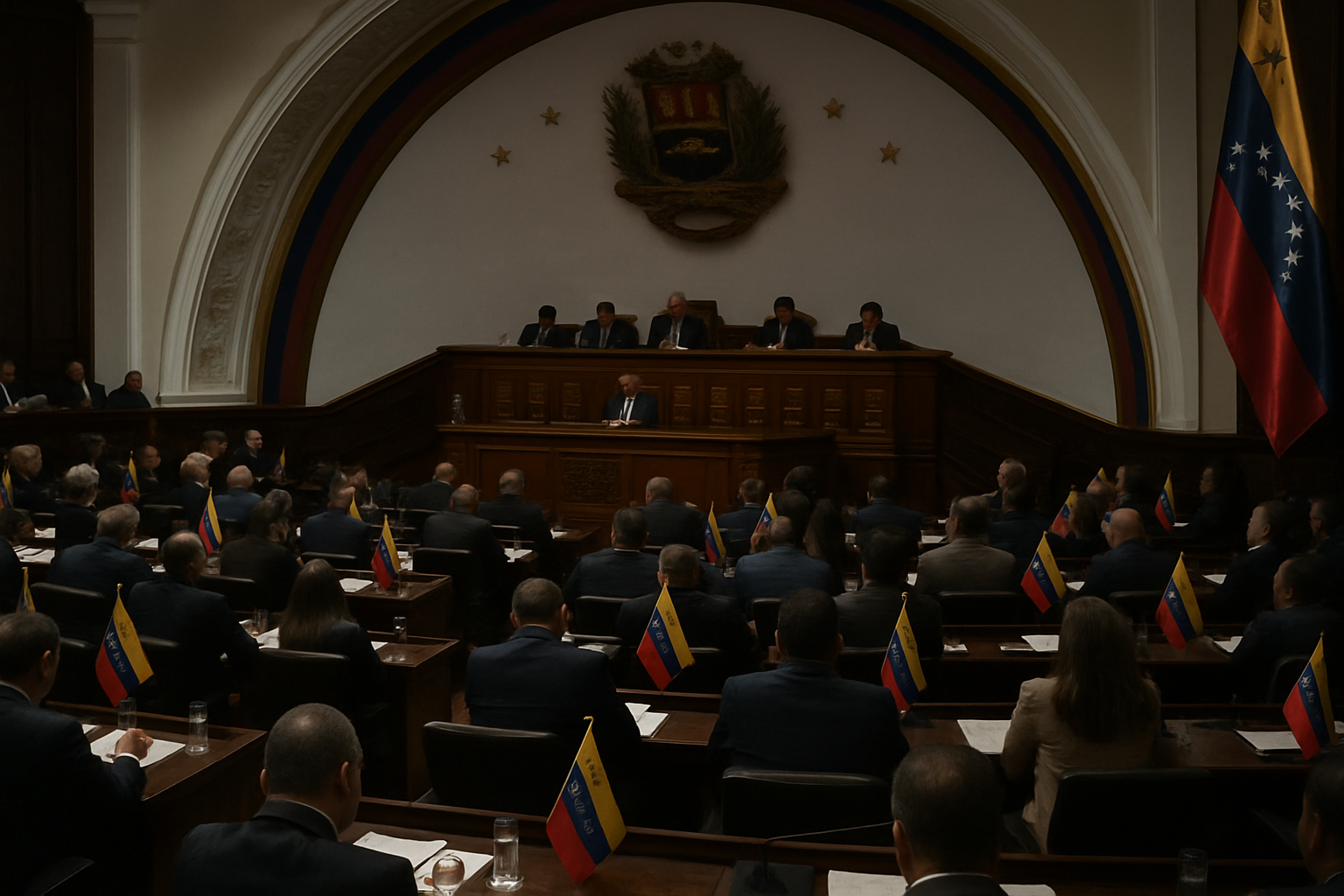
Venezuela's National Assembly unanimously approved a historic amnesty law on Thursday covering political offenses from 1999-2026, representing the most comprehensive political reconciliation effort in recent Latin American history, though implementation challenges and mixed international reactions highlight the complex path ahead for democratic transition.
Acting President Delcy Rodríguez immediately called for "maximum speed" implementation of the 13-article legislation, striking a conciliatory tone by stating: "One must know how to ask for forgiveness and one must also know how to receive forgiveness, and this is the process that opens with this amnesty."
The unanimous vote represents a remarkable achievement in Venezuela's polarized political landscape, covering nearly three decades of conflict spanning the entire Chávez-Maduro era. However, over 600 political prisoners remain detained according to human rights organization Foro Penal, despite more than 400 releases since January 2026 under the interim government's amnesty program.
International Diplomatic Responses
The amnesty law's passage has triggered significant international diplomatic activity, with Spain leading European engagement efforts. Spanish Foreign Minister José Manuel Albares announced that Spain will request the European Union lift sanctions against Delcy Rodríguez following the law's approval, marking a potential shift in EU policy toward Venezuela's interim government.
"Spain views with hope the situation in Venezuela and reiterates its support for a democratic transition that serves the Venezuelan people"
— José Manuel Albares, Spanish Foreign Minister
This diplomatic opening comes as former Spanish Prime Minister José Luis Rodríguez Zapatero continues mediation efforts in Caracas, providing international legitimacy to the reconciliation process. Cardinal Baltazar Porras has organized nationwide prayer vigils, adding religious authority to the peace efforts.
The United States maintains unprecedented diplomatic engagement through high-level meetings between Rodríguez and US Chargé d'Affaires Laura Dogu at Miraflores Palace - the highest-level US-Venezuela diplomatic contact since 2019. This engagement occurs within the framework of Marco Rubio's three-phase reconstruction plan encompassing stabilization, economic recovery, and democratic transition.
Implementation Challenges and Civil Society Concerns
Despite the unanimous legislative approval, significant implementation challenges remain. The law faced previous delays over Article 7, which requires political prisoners to "present themselves to justice" - a provision strongly opposed by opposition groups who argue it criminalizes persecution victims rather than acknowledging wrongful detention.
Human rights organization Provea criticized the law as having "an unjustifiable excess of exclusions" not required by the Constitution or international instruments. The NGO Justicia, Encuentro y Perdón characterized the legislation as "revictimizing, exclusionary, and absolutely does not guarantee the full liberation of all political prisoners."
Article 9 of the law specifically excludes those who "promoted attacks on national territory by foreign states or corporations," maintaining certain limitations on amnesty scope that could potentially exclude prominent opposition figures like María Corina Machado.
Civil society reactions reflect ongoing debates about the nature of political prosecutions under the previous regime. While Cofavic emphasizes that releases represent "rights restitution, not State favor," opposition leader Andrés Velásquez questions the amnesty's necessity, arguing that political prisoners "are innocent."
Current Prisoner Status and Family Protests
The complex reality of Venezuela's political prisoner situation is exemplified by recent cases like that of Juan Pablo Guanipa, a close ally of Nobel Peace Prize laureate María Corina Machado and former National Assembly vice-president. Guanipa was released then quickly re-arrested and placed under house arrest with electronic monitoring and communication restrictions, raising questions about the sustainability of the democratic reforms.
Families of political prisoners have maintained desperate vigils and hunger strikes outside detention centers, with some protests lasting over 70 hours. The Committee for Liberation of Political Prisoners (CLIPP) warns that government indifference puts protesters' lives at "grave risk," with at least one woman fainting and requiring hospital transport during the protests.
These family demonstrations at facilities like Zona 7 detention center underscore the human cost of legislative deadlock and the urgent need for complete implementation of prisoner releases.
Economic Context and International Support
The amnesty law implementation occurs during Venezuela's broader economic transformation following the January 2026 transition. Oil exports have surged 60% to 800,000 barrels daily, with the United States displacing China as Venezuela's top customer. This economic recovery provides crucial context for international engagement and the sustainability of democratic reforms.
The Dominican Republic has reopened commercial relations and diplomatic ties, while Brazil and European Union nations express cautious support for the transition. However, the success of political reconciliation remains closely tied to economic stability and continued international investment.
Energy Secretary Chris Wright's historic February visit to Caracas, resulting in comprehensive energy cooperation agreements, demonstrates the scale of international re-engagement dependent on sustained democratic progress.
Regional and Historical Significance
The Venezuelan amnesty law represents the most ambitious political prisoner release program in recent Latin American history. The 27-year temporal coverage spanning from 1999 to 2026 provides unprecedented scope for political reconciliation, potentially serving as a template for other post-authoritarian transitions in the region.
However, the law's effectiveness will ultimately depend on complete implementation without discrimination, adequate reintegration guarantees for released prisoners, and robust monitoring mechanisms to prevent future political persecution. International observers emphasize that success requires genuine reconciliation rather than cosmetic reform.
Looking Ahead: Democratic Transition Test
The amnesty law represents a critical indicator of Venezuela's democratic transformation credibility. Success in fully implementing the legislation could influence future democratic consolidation efforts throughout Latin America, while failure might highlight the persistent challenges of building sustainable democratic institutions after decades of authoritarian rule.
The coming weeks will be decisive for Venezuela's democratic future, as the international community closely monitors whether the legislative achievement translates into meaningful change for hundreds of families still awaiting their loved ones' freedom. The ultimate test lies not in the law's passage, but in its complete and equitable implementation across all categories of political prisoners.
As Venezuela navigates this critical transition period, the amnesty law stands as both a symbol of hope for national reconciliation and a practical test of the interim government's commitment to genuine democratic renewal. The mixed reactions reflect the complex challenges ahead in rebuilding trust and establishing lasting democratic institutions in a deeply polarized society.