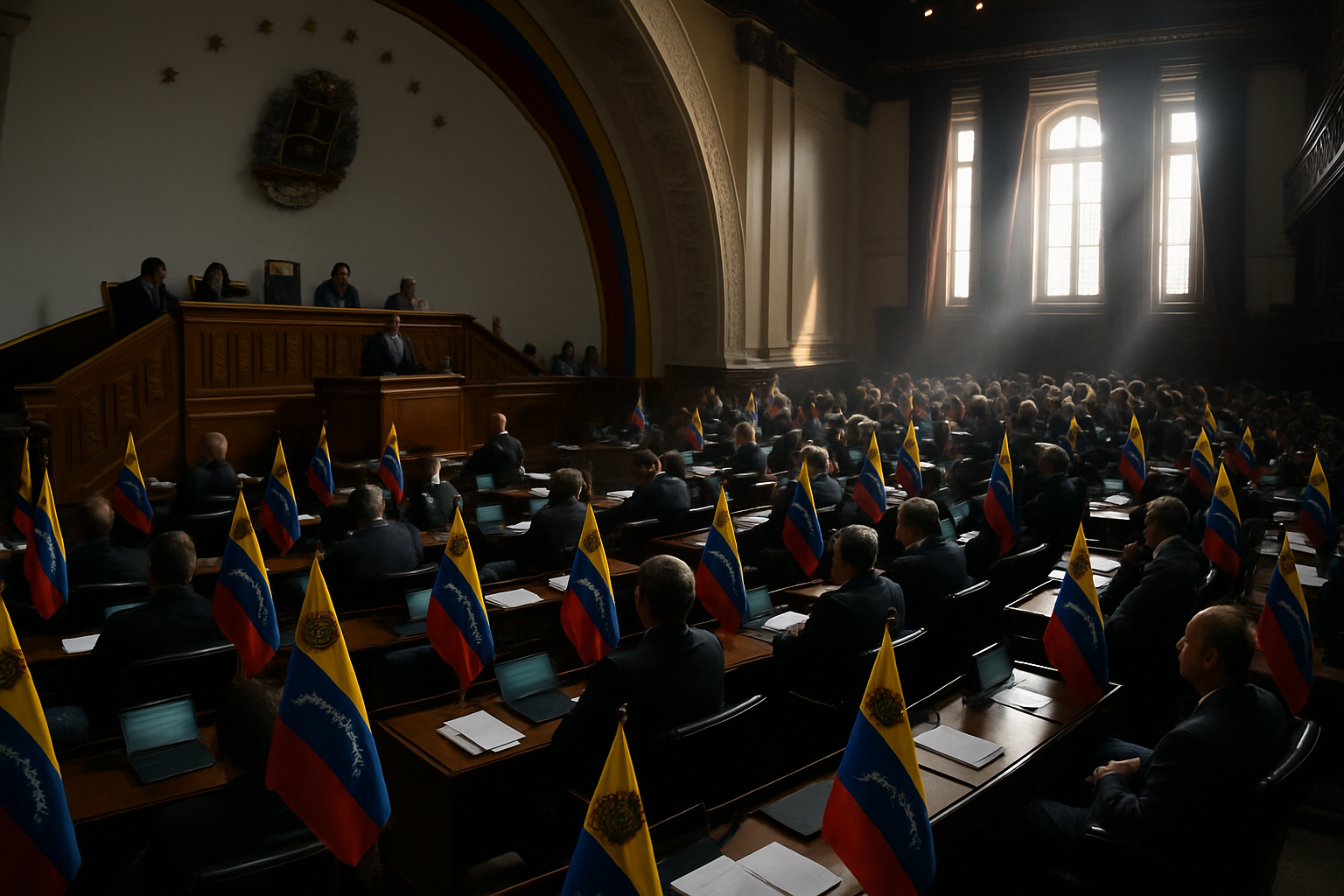
Venezuela's National Assembly on February 5, 2026, unanimously approved in first reading a historic amnesty law that could potentially release hundreds of political prisoners, representing the most significant criminal justice reform in the country's modern democratic transition following the removal of Nicolás Maduro from power.
The comprehensive legislation, spanning 13 articles and covering political offenses committed between 1999 and 2026, was presented by Acting President Delcy Rodríguez as part of her government's broader reconciliation agenda. The proposal seeks to address nearly three decades of political persecution and systematic detention of opposition figures under the previous regime.
Legislative Process and Political Context
National Assembly President Jorge Rodríguez emphasized the urgency surrounding the legislation during Wednesday's session, stating "Celeridad, no tenemos mucho tiempo" (Speed, we don't have much time), according to reports from Efecto Cocuyo. The law must now undergo a second and final discussion in the Assembly before becoming enforceable.
According to the bill's exposition of motives published by El Nacional, the legislation aims to achieve "justice and coexistence among Venezuelans, allowing coexistence from diversity and plurality" through "the consolidation of a comprehensive amnesty framework that exhaustively details the covered facts and crimes and those that, according to the Constitution, must be excluded."
The timing of the legislative push comes exactly one month after U.S. military intervention led to Maduro's capture and subsequent detention in New York federal custody on drug trafficking charges. Since assuming power, Rodríguez has prioritized political prisoner releases as a cornerstone of her transitional government's legitimacy.
International Concerns and Civil Society Response
Despite widespread support for prisoner releases, human rights organizations have expressed significant reservations about the legislative process and scope. Nicaragua Investiga reported that activists and non-governmental organizations showed concern before the National Assembly began debating the amnesty law, citing procedural transparency issues.
Key concerns include the lack of public consultation before the legislative debate began and questions about which specific crimes will be excluded from amnesty coverage. The legislation references "hate crimes" as potentially excluded offenses, though the definition remains unclear and subject to interpretation.
Families of political prisoners gathered outside the Palace of Justice on February 5, demanding inclusion in the proposed law according to Efecto Cocuyo reporting. Their presence underscored the human stakes involved in the legislation's final provisions.
Opposition Perspectives and Criticism
The amnesty proposal has generated mixed responses from opposition leaders and legal experts. Andrés Velásquez, a prominent opposition figure, declared the amnesty law unnecessary because political prisoners "are innocent," suggesting that pardons imply guilt where none exists.
El Nacional's analysis questioned whether the legislation represents "a bridge toward freedom or safe passage for the regime," noting that the proposal's coverage period from 1999-2026 could potentially benefit former Chavista officials while appearing to offer reconciliation. Critics argue the law might serve as a mechanism to protect remaining regime elements under the guise of national healing.
Previous Prisoner Releases and Current Impact
The legislative action builds upon an ongoing prisoner release program that has already freed 367 political detainees since early January 2026, according to Venezuelan human rights organization Foro Penal. Notable releases include journalist Rory Branker, who spent nearly a year in detention, and Javier Tarazona, director of the NGO Fundaredes, who was freed on February 1 after more than four years of imprisonment on terrorism and treason charges.
These releases occurred at multiple detention facilities including El Rodeo penitentiary in Miranda state and represent a dramatic reversal from the systematic detention policies that characterized the Maduro era. International human rights organizations estimate that hundreds more political prisoners remain in Venezuelan detention facilities awaiting potential release.
International Diplomatic Context
The amnesty legislation advances amid unprecedented diplomatic engagement between Venezuela and the United States. High-level meetings between Acting President Rodríguez and U.S. Chargé d'Affaires Laura Dogu at Miraflores Palace have focused on implementing Secretary of State Marco Rubio's three-phase reconstruction plan: stabilization, economic recovery, and democratic transition.
International observers view the prisoner releases and amnesty law as critical confidence-building measures that could determine Venezuela's path toward democratic normalization or continued authoritarian governance under new leadership. The European Union and Brazil have expressed cautious support for the transition process while emphasizing the importance of transparent and inclusive reforms.
Economic and Strategic Considerations
The political reconciliation effort occurs alongside significant economic transformations. Venezuela's oil exports have surged 60% since Maduro's removal, reaching 800,000 barrels daily in January 2026, with the United States displacing China as the country's primary petroleum customer. This economic shift provides the interim government with increased resources and international legitimacy to implement social and political reforms.
However, Venezuela continues facing massive infrastructure challenges, with oil production at only 700,000 barrels daily compared to its historical peak of 3 million barrels. Hyperinflation, power outages, and fuel shortages persist, requiring sustained international assistance and investment for meaningful recovery.
Constitutional and Legal Framework
The proposed amnesty law must navigate complex constitutional requirements while addressing international legal standards. Venezuelan law explicitly excludes certain categories of crimes from amnesty provisions, including crimes against humanity and serious human rights violations. The final legislation will need to clearly define these exclusions to maintain both domestic legitimacy and international compliance.
Legal experts note that the broad temporal scope covering 27 years of potential political offenses presents unprecedented challenges for implementation. Courts will need to review thousands of cases to determine eligibility, requiring significant judicial resources and potentially months of processing time even after the law's final approval.
Regional and Global Implications
Venezuela's amnesty process has attracted attention across Latin America as a potential model for political transition in other countries facing similar authoritarian legacies. The Dominican Republic has already begun reopening commercial relations and air traffic with Venezuela, while other regional governments monitor the transition's progress.
For the United States, successful implementation of the amnesty law represents a crucial test of whether diplomatic engagement can achieve sustainable democratic transition without prolonged military intervention. The Biden-era maximum pressure policies toward Venezuela have been replaced by the Trump administration's conditional engagement strategy, contingent on measurable democratic progress.
The legislation's passage into law would mark a definitive break from the Maduro era's systematic political repression while establishing institutional frameworks for democratic governance. However, critics warn that without genuine power-sharing and electoral reforms, the amnesty could merely facilitate the consolidation of a new authoritarian system under different leadership.
As Venezuela approaches the second and final legislative debate on the amnesty law, the international community continues watching closely for signs that this represents authentic democratic transition rather than cosmetic political theater designed to secure international legitimacy while maintaining authoritarian control.