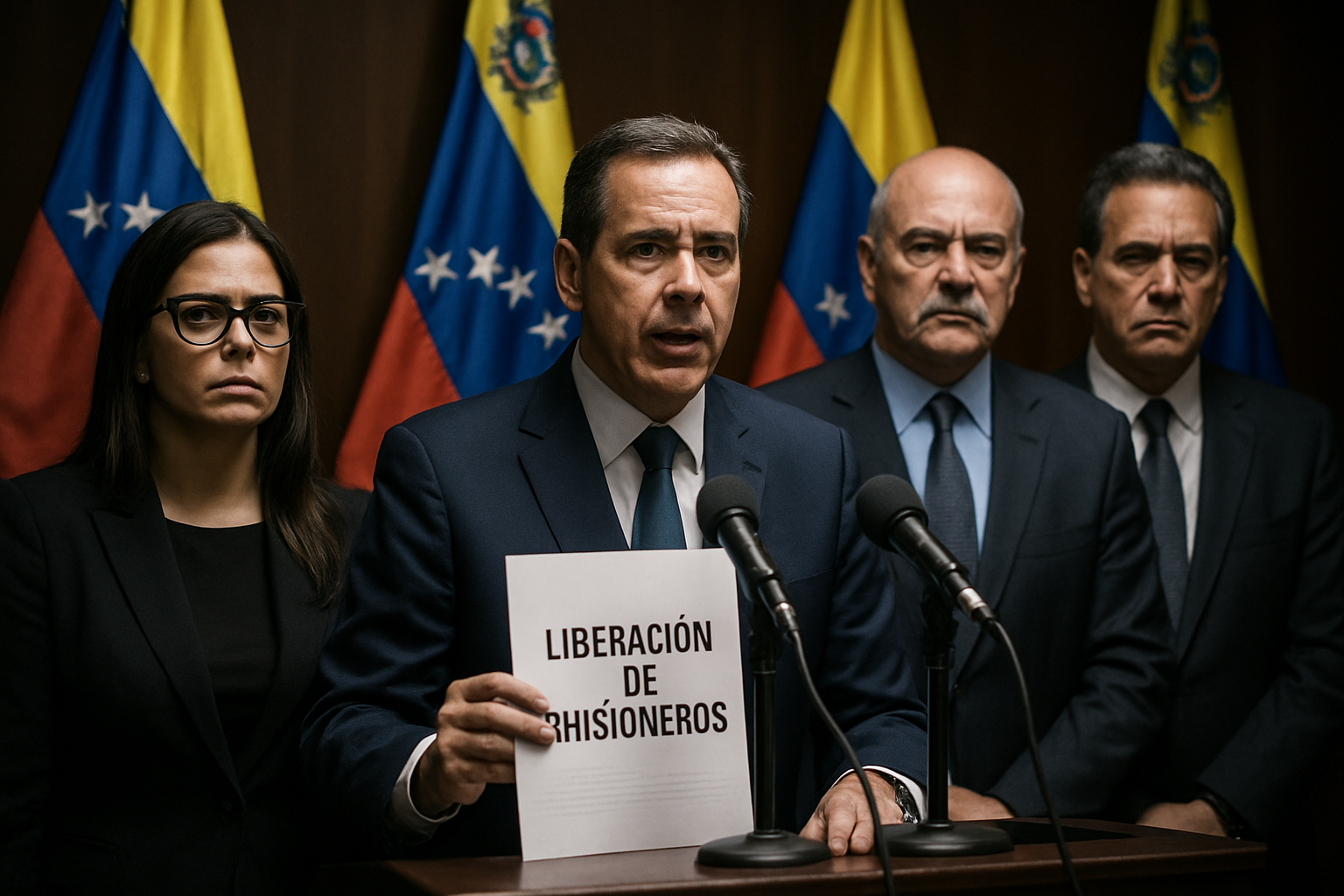
Venezuela's government has confirmed that all remaining political prisoners will be released between Tuesday and Friday next week following the expected approval of a comprehensive amnesty law, marking what could be the most significant human rights development in the country's recent history.
National Assembly President Jorge Rodríguez made the definitive promise to families gathered at Boleíta police station, stating "We hope that between next Tuesday and, at latest, Friday, everyone will be free." The announcement represents the culmination of a month-long transition process that has already seen 367 political prisoners released since January 2026.
Amnesty Law Advances to Final Reading
The 13-article amnesty legislation, proposed by Acting President Delcy Rodríguez on January 30, covers political offenses committed between 1999-2026 and passed its first reading unanimously in the National Assembly on February 5. The law is scheduled for its second and final reading on Tuesday, February 11, with immediate releases promised upon approval.
The legislation is designed to address decades of political prosecutions under the previous Maduro regime, covering opposition figures, journalists, and activists detained on charges including terrorism and treason. However, the law excludes constitutionally forbidden crimes, including hate crimes, though the scope of these exclusions has raised concerns among human rights organizations.
"We ask for forgiveness because I don't like prisoners," Jorge Rodríguez said in an emotional plea during legislative sessions, referencing his family's personal history with police violence.
— Jorge Rodríguez, National Assembly President
International Mediation and Religious Support
The amnesty process has gained significant international legitimacy with the arrival of former Spanish Prime Minister José Luis Rodríguez Zapatero in Caracas on February 6 to participate in the peace plan promoted by Acting President Delcy Rodríguez. Zapatero, who previously mediated Latin American political crises during his 2004-2011 tenure, brings extensive democratic transition experience to the reconciliation efforts.
Cardinal Baltazar Porras organized a "Saturday of prayers" with vigils and ecumenical moments outside prisons nationwide, adding moral authority to the reconciliation process. The Catholic Church's backing represents a significant endorsement of the democratic transition following Maduro's removal in January 2026.
Continuing Releases and Civil Society Response
The gradual release program has already freed several high-profile political prisoners, including journalist Rory Branker, who was detained for nearly a year, and Javier Tarazona, director of human rights organization Fundaredes, who was freed on February 1 after more than four years in detention.
However, civil society organizations have expressed mixed reactions to the process. Cofavic, a prominent human rights group, emphasized that releases constitute "restitution of rights, not a state favor," while opposition leader Andrés Velásquez questioned the necessity of an amnesty law, arguing that political prisoners "are innocent."
Procedural Concerns
Human rights activists and NGOs have raised concerns about the lack of public consultation and procedural transparency in drafting the amnesty law, despite supporting the goal of prisoner releases. The Committee of Mothers for Truth submitted a separate proposal demanding family participation in implementation and verification processes.
Historical Context and Regional Significance
The amnesty represents the most comprehensive political prisoner release program in recent Latin American history. The legislation covers 27 years of political conflict, spanning from Hugo Chávez's rise to power in 1999 through the end of the Maduro era in January 2026.
The timing coincides with broader democratic transition efforts under Acting President Delcy Rodríguez following Maduro's removal by U.S. military intervention in January. The interim government has pursued diplomatic engagement with the United States, with oil exports increasing by 60% to 800,000 barrels daily as the U.S. displaced China as Venezuela's top oil customer.
"This law aims for justice and coexistence among Venezuelans," the legislation states, reflecting the government's commitment to national reconciliation.
— Amnesty Law Text
Implementation Challenges Ahead
Despite the promise of complete releases, significant challenges remain for successful implementation. These include ensuring reintegration guarantees for former prisoners, establishing monitoring mechanisms to prevent future persecution, and creating safeguards for the safe return of political exiles abroad.
International observers view the amnesty as a critical test of the interim government's genuine commitment to democratic principles versus cosmetic reform. Success could influence future democratic consolidation efforts and serve as a model for reconciliation processes across the region.
Regional and International Response
The Dominican Republic has announced plans to reopen relations with Venezuela, while Brazil and the European Union have expressed cautious support for the democratic transition. The United States has implemented a three-phase reconstruction plan under Secretary of State Marco Rubio, focusing on stabilization, economic recovery, and democratic transition.
Looking Forward
The promised release of all political prisoners next week would mark a historic turning point for Venezuela after decades of authoritarian rule. However, the true test of the amnesty's success will lie not just in the releases themselves, but in ensuring these former prisoners can participate freely in Venezuela's democratic future without fear of reprisal.
As families maintain their vigil outside prisons and international observers monitor the process, Venezuela stands at a crossroads between its authoritarian past and a potentially democratic future. The complete fulfillment of Jorge Rodríguez's promise could signal the beginning of genuine reconciliation and the restoration of democratic institutions in the South American nation.