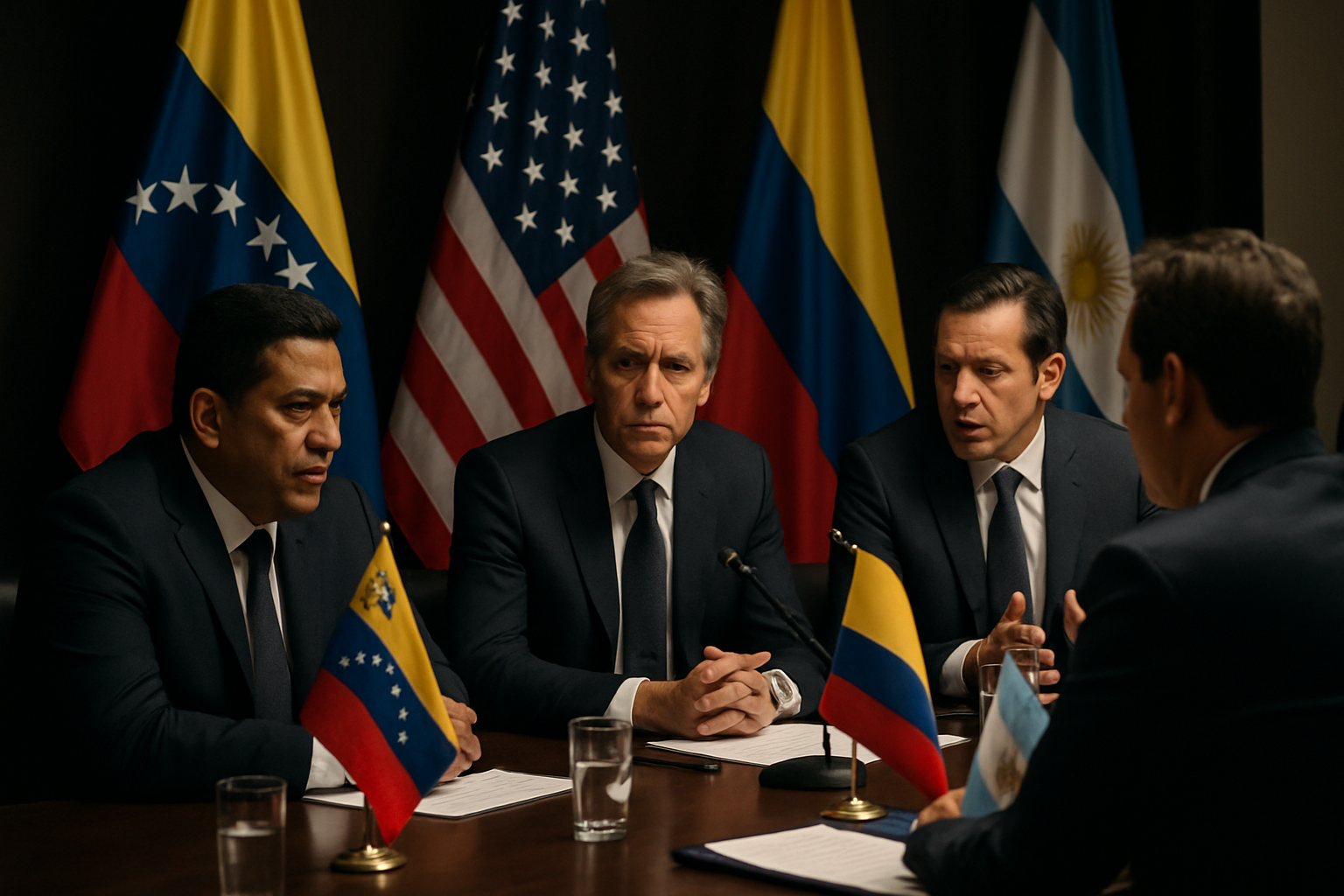
Venezuela's ongoing political crisis has triggered a cascade of international diplomatic responses as 179 political prisoners were released under a new amnesty law, while diplomatic tensions with Panama and refugee deportation policies in the United States create ripple effects across the Western Hemisphere.
The release of 179 imprisoned individuals was announced Tuesday by Jorge Arreaza, president of the parliamentary commission overseeing the implementation of Venezuela's historic amnesty law. The legislation, adopted last Thursday, aims to enable the freedom of hundreds of political prisoners in what represents the most comprehensive reconciliation effort in recent Latin American history.
Amnesty Law Implementation Accelerates
According to Arreaza, since the law's enactment 100 hours ago, 4,293 applications have been submitted, with 3,052 resulting in "full freedoms," encompassing both prison releases and the termination of conditional freedom procedures. The ambitious scope of the 1999-2026 amnesty law covers a 27-year period spanning the entire Chávez-Maduro era, representing an unprecedented attempt at national reconciliation.
The amnesty process has gained momentum under Acting President Delcy Rodríguez's interim government, which has overseen the release of over 750 political prisoners since January 2026. This includes prominent opposition figures such as Juan Pablo Guanipa, a close ally of Nobel Peace Prize laureate María Corina Machado, though his case highlights the complex implementation challenges, as he was subsequently placed under house arrest with electronic monitoring.
Diplomatic Protests Escalate
Venezuela's foreign relations have been further strained by a diplomatic incident at a Panamanian airport, where Venezuelan authorities denounced the "violation of diplomatic pouch" by Panamanian officials. Foreign Affairs Minister Yvan Gil demands "full guarantees of non-repetition" and compliance with "norms governing diplomatic and consular activity," while the Panamanian government has remained silent on the matter.
"It has been clearly demonstrated that the path chosen by the Government of Guyana regarding the Essequibo region is unilateral, unworkable and illegitimate."
— Yvan Gil, Venezuelan Foreign Affairs Minister
Simultaneously, Venezuelan-Guyana tensions persist over the disputed Essequibo region. On the 60th anniversary of the 1966 Geneva Agreement, Gil criticized Guyana's actions as "unilateral, unworkable and illegitimate," urging dialogue to resolve the territorial dispute that has strained regional relations for decades.
US Migration Policy Creates New Pressures
The crisis extends beyond Venezuela's borders, particularly affecting Venezuelan migrants in the United States. The case of Carla López illustrates the precarious situation facing many Venezuelan immigrants with Temporary Protected Status (TPS). Her journey from a traffic violation to potential deportation began when police stopped her for "irregular driving" with a suspended license, despite possessing valid state identification and TPS documentation.
"I said: this is a traffic infraction. Nothing has to do with migration," López recounted, highlighting the intersection of immigration status with routine law enforcement encounters. Her case exemplifies the broader challenges facing the estimated hundreds of thousands of Venezuelans living in the United States under various immigration programs.
Regional Security Implications
The Venezuelan crisis has prompted unprecedented international engagement, with US Southern Command announcing plans for a high-level visit to Venezuela to activate a three-phase reconstruction plan. The strategy aims to stabilize the country's internal security, promote economic recovery, and facilitate political transition toward "a new institutional and democratic order."
This diplomatic engagement represents a dramatic shift from previous maximum pressure policies, as oil exports have surged 60% to 800,000 barrels daily, with the United States displacing China as Venezuela's top customer. Energy Secretary Chris Wright's historic February visit resulted in comprehensive cooperation agreements, formally ending Trump's 2019 oil embargo.
International Mediation Efforts
Former Spanish Prime Minister José Luis Rodríguez Zapatero continues mediation efforts in Caracas, while Cardinal Baltazar Porras has organized nationwide prayer vigils supporting the reconciliation process. These international figures lend credibility to what many view as the most significant opportunity for Venezuelan democratic renewal in over two decades.
The Dominican Republic has reopened diplomatic and commercial relations with Venezuela, while Brazil and the European Union maintain cautious support for the transition process. However, implementation challenges persist, with over 600 political prisoners still detained according to human rights organizations.
Civil Society and Family Pressures
Families of political prisoners have maintained desperate vigils outside detention centers, with some entering hunger strikes to pressure authorities for complete releases. The Committee for Liberation of Political Prisoners (CLIPP) has warned of "grave risks" from government indifference to their protests, highlighting the human cost of the political crisis.
Civil society reactions remain mixed. Human rights organization Cofavic emphasizes that releases constitute "rights restitution, not State favor," while opposition leader Andrés Velásquez questions the amnesty's necessity, arguing that prisoners "are innocent" rather than requiring pardons.
Economic and Geopolitical Realignment
The political transition occurs amid significant economic transformation. Venezuela's oil production, while still only 700,000 barrels compared to historical peaks of 3 million daily, has enabled renewed international engagement. However, challenges remain substantial: hyperinflation, infrastructure decay, power outages, and food insecurity continue to require sustained international investment and technical assistance.
The crisis has created a template for what analysts term "bilateral energy diplomacy" as a tool for countering Chinese influence in Latin America. This approach combines military pressure with selective economic engagement, representing a new model for great power competition in the 21st century.
Implementation Challenges and Future Prospects
Despite legislative achievements, significant implementation gaps remain. Many releases involve conditional arrangements rather than complete freedom, with restrictions on political participation and public statements. The case of Perkins Rocha, who remains with an electronic ankle monitor, led his wife to declare that "amnesty hasn't reached our home."
Article 9 of the amnesty law excludes those who "promoted attacks on national territory by foreign states," while Article 7 requires prisoners to "present themselves to justice," creating delays and disputes. Critics describe the law as "partial, selective, and discriminatory," while supporters argue it represents meaningful progress toward reconciliation.
Regional and Global Implications
The Venezuelan crisis serves as a critical test case for democratic transitions in authoritarian contexts. Success could provide a template for similar reconciliation efforts throughout Latin America, while failure might demonstrate the persistent challenges of building sustainable democratic institutions after decades of authoritarian rule.
International observers monitor the process closely as an indicator of whether rapid diplomatic transformations through combined military pressure and economic incentives can achieve lasting political change. The stakes extend beyond bilateral relations to broader questions of international order adaptation and conflict resolution mechanisms for 21st-century sovereignty principles.
The coming weeks will prove decisive for Venezuela's democratic transformation credibility and the sustainability of this ambitious reconciliation effort. With hundreds of families still awaiting the freedom of their loved ones, the success of this historic amnesty process will ultimately be measured not by legislative achievements alone, but by the genuine restoration of democratic norms and human rights protections that have been absent from Venezuelan society for over two decades.