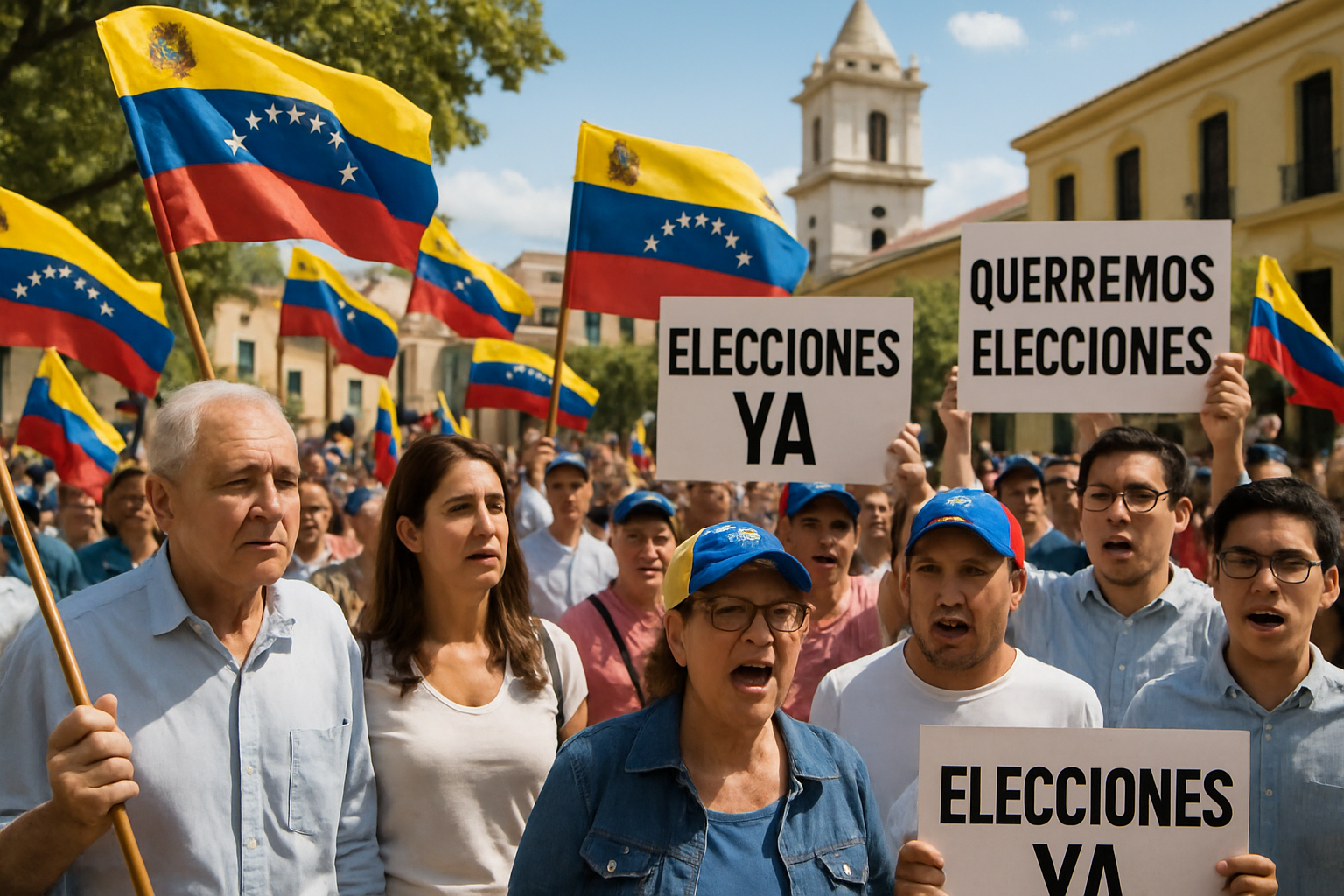
A new survey reveals that 80% of Venezuelans believe presidential elections should be the immediate priority for resolving the country's ongoing political and economic crisis, while civil society groups formally petition U.S. Secretary of State Marco Rubio to advance Venezuela's democratic transition.
The comprehensive polling, conducted as Venezuela enters its fourth month under Acting President Delcy Rodríguez following the January 2026 U.S. military capture of Nicolás Maduro, demonstrates unprecedented public appetite for democratic electoral processes. According to the survey, 93% of respondents affirm they would vote if elections were called in the coming months, representing a return to maximum participation levels and a significant increase from 2025.
Civil Society Mobilization for Democracy
Venezuelan civil society organizations have intensified their campaign for immediate democratic transition, addressing formal petitions to Secretary Rubio emphasizing the "historic opportunity" created by Maduro's removal. The organizations argue that the political process initiated after Maduro's capture on January 3 has opened unprecedented possibilities for advancing toward "the recovery of justice, the economy, and the rule of law."
These groups represent a broad coalition spanning human rights organizations, professional associations, and democratic advocacy networks that have maintained operations throughout the authoritarian period. Their coordinated approach signals sophisticated strategic planning for post-transition governance structures.
Political Prisoner Releases and Ongoing Challenges
The Rodríguez administration has released over 750 political prisoners under a comprehensive amnesty program covering the entire 1999-2026 period of Chávez-Maduro rule, representing the most ambitious Latin American political reconciliation effort in recent history. The historic 13-article amnesty law passed the National Assembly unanimously, covering 27 years of political conflict.
However, implementation remains incomplete. Human rights groups report that approximately 600 political prisoners still remain detained, with some releases involving restrictive conditions including house arrest and electronic monitoring. The case of Juan Pablo Guanipa, a close ally of Nobel laureate María Corina Machado, illustrates these challenges - despite his release, he remains under house arrest with electronic monitoring.
"The importance of implementing a complete and unconditional release of all political prisoners cannot be overstated for genuine democratic transition."
— Alfredo Romero, President of Foro Penal
Economic Transformation Amid Political Change
Venezuela's economic landscape has undergone dramatic transformation since Maduro's removal. Oil exports have surged 60% to 800,000 barrels daily, with the United States displacing China as Venezuela's top customer following comprehensive sanctions relief. Energy Secretary Chris Wright's February visit to Caracas resulted in sweeping cooperation agreements that formally ended the 2019 oil embargo.
Major international energy companies including Chevron, BP, Shell, Eni, and Repsol have received Treasury authorization for expanded operations. Interior Secretary Doug Burgum's March visit focused on mining code reforms providing "unlimited opportunities" for American companies to access critical minerals.
Despite these improvements, substantial challenges persist. Venezuela's oil production remains at only 700,000 barrels daily compared to its historical peak of 3 million barrels. The Central Bank reported a staggering 475% inflation rate for 2025 - the world's highest - while infrastructure decay and power outages continue affecting millions of citizens.
International Diplomatic Breakthrough
The most significant diplomatic development has been the complete restoration of U.S.-Venezuela relations after a seven-year break. The American flag was raised at the U.S. Embassy in Caracas in March 2026, with Chargé d'Affaires Laura Dogu conducting high-level meetings at the Miraflores Presidential Palace.
This dramatic shift from "maximum pressure" to strategic partnership represents one of the most significant hemispheric realignments since the Cold War's end. The transformation follows Secretary Rubio's three-phase reconstruction plan: stabilization through prisoner releases and institutional changes, economic recovery through sanctions relief and investment, and democratic transition toward free elections.
Regional support has been mixed but growing. The Dominican Republic has reopened full diplomatic relations, while Brazil and the European Union maintain cautious but supportive engagement. Former Spanish Prime Minister José Luis Rodríguez Zapatero continues mediation efforts, and Cardinal Baltazar Porras has organized nationwide prayer vigils supporting the reconciliation process.
The Road to Elections
The survey results indicating 80% support for immediate presidential elections align with broader democratic demands. March polling conducted with 1,040 valid household interviews found that 64% of Venezuelans specifically demand presidential elections in 2026, demonstrating sustained public appetite for democratic electoral processes.
However, significant obstacles remain. The current electoral authority (CNE) faces credibility challenges, with opposition leaders like former Zulia Governor Manuel Rosales calling for comprehensive CNE replacement to ensure "clean and transparent elections." Opposition demands include salary increases for electoral workers, electrical system improvements, and repeal of controversial legislation including hate crimes laws.
María Corina Machado's Anticipated Return
Perhaps the most crucial test of Venezuela's democratic commitment will be the return of María Corina Machado, the 2025 Nobel Peace Prize laureate who announced her intention to return "within weeks" from her current location in the United States. Machado held two meetings with senior Trump administration officials, including Secretary Rubio and Chief of Staff Susie Wiles, signaling escalating opposition integration into the transition process.
Machado's safe return and ability to participate freely in political activities will serve as a critical indicator of genuine democratic reform versus cosmetic changes designed to maintain international legitimacy while preserving authoritarian control.
Regional and Global Implications
Venezuela's transition is being closely monitored throughout Latin America as a potential template for post-authoritarian democratic reconstruction. The innovative combination of military pressure, economic incentives, and selective engagement that characterized the U.S. approach represents a new model for international crisis resolution in the era of great power competition.
The success of this "bilateral energy diplomacy" approach has already influenced regional relationships, with countries forced to choose between traditional solidarity arrangements and economic partnerships with Washington. China faces significantly reduced influence as Venezuela reorients toward U.S. markets and Western investment.
The template's broader application could reshape international approaches to territorial disputes, democratic transitions, and strategic partnership development globally. Success would demonstrate the viability of rapid diplomatic transformation through combined pressure and incentives, while failure might undermine the credibility of such approaches elsewhere.
Challenges Ahead
Despite the encouraging survey results and diplomatic progress, Venezuela faces enormous reconstruction challenges. The humanitarian crisis persists, with UN programs receiving only $133 million of a requested $606 million in 2025, covering just 19% of identified needs despite assisting over 2 million people.
The Venezuelan diaspora, estimated at 7.7 million people abroad, shows reluctance to return despite political changes. A Migration Observatory study indicates that the majority have no immediate return plans, prioritizing proven stability over promising but uncertain political improvements. This brain drain represents a significant challenge for long-term reconstruction, as skilled professionals and entrepreneurs will be crucial for economic recovery.
Infrastructure modernization requires massive international investment. Power generation facilities need comprehensive upgrades, with Siemens and General Electric currently evaluating electrical system recovery plans. Multiple generating units among 48 power facilities require immediate intervention after years of inadequate maintenance.
The Democratic Test
The survey results revealing overwhelming support for elections occur at a critical juncture in Venezuela's transition. Civil society's organized pressure on international actors, combined with sustained public demand for democratic processes, creates momentum for genuine electoral competition.
However, the success of Venezuela's democratic transition will ultimately depend on the interim government's willingness to allow genuine political competition, opposition leaders' safe participation, and the international community's sustained engagement beyond immediate economic interests.
The coming months will determine whether Venezuela can break the cycle of authoritarianism that has dominated the country for over two decades, or whether the current changes represent merely a new configuration of power designed to maintain control while satisfying international demands for democratic legitimacy.
As one of the most closely watched political transitions in the Western Hemisphere, Venezuela's experience will likely influence democratic movements and international intervention strategies for decades to come. The overwhelming public demand for elections, as demonstrated in the latest survey, provides both opportunity and pressure for genuine democratic transformation in one of Latin America's most strategically important nations.