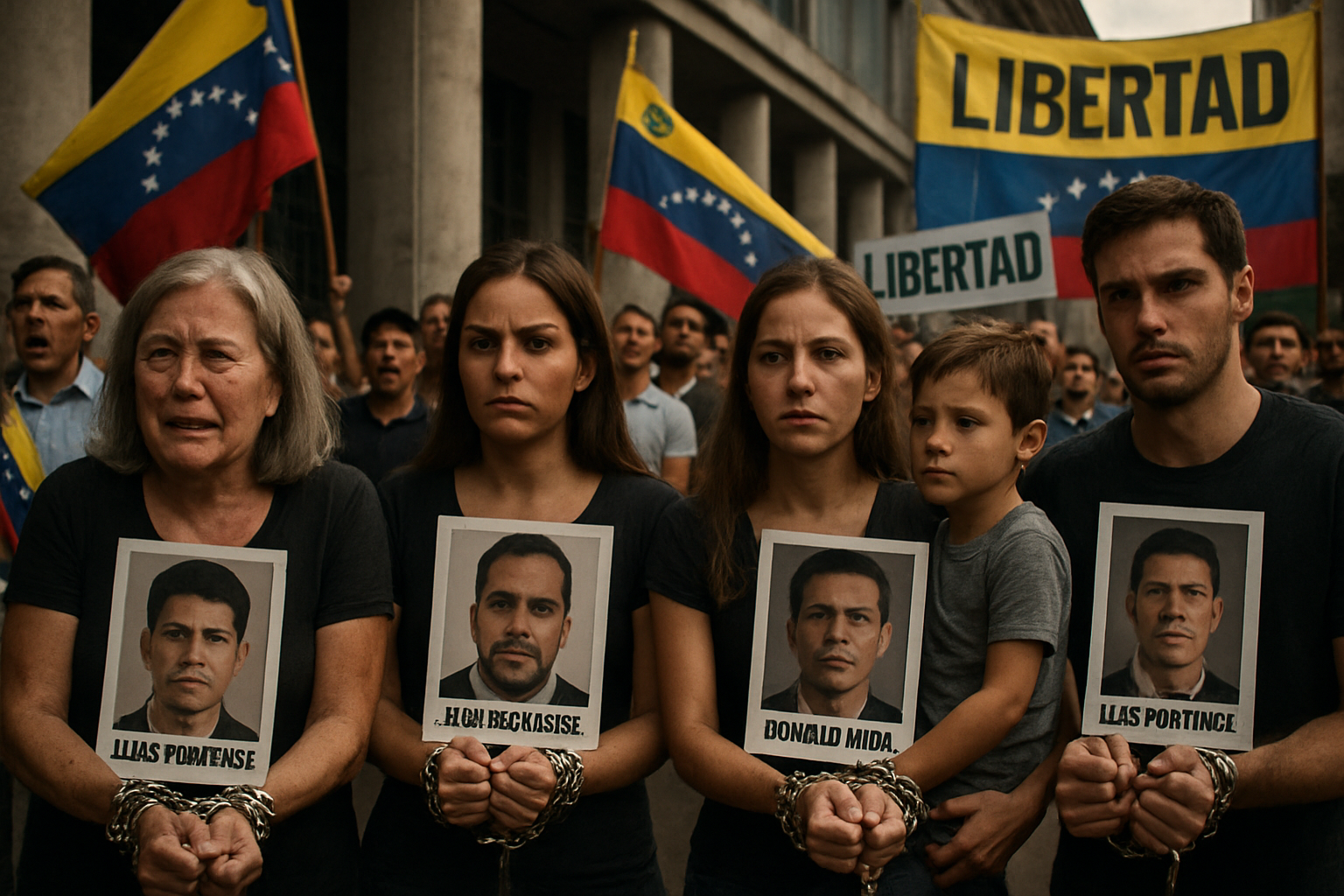
Families of political prisoners in Venezuela have resorted to chaining themselves to concrete barriers outside a major detention facility in Caracas, maintaining a desperate vigil as the country's promised amnesty law encounters unexpected parliamentary resistance despite government assurances that all remaining detainees would be freed by mid-February.
The dramatic protest at the Zona 7 detention center underscores the human cost of Venezuela's stalled political reconciliation process, even as Acting President Delcy Rodríguez this week committed to conducting "free and honest elections" and promised continued prisoner releases under the country's democratic transition following Nicolás Maduro's removal in January 2026.
Broken Promises Fuel Family Desperation
Sandra Rosales, wife of detained police officer and political prisoner Dionnys Quintero, told reporters she will continue her chained protest "until we have an answer" about her husband's fate, despite acknowledging the severe "psychological and physical exhaustion" the vigil has inflicted on families. The families' extreme action came after National Assembly President Jorge Rodríguez's specific promise to free all remaining political prisoners "between Tuesday and Friday at latest" (February 11-14) was delayed due to parliamentary disagreements.
The comprehensive amnesty law, covering political offenses from 1999-2026 spanning the entire Chávez-Maduro era, has become mired in controversy over Article 7, which requires political prisoners to "present themselves to justice" or "come forward legally" – language the ruling Chavista party interprets as requiring acknowledgment of alleged crimes, while the opposition rejects this as criminalizing persecution victims.
"We are not criminals who need to acknowledge crimes. These are innocent people who were persecuted for their political beliefs."
— Opposition leader addressing Article 7 controversy
Massive Release Program Meets Resistance
Despite the current impasse, Venezuela's amnesty program represents the most comprehensive political prisoner release in recent Latin American history. Since January 2026, over 400 political prisoners have been freed from facilities including the notorious Helicoide complex and El Rodeo penitentiary, according to Foro Penal, the country's leading human rights organization documenting political detentions.
Recent high-profile releases have included opposition leader Juan Pablo Guanipa, a close ally of Nobel Peace Prize nominee María Corina Machado, who was freed after more than eight months in detention, and prominent journalist Rory Branker, who had been imprisoned for nearly a year. However, NGO Laboratorio de Paz this week issued alarming reports about 32 political prisoners linked to the "Operation Gedeón" case showing "severe signs of malnutrition, physical weakening, cognitive disorientation, and psychological trauma, presumably associated with detention conditions and insufficient food supply."
International Mediation and Religious Support
Former Spanish Prime Minister José Luis Rodríguez Zapatero has been in Caracas since February 6, participating in the peace plan promoted by Acting President Rodríguez and bringing international legitimacy to the reconciliation process. Cardinal Baltazar Porras has organized nationwide "Saturday of prayers" vigils outside prisons, adding moral authority to the amnesty campaign through Catholic Church support.
The international engagement extends to unprecedented U.S.-Venezuela diplomatic contact, with high-level meetings between Acting President Rodríguez and U.S. Chargé d'Affaires Laura Dogu at Miraflores Palace representing the highest American diplomatic engagement since relations were severed in 2019.
Economic Recovery Amid Political Uncertainty
The amnesty debate occurs during Venezuela's remarkable economic transformation under the interim government. Oil exports have surged 60% to 800,000 barrels daily, with the United States displacing China as Venezuela's top customer. The economic recovery has provided political space for democratic reforms while demonstrating the potential benefits of normalized international relations.
However, Venezuela continues to face significant infrastructure challenges, with oil production at only 700,000 barrels compared to the historical peak of 3 million barrels daily, requiring sustained international investment and technical assistance for full recovery.
Civil Society Divided on Amnesty Approach
Venezuelan civil society organizations have expressed mixed reactions to the amnesty process. Cofavic, a leading human rights group, emphasized that prisoner releases represent "the restitution of rights, not a favor from the State," while opposition leader Andrés Velásquez has questioned the necessity of amnesty legislation altogether, arguing that political prisoners "are innocent" and should not require pardons.
The Committee of Mothers for Truth has demanded family participation in the verification process for releases, reflecting broader concerns about transparency and inclusivity in the reconciliation framework.
Elections Promise Without Timeline
In a significant development this week, Acting President Delcy Rodríguez publicly committed to conducting "free and honest elections" in Venezuela, though she provided no specific timeline. When asked directly by international media whether such elections would be "free and fair," she responded unequivocally "Yes, absolutely," describing them as representing "a free country where justice prevails, without sanctions, and not under international pressure."
This electoral commitment comes as opposition leader María Corina Machado has predicted presidential elections could be held within 2026, expressing growing confidence in the democratic transition following Maduro's removal.
Regional Template for Reconciliation
International observers view Venezuela's amnesty process as a critical test of genuine democratic transformation versus cosmetic reform. The 27-year temporal coverage of the proposed legislation would establish a landmark precedent for political reconciliation in Latin America, potentially affecting hundreds still detained.
Success depends on several factors: genuine commitment to preventing future persecution cycles, reintegration guarantees for released prisoners, monitoring mechanisms for implementation, and safeguards for the safe return of political exiles. The Committee of Mothers for Truth and other civil society organizations have emphasized the need for family participation in verification processes to ensure transparency.
Health Crisis Behind Bars
The urgency of the amnesty debate has been heightened by deteriorating conditions for remaining political prisoners. Laboratorio de Paz's report on 32 detainees linked to Operation Gedeón – a failed 2020 incursion attempt – describes "severe signs of malnutrition, debilitation, disorientation and psychological trauma" presumably linked to inadequate detention conditions and nutrition.
These revelations have intensified pressure on the National Assembly to resolve the Article 7 deadlock and proceed with complete prisoner releases, as families maintain their chained vigil demanding immediate action.
Parliamentary Deadlock Resolution Efforts
The National Assembly's postponement of the amnesty law's final debate has created uncertainty about the timeline for remaining releases, with over 600 political prisoners still detained according to Foro Penal despite the 400+ releases since the January transition. The deadlock on Article 7 reflects deeper disagreements about the nature of political prosecutions under the previous regime and the appropriate framework for reconciliation.
Opposition leaders have indicated that modifications to Article 7 are necessary to achieve consensus, while the ruling party maintains that some form of legal acknowledgment is required. The resolution of this impasse will determine whether Venezuela's amnesty process can achieve its ambitious goal of becoming the most comprehensive political reconciliation in recent Latin American history.
As families continue their chained protest outside detention centers, their desperate actions serve as a stark reminder of the human stakes involved in Venezuela's democratic transition and the urgent need for political leaders to find common ground that prioritizes justice and healing over partisan considerations.