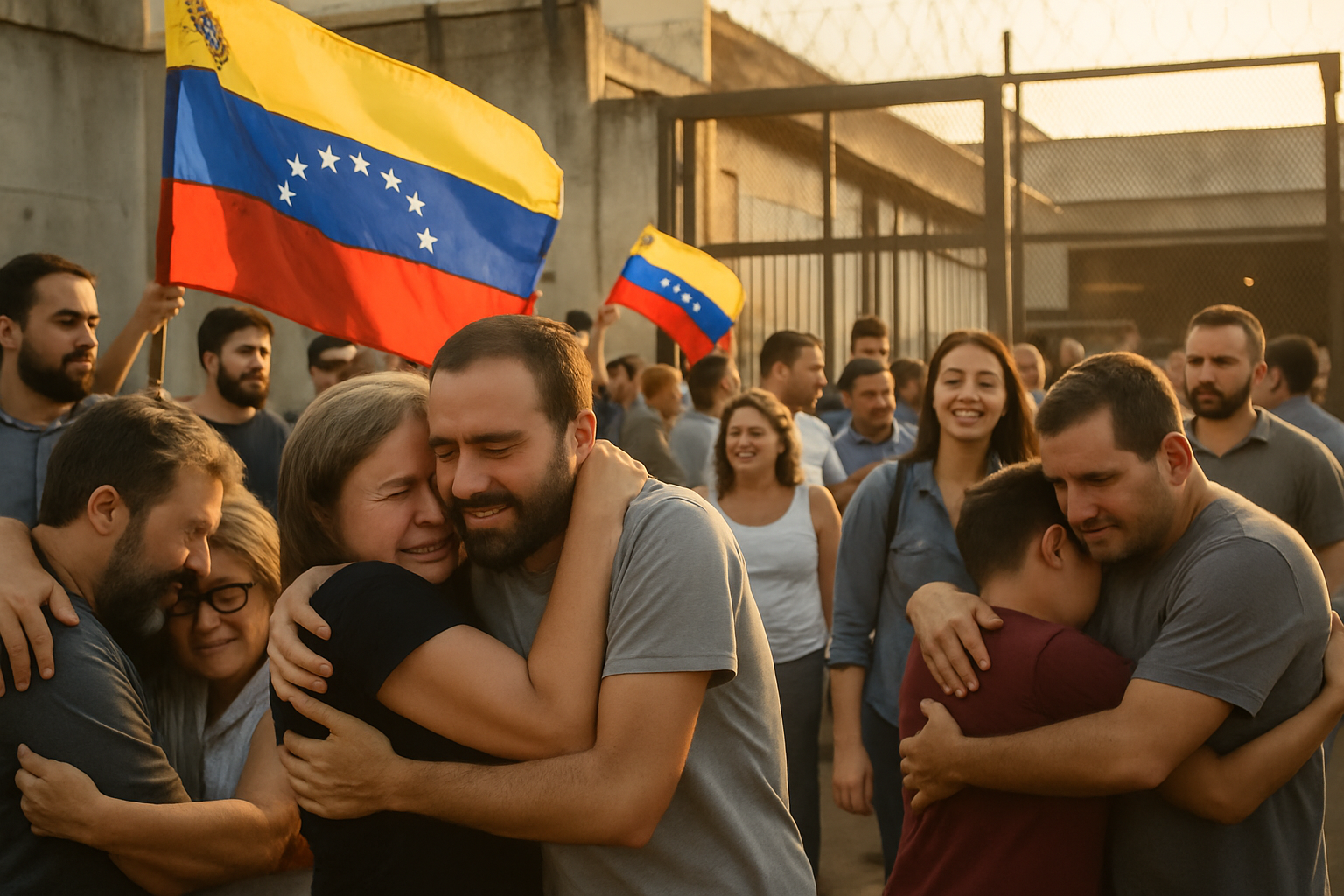
Venezuelan authorities released dozens more political prisoners on February 8, including prominent opposition politicians Juan Pablo Guanipa and Freddy Superlano, as part of an accelerating amnesty program that has now freed over 400 detainees since the country's democratic transition began in January 2026.
The releases, confirmed by human rights organization Foro Penal, represent the largest single-day wave of political prisoner releases in recent Venezuelan history. At least 35 individuals were freed from detention centers across the country, bringing the total number of releases to over 400 since Acting President Delcy Rodríguez announced her comprehensive amnesty program following Nicolás Maduro's removal from power.
Juan Pablo Guanipa, a close ally of Nobel Peace Prize laureate María Corina Machado and former National Assembly vice-president, walked free after more than eight months in detention. His son Ramón announced the release on social media, writing: "After more than eight months of unjust imprisonment and more than a year and a half apart, our whole family will be able to embrace each other again soon."
Opposition Leaders Call for Electoral Recognition
Upon his release, Guanipa recorded a video statement emphasizing the need for truth and reconciliation in Venezuela's political future. "Today we are being released. There is much to discuss regarding the present and future of Venezuela. Always with the truth at the forefront," he declared.
"Any process in the country must obligatorily transit through the recognition of electoral results and the legality of political forces. Reconciliation starts from the truth."
— Juan Pablo Guanipa, Opposition Leader
Guanipa's comments referenced the disputed July 28, 2024 presidential election, which opposition leaders and international observers claimed was won by opposition candidate Edmundo González despite Maduro's declaration of victory. The electoral dispute became a central catalyst for the political crisis that ultimately led to Maduro's downfall in January 2026.
Also released was Freddy Superlano, another prominent opposition figure, alongside lawyer Perkins Rocha and dozens of other political detainees held at facilities including the notorious Helicoide detention center in Caracas.
Foro Penal Confirms Accelerating Pace
Foro Penal, Venezuela's leading human rights organization tracking political prisoners, confirmed that their legal team remains deployed across the country to process the continuing stream of releases. The NGO emphasized that they are maintaining detailed records of all releases while preparing for what could be the complete liberation of all political prisoners in the coming days.
The releases occurred simultaneously with demonstrations by previously freed political prisoners, who organized a caravan through Caracas demanding freedom for all remaining detainees. The caravan stopped at El Helicoide, headquarters of Venezuela's intelligence service (Sebin), where families of political prisoners have maintained vigils for over a month.
Historic Amnesty Law Advances
These latest releases come as Venezuela's National Assembly prepares for the final vote on Acting President Delcy Rodríguez's comprehensive amnesty law. The 13-article legislation, which covers political offenses from 1999-2026, passed its first reading unanimously on February 5 and is scheduled for final approval on February 11.
National Assembly President Jorge Rodríguez has made unprecedented promises to families maintaining vigils outside detention centers, stating that all remaining political prisoners will be freed "between Tuesday and Friday at latest" following the law's final passage. This represents the most specific timeline yet provided for complete political prisoner releases.
International Mediation and Support
The amnesty process has gained international legitimacy through the participation of former Spanish Prime Minister José Luis Rodríguez Zapatero, who arrived in Caracas on February 6 to support the peace plan. Cardinal Baltazar Porras has organized nationwide "Saturday of prayers" vigils outside prisons, adding moral authority to the reconciliation efforts.
The releases are occurring within the context of unprecedented diplomatic engagement between Venezuela and the United States. High-level meetings between Acting President Delcy Rodríguez and US Chargé d'Affaires Laura Dogu at Miraflores Palace represent the most significant diplomatic contact between the countries since 2019.
Economic Recovery and Regional Relations
Venezuela's political transformation has coincided with dramatic economic improvements. Oil exports have surged 60% from 498,000 to 800,000 barrels daily since Maduro's removal, with the United States displacing China as Venezuela's top oil customer. The interim government has implemented oil industry reforms and lifted export restrictions, contributing to stabilizing the country's finances.
Regional support for Venezuela's democratic transition continues to grow. The Dominican Republic has reopened commercial relations and air traffic with Venezuela, while Brazil and the European Union have expressed cautious support for the transition process.
Scope and Historical Context
The current amnesty program represents the most comprehensive political prisoner release in recent Latin American history. The proposed law covers nearly three decades of political conflict, spanning the entire Chávez-Maduro era from 1999 to 2026.
However, the legislation excludes constitutionally forbidden crimes, including hate crimes and serious human rights violations. This limitation has raised some concerns among human rights organizations about the law's scope, though they broadly support the release process.
Civil Society Reactions
Venezuelan civil society organizations have offered mixed reactions to the amnesty process. Cofavic, a prominent human rights group, emphasized that the releases represent "restitution of rights, not State favor," highlighting that the prisoners should never have been detained for their political activities.
Opposition leader Andrés Velásquez questioned the necessity of an amnesty law, arguing that political prisoners "are innocent" and should simply be released without requiring pardons. This perspective reflects ongoing debates about acknowledging versus correcting past injustices.
Implementation Challenges Ahead
Despite the momentum behind the releases, significant challenges remain for successful implementation. These include establishing reintegration guarantees for released prisoners, creating monitoring mechanisms to prevent future persecution, and ensuring safe return provisions for political exiles living abroad.
The success of Venezuela's amnesty program will likely serve as a template for future democratic transitions and reconciliation processes throughout Latin America. International observers view the program as a critical test of genuine democratic commitment versus cosmetic political reforms.
Looking Forward
As Venezuela approaches the February 11 final vote on the amnesty law, the country stands at a crucial juncture in its democratic transition. The release of over 400 political prisoners represents a fundamental reversal from the systematic detention policies of the Maduro era and signals a commitment to political reconciliation.
The coming days will determine whether Acting President Rodríguez's government can fulfill its promise of complete political prisoner releases, potentially ending decades of political persecution and opening a new chapter in Venezuelan democracy.
For families like the Guanipas, who have endured months of separation and uncertainty, these releases represent not just political victory but personal healing. As Venezuela continues its transition from authoritarianism to democracy, the success of the amnesty program will be measured not only in numbers of prisoners freed but in the country's ability to build lasting political reconciliation and prevent future cycles of persecution.