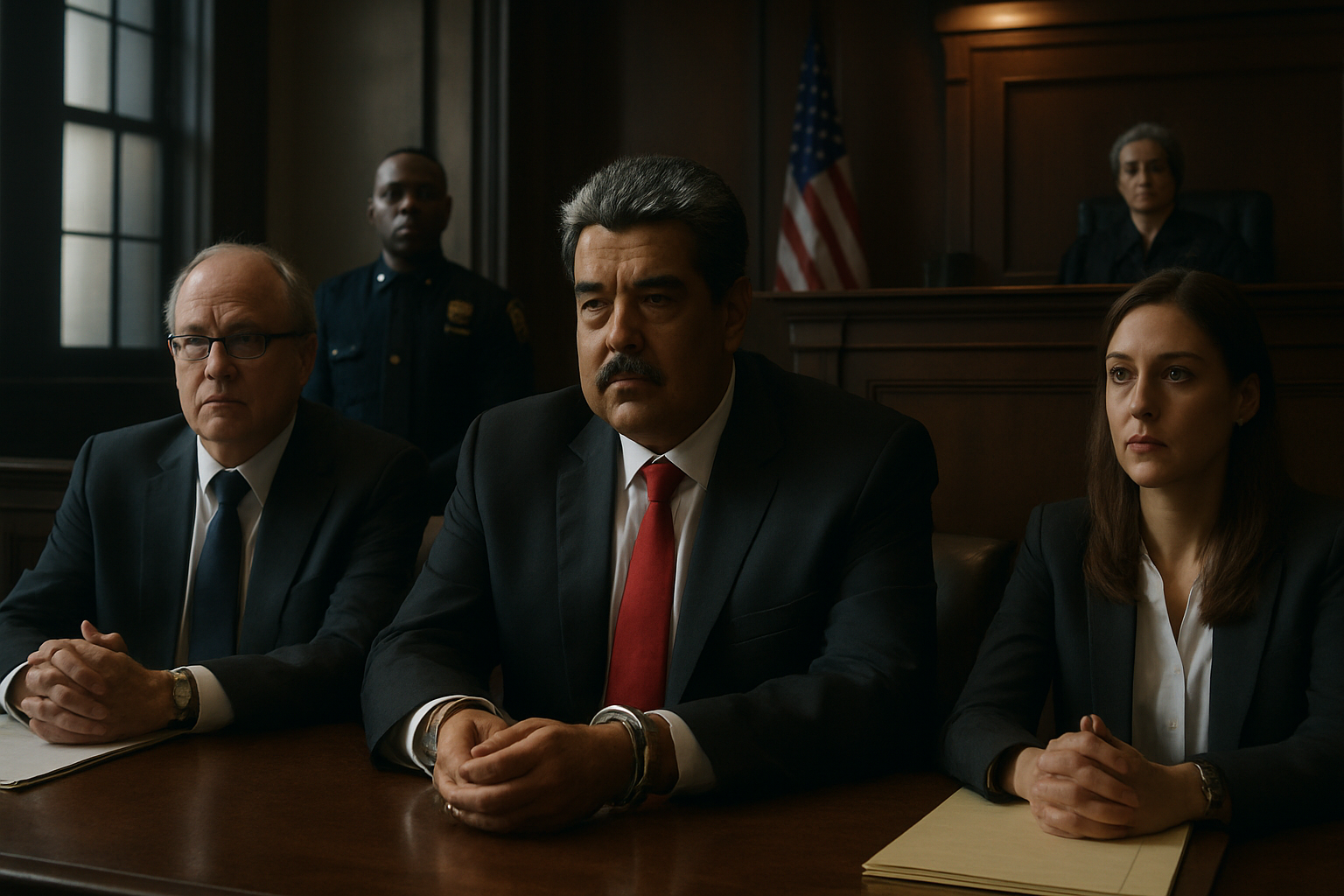
Former Venezuelan President Nicolás Maduro is scheduled to appear in a New York federal court on Thursday for the second time since his dramatic capture by U.S. forces in January, while back in Venezuela, the interim government has categorically rejected opposition proposals to privatize the nation's oil industry.
The dual developments underscore the complex political and legal challenges facing Venezuela as it navigates its most significant transformation in decades under Acting President Delcy Rodríguez's interim government.
Maduro's Legal Battle Continues
Maduro, who faces multiple charges including drug trafficking and weapons offenses, will make his second court appearance since being captured by U.S. military forces in January 2026. His legal team continues to challenge both legal and procedural obstacles while operating under the constraints of U.S. sanctions that have complicated his defense funding.
According to sources familiar with the proceedings, Maduro has been held in solitary confinement at a New York federal prison facility, with officials citing security concerns and the need to protect him from potential threats from other Venezuelan nationals who could pose a danger to the former president.
U.S. prosecutors have been defending their decision to block Venezuelan state funds from being used for Maduro's legal defense, arguing that the United States does not recognize him as a legitimate leader and therefore cannot authorize the use of state resources for his representation.
Government Condemns Oil Privatization Push
Meanwhile, in Caracas, Venezuela's Ministry of Hydrocarbons has strongly rejected recent proposals from opposition leader María Corina Machado to privatize the country's oil industry. The ministry characterized the opposition's privatization agenda as fundamentally "anti-national."
"The importance of oil for Venezuela can never be diminished by those who have no real or moral authority to speak about our industry."
— Ministry of Hydrocarbons Official Statement
The government's response comes as Venezuela's oil exports have surged 60% to 800,000 barrels daily since January 2026, with the United States displacing China as the country's top customer following comprehensive energy cooperation agreements signed by Energy Secretary Chris Wright during his historic February visit to Caracas.
Political Reconciliation Amid Tensions
The rejection of privatization proposals occurs against the backdrop of Venezuela's most comprehensive political reconciliation process in recent Latin American history. Over 750 political prisoners have been released since January 2026 under the Rodríguez administration's historic 1999-2026 amnesty program, though approximately 600 prisoners remain detained according to human rights organizations.
The amnesty law, which passed the National Assembly unanimously, covers 27 years of political conflict spanning the entire Chávez-Maduro era. However, its implementation has faced challenges, with many releases involving restrictive conditions rather than complete freedom.
Notable among those affected is Juan Pablo Guanipa, a close ally of María Corina Machado and former National Assembly vice-president, who was released but subsequently placed under house arrest with electronic monitoring.
International Diplomatic Breakthrough
Venezuela's transformation has been marked by unprecedented diplomatic engagement with the United States. The two countries formally restored diplomatic relations in March 2026 after a seven-year break, representing one of the most dramatic foreign policy reversals in recent history.
Former Spanish Prime Minister José Luis Rodríguez Zapatero continues to mediate the reconciliation process, while Cardinal Baltazar Porras has organized nationwide prayer vigils to support the democratic transition. The Dominican Republic has reopened full diplomatic and commercial relations with Venezuela, while Brazil and the European Union maintain cautious but growing support for the interim government.
Economic Challenges Persist
Despite the diplomatic breakthroughs and oil export surge, Venezuela continues to face significant economic challenges. The country recorded a 475% inflation rate in 2025 — the world's highest — while oil production remains at only 700,000 barrels daily compared to historical peaks of 3 million barrels.
Infrastructure decay, power outages, and the need for sustained international investment remain critical issues requiring long-term solutions. The success of Venezuela's democratic transition depends not only on political reconciliation but also on economic modernization and institutional reforms.
Opposition Strategy and Future Elections
María Corina Machado, the 2025 Nobel Peace Prize laureate, has announced her intention to return to Venezuela "within weeks" to guarantee the democratic transition. Her planned return serves as a crucial test of the interim government's commitment to genuine democratic reform.
U.S. Secretary of State Marco Rubio has indicated that "just and democratic" elections represent the next phase of Venezuela's transition, following his three-phase reconstruction plan of stabilization, economic recovery, and democratic transition.
Regional and Global Implications
Venezuela's transformation is being closely monitored as a potential template for peaceful democratic transitions in Latin America and beyond. The country's experience combining military intervention, economic incentives, and diplomatic engagement represents a new model for international crisis resolution in an era of great power competition.
The success or failure of Venezuela's democratic transition will likely influence similar efforts across Latin America and could reshape how the international community approaches territorial disputes and authoritarian-to-democratic transitions globally.
As Maduro faces the American justice system and Venezuela grapples with fundamental questions about its economic future, the coming weeks will prove decisive in determining whether the country's transformation represents genuine democratic change or merely cosmetic adjustments to maintain political control.
The international community continues to watch closely, recognizing that Venezuela's experience may well become the defining case study for 21st-century democratic transitions and international intervention strategies.