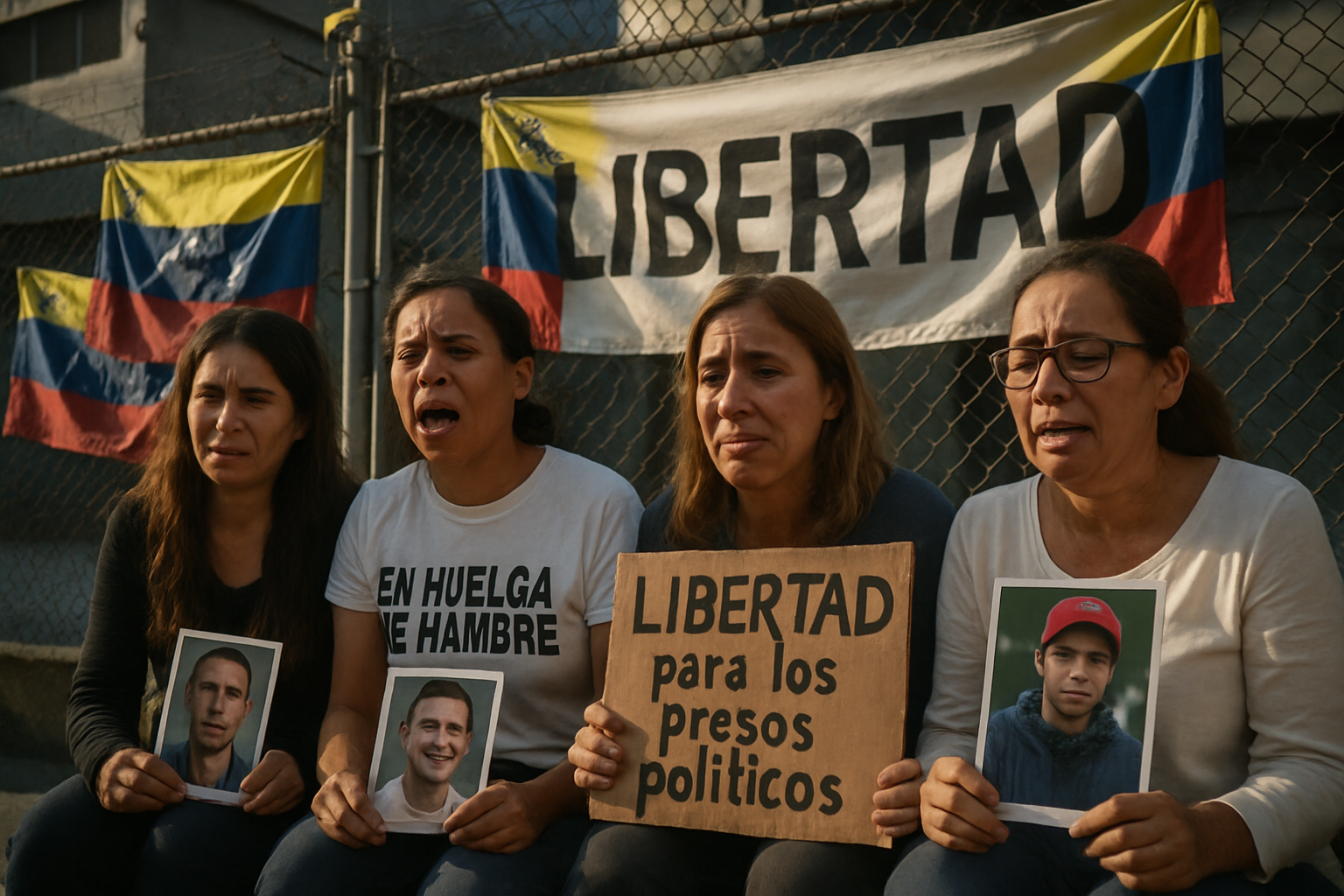
Families of Venezuelan political prisoners have completed over 72 hours of hunger strikes outside detention facilities in Caracas, escalating their desperate campaign for the immediate release of their loved ones as a promised amnesty law remains stalled in the National Assembly.
The Committee for the Liberation of Political Prisoners (CLIPP) reported that the families' protest outside the Zona 7 detention center has entered a critical phase, with at least one woman fainting and requiring hospital transport by taxi due to the unavailability of ambulances. The organization warned that government "indifference and lack of responses" puts the protesters' lives and integrity at "grave risk."
The hunger strikes represent the culmination of weeks of sustained protest activity that began in early January when Acting President Delcy Rodríguez announced plans for a comprehensive political prisoner release program. What initially brought hope to hundreds of families has now become a source of frustration as bureaucratic delays and political disagreements have slowed the process.
Prolonged Vigils Stretch into 39 Days
Beyond the acute hunger strikes at Zona 7, families have maintained continuous vigils at major detention facilities including El Helicoide and El Rodeo I for 39 consecutive days. These vigils began in early January when the government announced it would begin a process of releases, but the promised timeline has repeatedly been extended without clear resolution.
The families' persistence reflects both hope and desperation. While over 400 political prisoners have been released since January 2026 under Rodríguez's amnesty program – representing the most significant such release in recent Venezuelan history – an estimated 600 prisoners remain detained according to human rights organization Foro Penal.
The contrast between government promises and family experiences has created a tense atmosphere of expectation mixed with growing anxiety. National Assembly President Jorge Rodríguez had promised that all remaining prisoners would be freed "between Tuesday and Friday" in mid-February, but that deadline passed without complete resolution.
Amnesty Law Deadlock Over Article 7
The source of delay lies in political disagreements over the comprehensive amnesty law covering political offenses from 1999-2026. The legislation passed its first reading unanimously but has encountered resistance over Article 7, which would require political prisoners to "present themselves to justice" as a condition for release.
The Chavista party has demanded that prisoners acknowledge alleged crimes as part of the release process, while opposition groups categorically reject this requirement, arguing that the detainees are victims of political persecution rather than genuine criminals. This philosophical disagreement has created a deadlock that affects hundreds of families.
"The releases are restitution of rights, not a state favor," emphasized human rights organization Cofavic, reflecting the opposition's position that these individuals should never have been imprisoned in the first place. Opposition leader Andrés Velásquez has questioned the necessity of an amnesty law entirely, arguing that political prisoners "are innocent" and should be freed immediately.
International Mediation Efforts Continue
International efforts to support the reconciliation process continue, with former Spanish Prime Minister José Luis Rodríguez Zapatero participating in peace discussions in Caracas since February 6. Cardinal Baltazar Porras has organized nationwide prayer vigils, adding religious legitimacy to calls for complete prisoner releases.
The international attention reflects the broader significance of Venezuela's democratic transition. The prisoner release program is occurring alongside unprecedented U.S.-Venezuela diplomatic engagement, with high-level meetings at Miraflores Palace representing the highest diplomatic contact since 2019. Oil exports have surged 60% to 800,000 barrels daily, with the United States displacing China as Venezuela's top customer.
These developments are part of Secretary of State Marco Rubio's three-phase reconstruction plan: stabilization, economic recovery, and democratic transition. The success of the political prisoner releases is seen as a critical test of the interim government's commitment to genuine democratic reform versus cosmetic changes.
Human Cost of Bureaucratic Delays
While diplomats and politicians debate legislative language, families continue to pay an immediate human price. The hunger strikers outside Zona 7 demonstrate the emotional and physical toll of prolonged uncertainty. Recent releases have included prominent figures like Juan Pablo Guanipa, a close ally of Nobel Peace Prize laureate María Corina Machado, though even his case involved complex conditions including house arrest and communication restrictions.
The Committee of Mothers for Truth has demanded direct family participation in any verification process, arguing that releases should be "inclusive rather than selective." This reflects broader concerns about the arbitrary nature of who gets released when, creating additional anxiety for families still waiting.
Recent reports from Laboratorio de Paz have documented severe health conditions among detained prisoners, including 32 individuals showing "severe malnutrition, physical weakening, cognitive disorientation, and psychological trauma" from inadequate detention conditions. Such reports intensify family concerns about their loved ones' immediate wellbeing.
Broader Democratic Transition Context
The prisoner release process occurs within Venezuela's broader democratic transition following Nicolás Maduro's removal in January 2026. The comprehensive amnesty law, covering 27 years of the Chávez-Maduro era, would represent the most ambitious political reconciliation effort in recent Latin American history.
Success depends on resolving not only the immediate Article 7 disagreement but also establishing frameworks for reintegration guarantees, monitoring mechanisms, and safeguards against future persecution cycles. International observers view the process as a critical indicator of whether Venezuela can achieve genuine reconciliation versus temporary political maneuvering.
The Dominican Republic has reopened relations with Venezuela, and Brazil and the European Union have expressed cautious support for the transition, but sustained international backing depends on demonstrable progress in human rights and democratic governance.
Families Demand Immediate Action
As the hunger strikes continue, families are demanding concrete action rather than continued promises. The 72-hour mark represents a critical threshold where health risks become severe, particularly for older participants or those with underlying medical conditions.
The strikes outside Zona 7 have been designated "without mobilization," representing a tactical shift from street protests to pure economic and moral pressure through personal sacrifice. This approach reflects both the families' desperation and their strategic calculation that dramatic personal gestures might succeed where traditional demonstrations have not.
The ongoing vigils at El Helicoide and El Rodeo I continue to draw attention to the estimated 600 prisoners who remain detained despite the release program. These facilities have become symbolic focal points for family activism, with participants maintaining round-the-clock presence to pressure authorities for action.
With the amnesty law's final passage still uncertain and no clear timeline for resolution, families face an agonizing choice between maintaining their protest pressure and preserving their own health and safety. Their continued presence outside detention facilities represents both a testament to their dedication and a reminder of the human cost of political persecution in Venezuela's path toward democratic reconciliation.