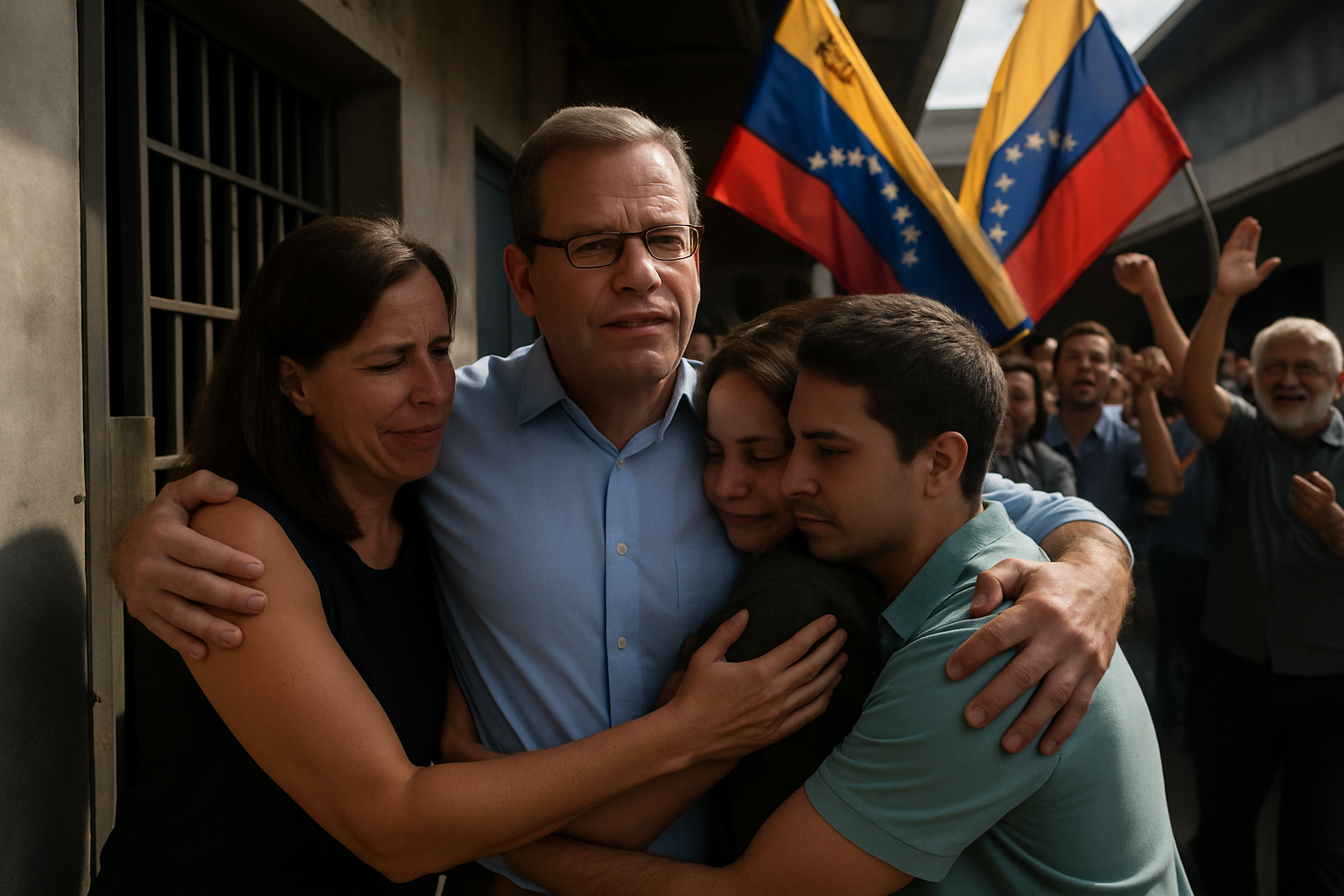
Venezuelan opposition leader Juan Pablo Guanipa was released from detention on February 8, 2026, after spending more than eight months in prison as a political prisoner under the previous Maduro regime. His release comes as Venezuela's interim government under Acting President Delcy Rodríguez accelerates a comprehensive amnesty program affecting hundreds of political prisoners.
Guanipa, a former vice-president of the National Assembly and close collaborator of Nobel Peace Prize laureate María Corina Machado, was detained on May 23, 2025, on charges that included terrorism, violence, and narcotics trafficking. The charges were widely denounced by human rights organizations as politically motivated persecution of opposition figures.
His son, Ramón Guanipa, announced the release on social media platform X, stating: "I announce that my father, Juan Pablo Guanipa, was released a few minutes ago. After more than eight months of unjust deprivation of liberty and over a year and a half of separation, our entire family will soon be able to embrace again."
Release Video and Statement
Upon his release from a police facility in Caracas, Guanipa recorded a brief video showing his release documentation and reflected on his time in hiding and detention. In the video, he stated there was "much to talk about regarding the present and future of Venezuela," signaling his intention to return to active political participation.
The release occurred one month after Acting President Delcy Rodríguez announced her proposed general amnesty law for political prisoners, marking a dramatic shift from the systematic detention of opposition figures that characterized the Maduro era.
Part of Broader Amnesty Program
Guanipa's release is part of an accelerating amnesty program that has already freed 367 political prisoners since Venezuela's political transition began in January 2026. The releases have included prominent figures such as journalist Rory Branker, who was detained for nearly a year, and Javier Tarazona, director of the NGO Fundaredes, who was freed on February 1 after more than four years in detention.
The comprehensive amnesty law currently under consideration by Venezuela's National Assembly covers political offenses committed between 1999 and 2026, spanning the entire Chávez-Maduro era. The legislation passed its first reading unanimously on February 5, with a second and final reading scheduled for Tuesday, February 11.
National Assembly President Jorge Rodríguez has made an unprecedented promise to families of political prisoners, stating that ALL remaining detainees will be freed "between Tuesday and Friday at latest" following the law's final approval.
"Between next Tuesday and at latest Friday, everyone is free"
— Jorge Rodríguez, National Assembly President
International Legitimacy and Support
The amnesty process has gained international credibility through the participation of former Spanish Prime Minister José Luis Rodríguez Zapatero, who arrived in Caracas on February 6 to support the peace plan promoted by Acting President Rodríguez. His presence brings democratic transition expertise and international legitimacy to the reconciliation efforts.
Religious leaders have also provided moral authority to the process. Cardinal Baltazar Porras organized a "Saturday of prayers" with vigils and ecumenical moments outside prisons nationwide, adding spiritual support to the humanitarian initiative.
The releases occur within the context of Venezuela's broader political transition following the January 2026 U.S. military intervention that resulted in the removal of Nicolás Maduro. The interim government has pursued high-level diplomatic engagement with the United States, including meetings between Acting President Rodríguez and U.S. Chargé d'Affaires Laura Dogu at Miraflores Palace.
Economic Transformation Amid Political Change
Venezuela's political transformation has coincided with significant economic developments. Oil exports have surged 60% from 498,000 to 800,000 barrels daily in January, with the United States displacing China as Venezuela's top oil customer. This economic recovery provides a foundation for the country's democratic transition efforts.
The broader diplomatic breakthrough includes Secretary of State Marco Rubio's three-phase reconstruction plan: stabilization addressing the humanitarian crisis, economic recovery requiring sanctions relief, and democratic transition with free elections.
Civil Society and Opposition Perspectives
Human rights organization Cofavic has emphasized that the releases represent "restitution of rights, not State favor," highlighting that the freedom of political prisoners should be viewed as the correction of injustices rather than governmental generosity.
However, some opposition voices, including leader Andrés Velásquez, have questioned the necessity of an amnesty law, arguing that political prisoners "are innocent" and should never have been detained in the first place. This perspective reflects ongoing debates about the nature of political prosecutions under the previous regime.
María Corina Machado, who received the Nobel Peace Prize and has been a central figure in Venezuela's democratic opposition, has expressed support for the releases while maintaining her broader vision for democratic transition and electoral reconstruction.
Challenges and Implementation
Despite the progress, significant challenges remain for the full implementation of political reconciliation. The amnesty law excludes constitutionally forbidden crimes, including hate crimes, though the scope of these exclusions has raised concerns among legal experts and human rights groups.
Implementation challenges include ensuring reintegration guarantees for former prisoners, establishing monitoring mechanisms to prevent future persecution, and facilitating the safe return of political exiles who fled the country during the Maduro era.
The success of the amnesty program is viewed as a critical test of the interim government's commitment to genuine democratic transition versus cosmetic reforms. International observers are monitoring the process as an indicator of Venezuela's human rights progress and democratic commitment.
Regional and Historical Significance
The Venezuelan amnesty represents the most comprehensive political prisoner release program in recent Latin American history. If successfully implemented, it could affect hundreds of individuals still detained and serve as a model for regional reconciliation efforts.
The 27-year coverage period of the amnesty law reflects the extended nature of political conflict in Venezuela and represents an opportunity to address decades of political persecution. The international community is watching closely as the program could influence future democratic consolidation efforts throughout Latin America.
For Juan Pablo Guanipa specifically, his release marks not only personal freedom after months of unjust detention but also the return of an experienced political leader to Venezuela's democratic reconstruction efforts. As a close ally of María Corina Machado and former National Assembly vice-president, his expertise will be valuable in building the institutional foundations for Venezuela's democratic future.
The coming days will be crucial as Venezuela's National Assembly prepares for the final vote on the amnesty law, with the promise of complete political prisoner releases representing a historic opportunity for national reconciliation and democratic renewal.