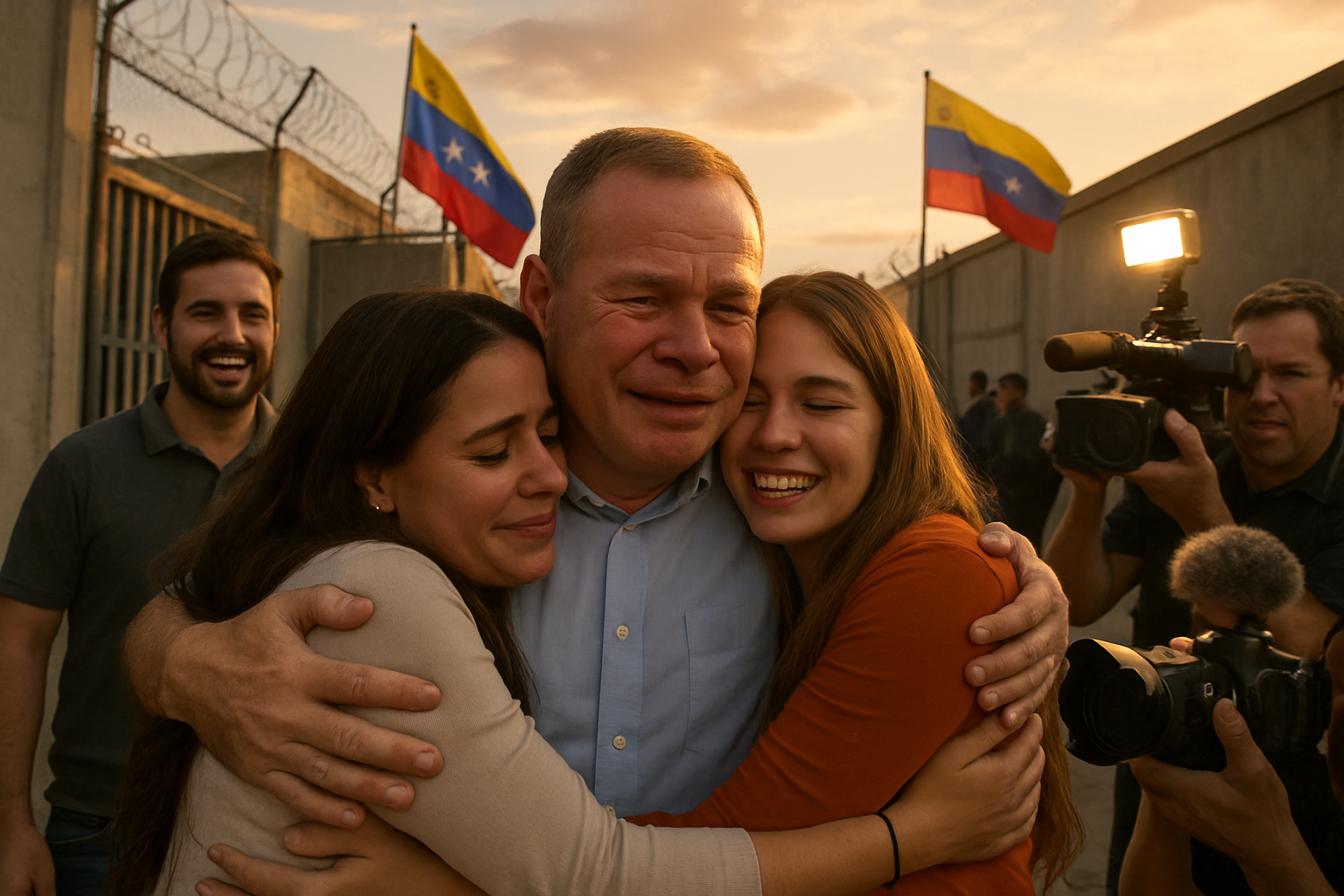
Venezuelan opposition leader Juan Pablo Guanipa was released from detention on Sunday after more than eight months in prison, marking a significant development in Venezuela's ongoing political prisoner amnesty program under Acting President Delcy Rodríguez.
Guanipa, a former National Assembly vice-president and close ally of Nobel Peace Prize laureate María Corina Machado, was among at least 30 political prisoners freed on February 8, 2026, according to multiple sources. His son, Ramón Guanipa, announced the release on social media platform X, stating: "After more than eight months of unjust imprisonment and more than a year and a half apart, our whole family will be able to embrace each other again soon."
Release as Part of Broader Amnesty Program
The release comes as Venezuela's government faces mounting international pressure to free hundreds of political prisoners detained under the previous Maduro regime. According to sources familiar with the matter, Venezuela has now released at least 367 political prisoners since the political transition began in January 2026, following the removal of Nicolás Maduro from power.
Among those freed alongside Guanipa were several other prominent opposition figures, including former councilman Jesús Armas, who was released from the notorious Helicoide detention center after being arbitrarily detained in December 2024. The releases also included activists María Oropeza, Dignora Hernández, and Carmen Ramos, all associated with Machado's political movement.
"Today we are being released. There is much to discuss regarding the present and future of Venezuela. Always with the truth at the forefront."
— Juan Pablo Guanipa, upon his release
International Diplomatic Pressure
The prisoner releases follow a recent visit to Venezuela by representatives of former Spanish Prime Minister José Luis Rodríguez Zapatero, who arrived in Caracas on February 6 to participate in a peace plan promoted by Acting President Delcy Rodríguez. The international engagement adds legitimacy to the reconciliation efforts and represents the highest-level diplomatic involvement in Venezuela's transition process.
United States Chargé d'Affaires Laura Dogu has been conducting high-level meetings with Venezuelan officials at the Miraflores Presidential Palace, marking the most significant US-Venezuela diplomatic contact since relations were severed in 2019. These diplomatic developments coincide with Venezuela's oil exports increasing by 60% to 800,000 barrels daily, with the United States displacing China as Venezuela's top oil customer.
Congressional Response
Republican congresswoman María Elvira Salazar and fellow Republican Mario Díaz-Balart expressed their joy over Guanipa's release while demanding freedom for all remaining political prisoners. The Congressional response from Florida, home to a significant Venezuelan diaspora, highlights the continued international attention on Venezuela's human rights situation.
Comprehensive Amnesty Law in Progress
Venezuela's National Assembly is currently advancing a comprehensive amnesty law that could affect hundreds of additional political prisoners. The 13-article legislation covers political offenses from 1999-2026, spanning the entire Chávez-Maduro era. National Assembly President Jorge Rodríguez has made unprecedented promises to families of political prisoners that all remaining detainees will be freed "between Tuesday and Friday at latest" following the second reading approval scheduled for February 11.
The amnesty law passed its first reading unanimously on February 5, with Assembly President Jorge Rodríguez emphasizing urgency by stating "we don't have much time." The legislation excludes constitutionally forbidden crimes, including hate crimes, though the scope of these exclusions has raised concerns among human rights organizations.
Civil society groups have expressed mixed reactions to the amnesty process. Cofavic, a prominent human rights organization, emphasized that releases represent "restitution of rights, not State favor," while opposition leader Andrés Velásquez questioned the necessity of amnesty, arguing that political prisoners "are innocent."
Guanipa's Political Background
Juan Pablo Guanipa served as vice-president of the National Assembly and has been one of the most visible faces of Venezuela's opposition movement. His detention on May 23, 2025, on charges of terrorism, violence, and narcotics—widely considered politically motivated—made him one of the highest-profile political prisoners under the Maduro regime.
As a close ally of María Corina Machado, who won the Nobel Peace Prize for her democratic leadership, Guanipa brings significant political experience to Venezuela's democratic reconstruction efforts. His return to political activity comes at a crucial time when the opposition is working to rebuild democratic institutions and prepare for potential future elections.
Upon his release, Guanipa called for recognition of the July 28, 2024 election results, stating: "Any process in the country must obligatorily transit through the recognition of electoral results and the legality of political forces. Reconciliation starts from the truth."
Ongoing Challenges and International Context
Despite the positive developments in prisoner releases, Venezuela continues to face significant challenges. The country is still recovering from years of economic crisis, with oil production at only 700,000 barrels daily compared to a historical peak of 3 million. Infrastructure decay, power outages, and hyperinflation continue to affect daily life for millions of Venezuelans.
The prisoner amnesty program occurs alongside broader democratic transition efforts under Acting President Delcy Rodríguez's interim government. The European Union has expressed cautious support for the democratic reforms, while Brazil and other regional powers are monitoring the situation closely.
Religious leaders have also played a role in supporting the reconciliation process. Cardinal Baltazar Porras organized a "Saturday of prayers" with vigils outside prisons nationwide, adding moral authority to the peace efforts and demonstrating the broad coalition supporting democratic renewal.
Regional and International Implications
The success of Venezuela's amnesty program could serve as a model for political reconciliation throughout Latin America. The comprehensive nature of the prisoner releases—covering 27 years of political conflict—represents one of the most significant amnesty processes in recent regional history.
International observers view the releases as a critical test of Venezuela's commitment to genuine democratic transition versus cosmetic reforms. The Dominican Republic has already begun reopening commercial relations with Venezuela, while other regional partners are expressing cautious optimism about the country's trajectory.
The Portuguese Ministry of Foreign Affairs confirmed that Portuguese-Venezuelan citizen Manuel Enrique Ferreira González, a leader in the Vente Venezuela party who had been detained since July 2025, was also among those released. This international dimension adds complexity to the diplomatic considerations surrounding the amnesty process.
Looking Forward
The release of Juan Pablo Guanipa and dozens of other political prisoners represents a significant milestone in Venezuela's democratic transition. However, substantial challenges remain in ensuring sustainable reconciliation, preventing future persecution cycles, and addressing the country's deep economic and social problems.
With the comprehensive amnesty law expected to pass its final reading on February 11, the coming days will be crucial for determining whether Venezuela can complete one of Latin America's most ambitious political prisoner release programs. Success could influence similar efforts throughout the region and provide a template for peaceful political transitions.
The international community continues to monitor Venezuela's progress closely, with the hope that these releases mark the beginning of a broader democratic renewal that addresses the needs of all Venezuelans after years of political polarization and economic hardship.