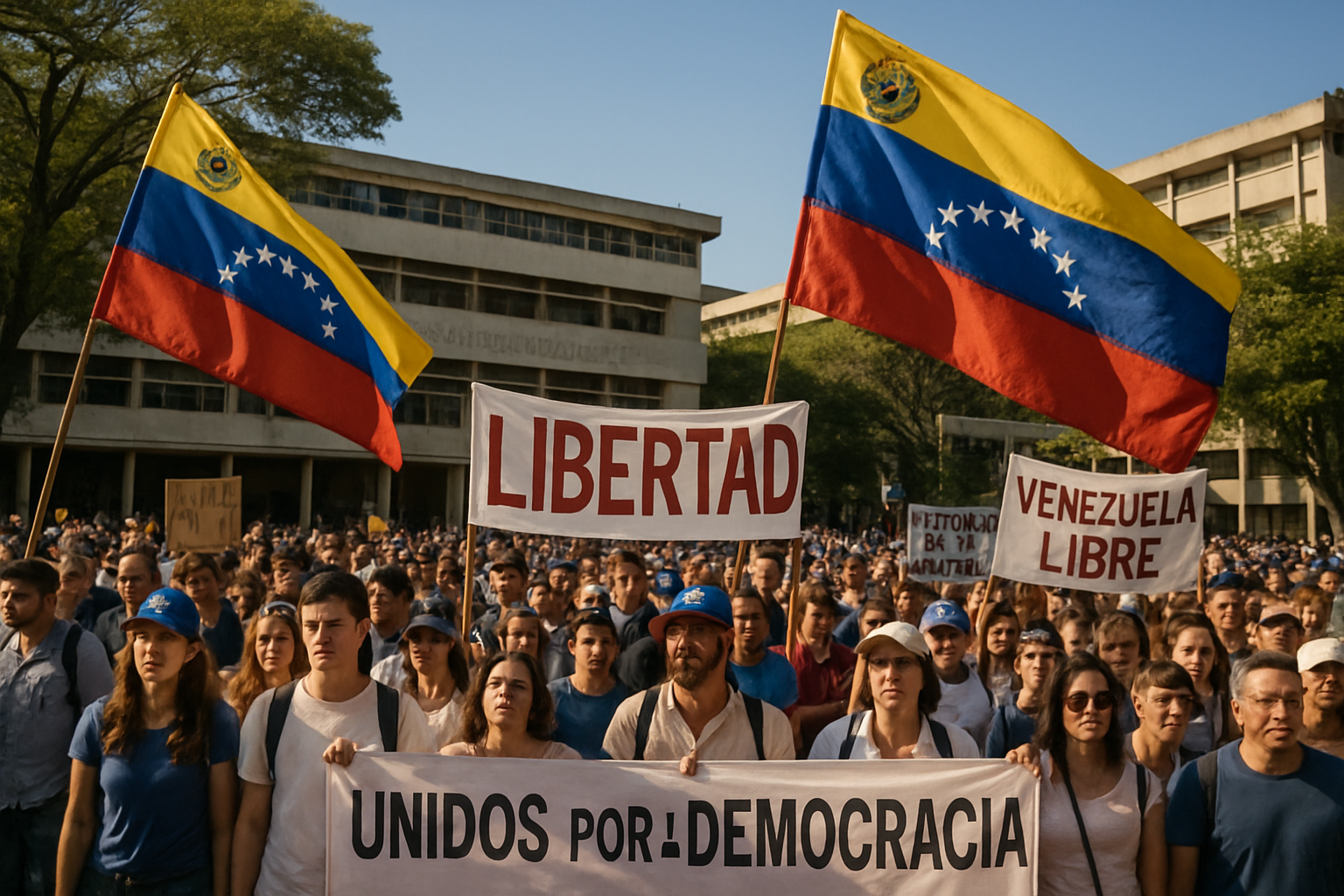
Thousands of Venezuelan opposition supporters took to the streets of Caracas on Thursday, February 12, 2026, demanding complete freedom for political prisoners and full democratic liberties, as the National Assembly postponed final approval of a comprehensive amnesty law that could affect hundreds of detainees.
The massive demonstration, organized around Youth Day commemorations, represented the first major opposition rally since the fall of Nicolás Maduro in January 2026. Protesters gathered near the Universidad Central de Venezuela (UCV) under the rallying cry "¡No tenemos miedo!" (We are not afraid!), marking a dramatic shift in Venezuela's political landscape under Acting President Delcy Rodríguez's interim government.
Parliamentary Deadlock Stalls Historic Legislation
The protest coincided with a critical parliamentary session where lawmakers failed to reach consensus on the final version of Venezuela's most comprehensive amnesty law in decades. The 13-article legislation, covering political offenses from 1999 to 2026, passed its first reading unanimously but encountered resistance during the second and final debate.
According to sources from multiple Venezuelan media outlets, disagreement centered on Article 7 of the proposed law, with the ruling PSUV party demanding that political prisoners acknowledge their alleged crimes as a condition for release. Opposition legislators rejected these requirements, arguing that political detainees are innocent victims of persecution rather than criminals requiring amnesty.
"The deputies could not reach an agreement on article seven, so the approval was postponed"
— Venezuelan National Assembly Source
National Assembly President Jorge Rodríguez had previously promised that all remaining political prisoners would be freed "between Tuesday and Friday at latest" following the law's final approval. The postponement represents a significant delay in what was expected to be Venezuela's most ambitious political reconciliation effort since the democratic transition began.
Student Movement Leads Democratic Resurgence
The protests demonstrated the renewed vigor of Venezuela's student movement, which had been largely dormant following the heavily criticized 2024 presidential elections and subsequent government crackdowns. The demonstration marked a stark contrast to recent years when the student movement had retreated from public activism due to systematic repression.
Organizers specifically chose Youth Day to highlight the role of young Venezuelans in demanding democratic change. The protest leadership emphasized that the political landscape had fundamentally shifted following Maduro's capture and the subsequent reordering of power under U.S. oversight, creating new opportunities for peaceful mobilization.
Participants included students, families of political prisoners, and civil society activists who gathered with banners demanding immediate freedom for all political detainees and full restoration of democratic rights. The demonstration's peaceful nature and substantial attendance signaled growing confidence in the opposition's ability to organize public displays of dissent.
Political Prisoner Crisis Persists
According to human rights organization Foro Penal, more than 600 individuals remain detained for political reasons despite an ongoing release program that has freed over 400 prisoners since January 2026. The organization has been documenting cases and providing legal support throughout the transition process.
The proposed amnesty law represents an unprecedented attempt to address 27 years of political conflict spanning the Chávez and Maduro eras. However, the legislation excludes constitutionally forbidden crimes, including hate crimes, though human rights groups have raised concerns about the undefined scope of these exclusions.
Recent releases have included prominent figures such as journalist Rory Branker, who was detained for nearly a year, and Fundaredes director Javier Tarazona, who was freed on February 1 after more than four years in detention. These releases were part of the broader reconciliation program initiated by the interim government.
International Mediation Efforts Continue
The amnesty debate is taking place amid significant international engagement with Venezuela's transition process. Former Spanish Prime Minister José Luis Rodríguez Zapatero has been participating in peace plan discussions in Caracas, bringing democratic transition expertise from his experience leading Spain.
Cardinal Baltazar Porras has organized nationwide prayer vigils outside prisons, adding moral authority to the reconciliation efforts. The Catholic Church's involvement has provided additional legitimacy to the process while highlighting the humanitarian dimensions of the political prisoner issue.
High-level U.S.-Venezuela diplomatic engagement continues, with Acting President Delcy Rodríguez maintaining regular contact with U.S. Chargé d'Affaires Laura Dogu at Miraflores Palace. These represent the highest-level diplomatic contacts between the two countries since relations were severed in 2019.
Economic Recovery Amid Political Transition
The political developments are occurring alongside significant economic transformation in Venezuela. Oil exports have surged 60% since January, reaching 800,000 barrels daily as the United States has displaced China as Venezuela's top oil customer. Chevron has more than doubled its Venezuelan shipments, while the U.S. has released 40 million barrels from strategic storage.
This economic cooperation is part of Secretary of State Marco Rubio's three-phase reconstruction plan: stabilization, economic recovery, and democratic transition. The approach combines immediate economic incentives with longer-term democratic development goals.
Civil Society Demands Inclusive Process
Civil society organizations have expressed mixed reactions to the amnesty process. Cofavic, a prominent human rights group, emphasized that prisoner releases represent "restitution of rights, not State favor," highlighting the legal rather than charitable nature of addressing political detention.
Opposition leader Andrés Velásquez has questioned the necessity of an amnesty law altogether, arguing that political prisoners "are innocent" and should be released unconditionally rather than through a clemency process that implies wrongdoing.
The Committee of Mothers for Truth has demanded family participation in the verification and implementation of any amnesty measures, seeking to ensure that the process addresses victims' needs and prevents future persecution cycles.
Regional and Historical Significance
Venezuela's amnesty process represents the most comprehensive political prisoner release program in recent Latin American history. International observers view it as a critical test of the interim government's commitment to genuine democratic transition versus cosmetic reforms.
The success or failure of the reconciliation process could influence democratic consolidation efforts throughout Latin America and serve as a template for resolving similar conflicts in the region. Brazil and European Union member states have expressed cautious support for the transition while monitoring implementation closely.
The Dominican Republic has already reopened commercial relations with Venezuela, signaling growing international confidence in the political transition. However, sustained progress will depend on the interim government's ability to balance reconciliation with accountability and ensure that democratic reforms are irreversible.
Implementation Challenges Ahead
Even with eventual parliamentary approval, the amnesty law faces significant implementation challenges. Legal experts anticipate court challenges that could create years of litigation, while the need for reintegration guarantees and monitoring mechanisms remains unresolved.
The process must also address the safe return of political exiles and provide safeguards against future persecution cycles. Success will require sustained international engagement and domestic consensus-building beyond the immediate political transition period.
Human rights advocates emphasize that meaningful reconciliation must go beyond prisoner releases to include institutional reforms that prevent the recurrence of political persecution. This includes judicial independence, press freedom protections, and constitutional guarantees for democratic participation.
As Venezuela navigates this critical juncture, the coming weeks will determine whether the country can achieve genuine democratic consolidation or whether current reforms represent temporary measures subject to reversal. The international community continues to monitor developments as a test case for democratic transitions in an era of global democratic challenges.